Property from an Old German Family Collection
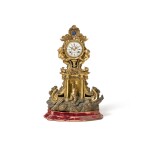
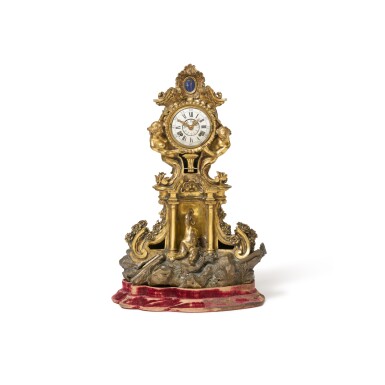
A rare early Rococo gilt-bronze mounted and patinated bronze sculptural mantel clock, South German, probably Munich, circa 1720/30
No reserve
Lot Closed
December 5, 03:44 PM GMT
Estimate
5,000 - 7,000 EUR
We may charge or debit your saved payment method subject to the terms set out in our Conditions of Business for Buyers.
Read more.Lot Details
Description
the crest inset with a lapis lazuli plaque, the associated movement with a 7cm white enamel dial, central alarm disk, anchor escapement and with rack quarter striking and alarm on two missing bells, the backplate numbered 809, raised on a later velvet covered shaped wooden socle
clock: 40cm high, total 44.5 cm
Formerly in the collection at the family’s residence in Munich;
After 1945 ex-collection Georg Weigang (1904-1978 ), Berlin Grünewald and thence by descent to the present owners.
This unusual, probably unique model, with the movement case flanked by a female and male half figure and with a Bacchic putto reclining in a portico below is clearly influenced by the then leading French Louis XIV court style, but with a very specific ‘local’ Rococo twist. The present velvet-covered socle is old but not period; the rather ‘rough’ ending of the patinated rocky shaped base of the clock suggests that this clock originally was mounted on top of something, possibly on top of a cartonnier.
Main driving force for the introduction and spreading of the Louis XIV style, first to the Wittelsbach court in Munich and from there to Central Europe in general, was the patronage of prince-elector Maximilian Emanuel II of Bavaria (1662-1726). With the appointment of chief court architect and designer Joseph Effner (circa 1687-1745) and his assistant François de Cuvilliés (1695- 1768), the French influence significantly increased, especially after Max Emanuel's return to Munich in 1715.