
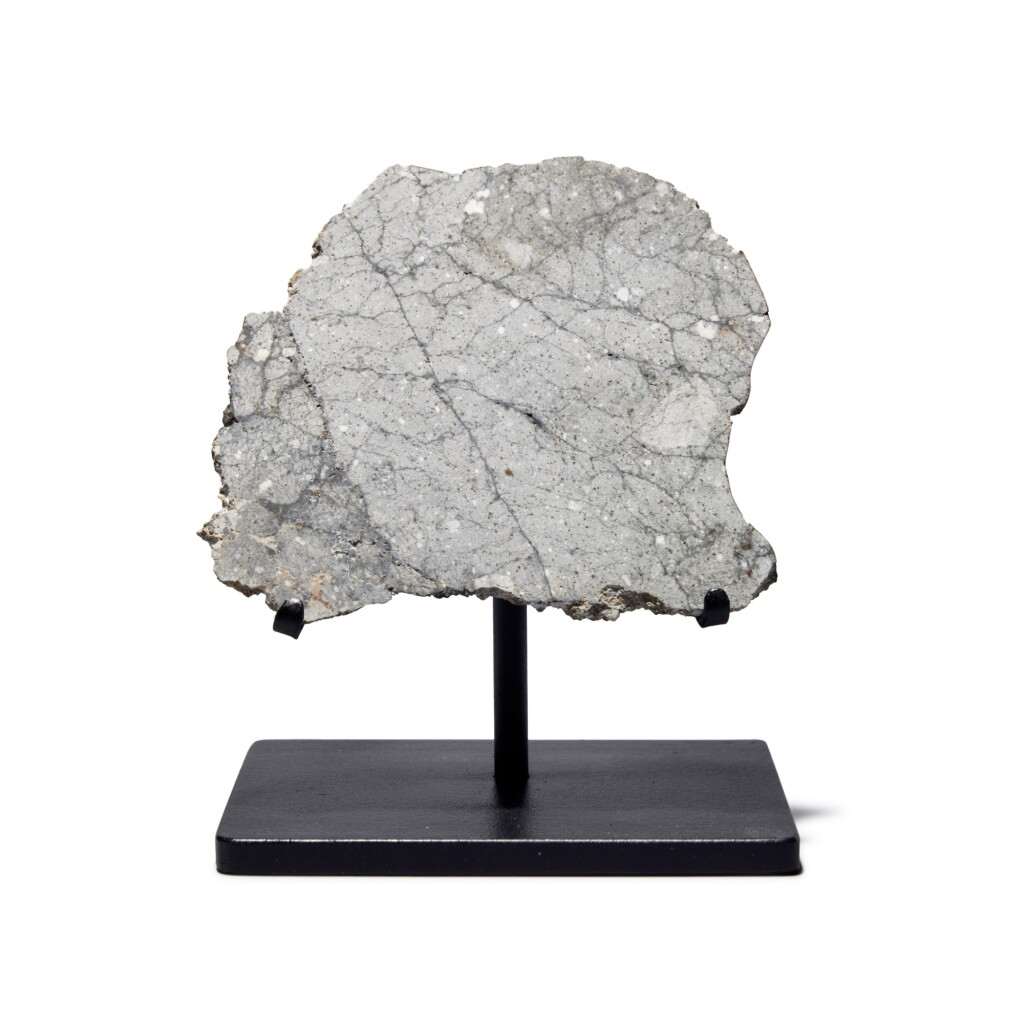
NWA 8022
A Complete Slice of a Lunar Meteorite
Auction Closed
July 17, 03:28 PM GMT
Estimate
6,000 - 9,000 USD
Lot Details
Description
NWA 8022 — A Complete Slice of a Lunar Meteorite
Lunar – feldspathic breccia
Sahara Desert, Northwest Africa
104 x 94 x 2 mm (4⅛ x 3¾ x ⅛ in). 39 grams (195 carats).
With custom metal stand.
This is a complete slice of a lunar meteorite; that is, a piece of the Moon ejected from the lunar surface following an asteroid impact. Lunar specimens are identified by specific geological, mineralogical, chemical, and radiation signatures. Many of the minerals commonly found on the Earth's surface are rare on the Moon, and lunar meteorites contain gases originating from the solar wind that have isotope ratios differing markedly from the same gases found on Earth.
Lunar material is some of the rarest material to exist on our planet – only 1,233 kg (2,718 pounds) of confirmed lunar meteorites exist on Earth at time of writing. And, although six of the Apollo missions brought back 382 kg (842 pounds) of so-called "Moon rocks" from their combined voyages, these samples of the Moon are unavailable for private ownership. As a result, any piece of lunar material is exceedingly rare and highly sought after by both institutions and private collectors.
Abundant anorthite inclusions are in evidence here — a substance that is rare on Earth but more common on the Moon — as well as grains of pigeonite and olivine, fully encompassed along the rim by a brown fusion crust, a result of the meteoroid's final melting and cooling before its eventual crash landing in the Sahara desert.
Until the first lunar meteorite was identified on Earth on January 17, 1982, the geologic history and surface composition of the Moon could only be studied from samples collected during the Apollo and Luna missions. Since these were exclusively harvested from the central near side of the Moon, the 1982 discovery proved to be a crucial scientific breakthrough. Thanks to the progressive retrieval on Earth of meteorite fragments originating from all areas of the Moon, invaluable and previously unattainable information about lunar geology has since become available.
REFERENCES:
You May Also Like


