
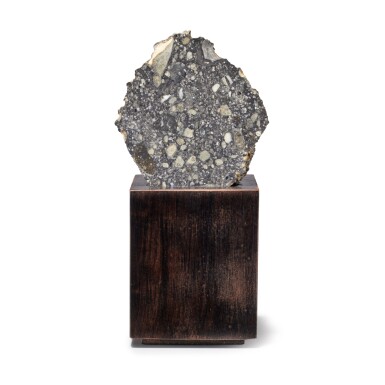
NWA 11303 End Piece
A Significant Offering of a Lunar Meteorite
No reserve
Auction Closed
July 17, 03:28 PM GMT
Estimate
12,000 - 18,000 USD
Lot Details
Description
NWA 11303 End Piece — A Significant Offering of a Lunar Meteorite
Lunar – feldspathic breccia
Sahara Desert, Northwest Africa
72 x 63 x 38 mm (2⅞ x 2½ x 1½ in). 162 grams (.36 lb).
With custom wood base.
A SIZABLE LUNAR METEORITE THAT RECENT STUDIES HAVE INDICATED IS FROM THE FAR SIDE OF THE MOON
Lunar material is some of the rarest material to exist on our planet – only 1,233 kg (2,718 pounds) of confirmed lunar meteorites exist on Earth at time of writing. And, although six of the Apollo missions brought back 382 kg (842 pounds) of so-called "Moon rocks" from their combined voyages, these samples of the Moon are unavailable for private ownership. As a result, any piece of lunar material is exceedingly rare and highly sought after by both institutions and private collectors.
This lunar meteorite end piece belongs to NWA 11303, a feldspathic regolith breccia that formed when shockwaves caused by repeated asteroid impacts turned the fragmented material on the surface of the Moon (regolith) into a consolidated mass of rock. This stone would have been ejected from the Moon's surface by the impact of an asteroid or meteoroid and would then have been captured by the Earth's gravitational field, plummeting toward the Sahara desert. There, it acquired a beautifully weathered, sand-polished patina after being subjected to blasting desert winds for possibly millennia. The dark gray stone is cut on one side to reveal a fine-grained matrix with white and beige clasts.
Until the first lunar meteorite was identified on Earth on January 17, 1982, the geologic history and surface composition of the Moon could only be studied from samples collected during the Apollo and Luna missions. Since these were exclusively harvested from the central near side of the Moon, the 1982 discovery proved to be a crucial scientific breakthrough. Thanks to the progressive retrieval on Earth of meteorite fragments originating from all areas of the Moon, invaluable and previously unattainable information about lunar geology has since become available. In fact, the geologic composition of NWA 11303 has led scientists to recently suggest that this meteorite originated from the far side of the Moon, and more specifically, the Feldspathic Highlands Terrane (FHT).
REFERENCES: