
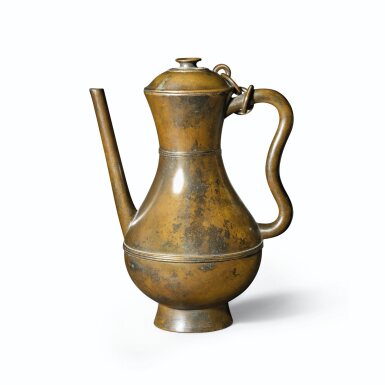
An inscribed bronze ewer and cover, Seal mark and period of Qianlong, dated to the dingchou year of the Qianlong period (corresponding to 1757) | 清乾隆 銅弦紋執壺 《乾隆丁丑年製》《敬信齋祭器》款
Lot Closed
April 17, 07:30 AM GMT
Estimate
100,000 - 120,000 HKD
Lot Details
Description
An inscribed bronze ewer and cover
Seal mark and period of Qianlong
dated to the dingchou year of the Qianlong period (corresponding to 1757)
清乾隆 銅弦紋執壺
《乾隆丁丑年製》《敬信齋祭器》款
of elegant pear-shaped form, the swollen body gently rising to a slender flared neck, supported on a recessed circular foot surrounded by a protruding footrim, cast with a long, tapering cylindrical spout set opposite a serpentine, cylindrical handle, the domed cover with flared, hollow finial, attached by a loop and chain to the handle, decorated a raised band of triple lines at the central body, neck, and cover, the foot inscribed in zhuanshu with two inscriptions: Qianlong dingchou nian zhi (‘Made in the dingchou year of the Qianlong period’); and Jingxin zhai jiqi (‘Ritual vessel [for the] Retreat for Honouring Faith’)
27.2 cm
Brian Harkins Oriental Art, London, November 2001.
The Water, Pine And Stone Retreat Collection.
Sotheby's Hong Kong, 8th April 2014, lot 218.
來源:
Brian Harkins Oriental Art,倫敦,2001年11月
水松石山房收藏
香港蘇富比2014年4月8日,編號218
The Jingxin zhai (‘Retreat for Honouring Faith’) lies within the precincts of the You Shengjiao si (‘Temple to Assist Superior Teaching’), usually called simply the Shengjiao si (‘Temple of Superior Teaching’), located in the south-east suburbs of Beijing. The temple, rather dilapidated by the Tongzhi era, was thoroughly renovated in 1867 and is still kept in good condition today.
There does not appear to be any particular archaic prototype for this form, although pouring vessels of other shapes with chain-linked lids exist. Whatever the origins of the form, there is a fierce austerity about it which is appealing. The ewer was probably made as a presentation to the Retreat by a patron, or grateful student, and may have originally been in ritual usage.