
Andrew Wyeth
For Sale
Lot Closed
July 17, 05:02 PM GMT
Estimate
60,000 - 80,000 USD
Lot Details
Description
Andrew Wyeth
1917 - 2009
For Sale
signed Andrew Wyeth (lower right)
watercolor and pencil on paper
21 ¾ by 29 ¾ in.
55.2 by 75.6 cm.
Executed in 1951.
The Andrew & Betsy Wyeth Study Center of the Brandywine Museum of Art confirms that this object is recorded in Betsy James Wyeth’s files.
The artist
[with] Macbeth Gallery, New York
Private Collection
Doll & Richards, Inc., Boston
Private Collection, Pennsylvania (acquired from the above in 1952)
Thence by descent in 2010 to the present owner
New York, National Academy of Design, One Hundred and Twenty-Seventh Annual Exhibition, March - April 1952, no. 17, p. 37
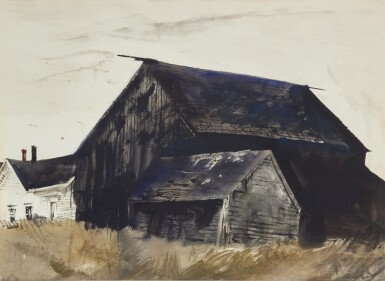
In For Sale, Andrew Wyeth leverages the fluidity and layering abilities of watercolor to depict the looming black barn, white farmhouse, and windswept foreground in mesmerizing washes of color. The coastal region of northern Maine occupies a significant role in Wyeth’s oeuvre. The dramatic seasonal changes and open, untouched land captured his fascination and beckoned his return year after year. Wyeth’s expressive brushwork and vast array of textures in For Sale testifies to the immense inspiration the artist found in Maine’s rural landscapes.
A signature aspect of Wyeth’s oeuvre is his aptitude for capturing the various textures that are emblematic of rural farm life, such as grassy fields or dirt roads. In the present work, Wyeth layers, smudges, and scrapes the pigments to mimic the textures of the barn’s aged wooden slats and the wind rippling across the grassy foreground. The urgency implied by the frenzied brushstrokes reflect the artist’s claim that “if you clean it up, get analytical, all the subtle emotion that caught you first goes sailing out the window” (Andrew Wyeth quoted in Richard Merryman, The Art of Andrew Wyeth, “Andrew Wyeth: An Interview,” p. 66).
In addition to demonstrating the artist’s mastery of watercolor as a medium, Andrew Wyeth’s For Sale captures a recurring subject within his oeuvre. The barn and farmhouse featured in the present work are no longer extant, but once stood in East Friendship, Maine. The property was lovingly nicknamed “blueberry house” by the local community in reference to the surrounding blueberry fields, and was located just a few miles north of the Olson house, where Wyeth painted one of his most renowned works, Christina’s World (1948). In addition to For Sale, Wyeth also features the blueberry house in works such as East Friendship, Maine (circa 1945) at the National Gallery of Art, Washington, D.C. and West Window (1947) at the Lyman Allyn Museum, New London, Connecticut. Wyeth’s dynamic brushstrokes and neutral color palette in depicting the blueberry house imbues the scene with powerful emotion, documenting the beloved cultural landmark in captivating beauty.