
Property from a Private Collection, Germany
Max Pechstein
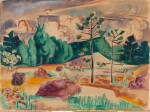
Waldlandschaft (Forest landscape)
Lot Closed
November 13, 01:20 PM GMT
Estimate
20,000 - 30,000 EUR
Lot Details
Description
Property from a Private Collection, Germany
Max Pechstein
1881 - 1955
Waldlandschaft (Forest landscape)
signed and dated 1919 (lower right)
watercolour and pastel over pencil on paper
48.3 by 64.1 cm.
19 by 25¼ in.
Executed in 1919.
The authenticity of this work has been confirmed by Julia Pechstein, Hamburg.
Galerie Lippeck, Berlin (by 1977)
Ahlden, Kunstauktionshaus Schloss Ahlden, 22 April 1978, lot 786
Private Collection, Germany
Thence by descent to the present owner
Waldlandschaft is one of a series of watercolours created by Max Pechstein during his summer stay at Nidden in northern Germany in 1919. Nidden, on the Curonian Spit, is one of the oldest artists' colonies in Europe. The remoteness of the village on the 100 kilometre long spit, the natural and seemingly unspoilt life of the fishermen, their fishing huts and spa boats inspired artists and provided a unique variety of motifs. The unspoilt landscape, with its beaches and dunes, pine forests and, of course, the lagoon, offered repeated opportunities to vary perspectives and study light conditions. All of the artists created works in Nidden that were particularly influential in the development of European art movements such as Expressionism. The five visits by the German Expressionist Max Pechstein between 1909 and 1920, each lasting several months, had a lasting impact on the artists' colony. Karl Schmidt-Rottluff also spent a summer in Nidden in 1913, infected by his enthusiasm for the unique landscape. The presence of the two Brücke painters led to lively discussions among the artists.
In 1919, in the turbulent political environment of the post-war period, the artist felt a personal longing for the rural respite that this place could offer him. By the time he arrived in Nidden, he had already produced at least a hundred paintings during his four-month summer stay. The works bear witness to his rapid personal recovery during this trip.
The present watercolour indicates a more uninhibited, free expression. Pechstein developed strong and vivid colours, as can be seen in the varied natural landscape. The view of the valley is like a mosaic of colours. A bright orange runs through the hilly foreground to the centre, accentuated by a few houses in shades of dark red. The expanding valley in the foreground is dynamically set in motion by the green and blue tones of the rural trees. Above, a vivid grey-blue sky appears with billowing clouds, accentuated by red contours. The cloud cover is interrupted only by a small, light blue gap, which could herald the end of the turbulent weather. Pechstein reinforces the effect of spatial depth by placing plants in the foreground and protruding fir trees in the interior of the valley, although their small crowns do not obstruct the view of the forest landscape on the horizon. This work shows that the artist was more interested in the atmospheric depiction of wind and weather. Although the landscape of hills and houses and the dense, dark forest on the horizon appear dynamic and menacing at first glance, they are made more cheerful and serene by the bright colours. There is also something undeniably primal about this watercolour, with a unique balance that reflects Pechstein's intimate connection with the landscape and the people who lived there.