
Property from a Private Collection
Alphonse Mucha
Portrait of Hanna Vitousek
Auction Closed
November 12, 03:36 PM GMT
Estimate
80,000 - 120,000 EUR
Lot Details
Description
Property from a Private Collection
Alphonse Mucha
1860 - 1939
Portrait of Hanna Vitousek
signed and dated Mucha 1912 (lower right)
oil on canvas, oval
50 by 38 cm.
19¾ by 15 in.
Executed in 1912.
The frame is the original carved wooden frame designed by Mucha.
A gift from the artist (a relative of the husband of the sitter)
Thence by descent in the family
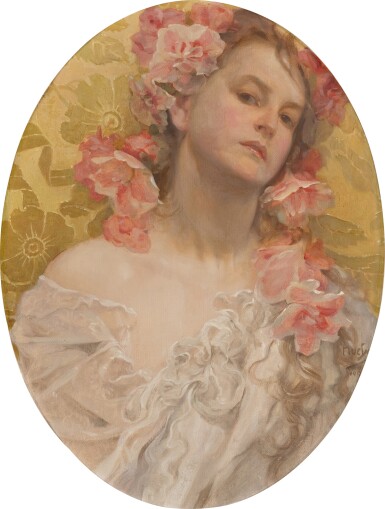
Painted in 1912, Portrait of Hanna Vitousek was executed at the height of Mucha’s ability as a painter, at the time when he had embarked on what was to become his most famous and important contribution to Czech art, a series of paintings telling the story of his people and his homeland, the Slav Epic. Hanna Vitousek was married to a relative of Mucha, and the portrait of her in a specially designed frame by Mucha was a present from the artist, that has remained in her family to this day. The intertwined sinuous curves of flowers, blond curled tresses and the folds of the white fabric are reflected in the ornate carving of the giltwood frame, creating a Gesamtkunstwork (total work of art).
Mucha was well versed with the symbolism of flowers and chose to drape pink azaleas around the face, nape of the neck and one shoulder of Hanna. In the language of flowers azaleas represent femininity, wealth, elegance, temperance, and an abundance of beauty and intelligence. Pink azaleas in particular represented joy and happiness. They were often given as gifts to someone who was kind and caring, or as a message that the giver sincerely cared for and respected the recipient.
Born in Ivancice, Moravia, near the city of Brno in modern-day Czech Republic, Alphonse Mucha began his artistic training taking drawing lessons at the Academy of Visual Arts in Prague and continued his studies in Munich. In 1890, the young artist moved to Paris and enrolled in the Academie Julien where he was the student of academic painters Jean Paul Laurens, Gustave Boulanger and Jules Lefebvre, whose influence can be seen in the rigorous modelling of the figure in the present work. He quickly became highly successful as a graphic and poster designer who defined the French Art Nouveau style, and was also a sought after painter, probably best known for his symbolist works and his portraits of the actress Sarah Bernard and young women in Slavic costumes. He became involved in a number of other mediums such as decorative panels, frames, sculpture, jewellery and stained glass windows. This breath of work is comparable to that of the Pre-Raphaelites (Millais, Burne-Jones, Rossetti, Holman Hunt) and of the Arts and Craft movements (William Morris) in the United Kingdom, who similarly used their creativity and artistic skills in a variety of different media.
One of the hallmarks of Mucha’s portraits is that his models and sitters directly engage the viewers’ gaze. This same powerful gaze is evident in the present work, as Hanna fixes the viewer with her piercing eyes. The luminous, fluid brushwork and the harmonious cool pastel colour palette of her portrait are also typical of Mucha’s paintings after 1910, and imbue the painting with softness and grace.