
Mohamed Melehi
Mirage
Auction Closed
March 21, 03:48 PM GMT
Estimate
70,000 - 100,000 GBP
Lot Details
Description
Mohamed Melehi
Moroccan
1936-2020
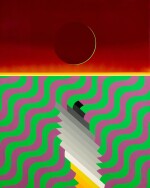
Mirage
signed and dated 1983 (on the reverse)
cellulose on panel
151 by 120cm., 59½ by 47¼in.
framed: 153.7 by 123.2cm., 60½ by 48½in.
Private Collection, USA
Thence by direct descent
The Bronx Museum of the Arts, Mohamed Melehi Recent Paintings, 6 December 1984-10 February 1985, illustrated in colour in the exhibition catalogue, pp. 99
'Conscious of the fact that I needed to represent Africa — too huge of a task, really — I wanted to create a form that, while traditional (the wave appears in all African art), while new (it is structurally modern), symbolizes a determined situation: despite its bloodthirsty, metallic, and programmed oppression, the dynamic spirit of this continent (its ‘SOUL’) rises up forcefully towards the sky.'
The Artist, 1968
The present lot is among the select few showcased in Mohamed Melehi’s career-defining exhibition, Mohamed Melehi: Recent Paintings, held at the Bronx Museum in New York City in 1984. Representing the first large-scale solo exhibition in the United States for an artist from North Africa and acclaimed as the most celebrated exhibition of his career, this ground-breaking show propelled Melehi to the status of a modern master with universal appeal. The present lot, an undoubted masterpiece, possesses all the characteristics of Melehi’s most sought-after works. Featuring his iconic crescent moon, hypnotic waves, and graduated ‘rainbow’ executed in a vibrant colour palette, using his innovative cellulose painting technique on a panel, Mirage epitomizes the essence of Melehi’s distinguished practice.
Mohamed Melehi was a trailblazer of postcolonial Moroccan art and of modernism in the Global South. Born in the
coastal town of Asilah in 1936, Melehi practiced as a painter, photographer, muralist, and designer. He would later become a leading figure in the radical Casablanca Art School and was at the helm of the artistic and cultural developments of post-colonial Morocco. His oeuvre effortlessly blends the traditional and representational — channeled through Islamic and Berber motifs and crafts — with abstracted, modern, hard-edge color paintings of the 1960s.
In 1962, Melehi travelled to the United States to take up the position of assistant professor in the painting department at
the Minneapolis Institute of Art. After one semester, a grant from the Rockefeller Foundation facilitated the artist’s move to New York to study at Columbia University. It was in the US that Melehi would explore the works of hard-edge painters such as Ellsworth Kelly and delve deep into his love of American film and jazz, all of which deeply influenced his early practice,
culminating in the inclusion of his works in two influential group shows in 1963, the Hard Edge and Geometric Painting and Sculpture exhibition at MoMA and Formalists at the Washington Gallery of Modern Art.
Melehi’s innovative cellulose panels were first produced in 1970 in a car workshop, using paint that was originally meant
for vehicles, before becoming a recurring feature in his studio. For Melehi, the industrial and impersonal quality of the sprayed-on cellulose paint juxtaposes wonderfully with the narrative qualities of his oeuvre.
Executed in 1983, the year before the seminal Bronx exhibition, Mirage is a product of the crescendo of Melehi’s career and marks a distinct shift in the artist's practice. During this period, Melehi veers away from the flat hard-edge strictly abstract paintings that marked the preceding decades in favour of multi-tiered pictorial planes, layering his signature waves with other representational elements, often in the shape of a crescent moon. This new narrative quality is perfectly exemplified
in the present lot. Entitled Mirage, we see the hot red sky meeting melodic ocean waves on the horizon line, anchoring the painting, and allowing for the two halves to be appreciated simultaneously.
'Sprayed in lacquer on wood panels, the motifs are geometrical and hard-edged: stripes, chevrons, crescents, disks, and rippling bands all arranged in masses with Cubist disjunctions... the Berber art that has been Melehi's main source of inspiration... virtually unknown in the United States, are distinctly African in character and very beautiful. Melehi is a witty and highly intelligent man, totally absorbed in Moroccan culture, which has been affected by all the major Mediterranean civilizations including Carthage, Crete, and Egypt.'
The New York Times, 26 January 1985
Mohamed Melehi’s waves have long been considered the hallmark of this important artist’s career. For the artist, the waves embody both traditional symbolism, notions of modernity, and free-spirited abstraction. Having spent his formative years in the coastal town of Asilah, Melehi’s waves evoke fond memories of his childhood, while also paying homage to Islamic and Berber heritage and craft. Through their gentle curves, the artist also delves into the structural oppression experienced across the African continent. To Melehi, the wave serves as a powerful symbol of Africa's invincible spirit. In 1966, he unveiled his wave motif at the inaugural World Festival of Black Arts in Dakar and in 1969 he executed his ‘African Waves’ series. Melehi would continue to feel a profound bond with Africa throughout his career, finding solace in its cultural and artistic circles, where distinctions between applied and fine arts carried little weight.
The grant from the Rockefeller Foundation, which took Melehi to New York, stipulated his return to Morocco on completion of his studies, to apply what he had learned in the West. In 1964, Melehi joined the Casablanca School of Fine Arts, where he was a professor until 1969. Together with colleagues such as Farid Belkahia, Melehi pioneered modern abstract painting and revitalized the contemporary art scene in Morocco, impressing upon their students the importance of amalgamating Modernist ideas with local sources.
You May Also Like