Théodore Géricault
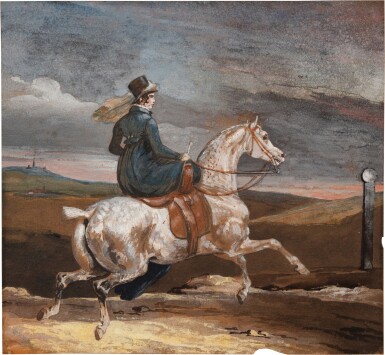
Zoë Elmore riding side-saddle
Auction Closed
January 31, 05:59 PM GMT
Estimate
200,000 - 300,000 USD
Lot Details
Description
Théodore Géricault
Rouen 1791 - 1824 Paris
Zoë Elmore riding side-saddle
Watercolor heightened with white over traces of black chalk
239 by 250 mm; 9 ⅜ by 9 ⅞ in.
Executed by the artist for Adam and Zoë Elmore, during his London stay in 1821;
Adam and Zoë Elmore Collection,
Thence by descent to the present owners.
Calais, Musée des beaux-arts, L’Aquarelle romantique, 1961, no. 60.
G. Bazin, Théodore Géricault, étude critique, documents et catalogue raisonné, Paris 1997, tome VII, pp. 23, 114, no. 2253.
Powerful and masterfully executed, this work portrays Zoë Elmore on horseback, seen in slight three-quarter view, her face in profile. She wears an elegant dark riding habit and a top hat with a veil, which flutters in the breeze generated by the horse’s movement. Germain Bazin was uncertain as to whether this experienced rider was Mrs Elmore.1 However, the dark hair and ringlets, clearly visible in two other portraits by Géricault in the Elmore collection, confirm the model’s identity without any possible doubt, as does the young woman’s fresh youthfulness and slim figure. The facial expression and haughty demeanour of the rider also accord with Zoë Elmore’s lively and determined character.
Géricault painted this work in a style that is powerful, vigorous, spirited and brisk. A few pencil marks are still visible beneath the watercolor. The animated and spontaneous technique conveys the impression of speed. This is another instance of the atmosphere so dear to Géricault, with turbulent skies and dark spaces abruptly crossed by rays of light. With his extraordinary sense of color, Géricault alternates greys, blues and whites, greens and browns, to make the material shimmer and bring life to the wild moor. In the background, under thick grey-blue clouds, a delicate pink light hugs the horizon. The watercolor treatment of the sky, strengthened by subtle applications of gouache, is very close, in terms of both technique and palette, to that of the English Horse Guard, at the Fogg Art Museum, Harvard University.2 In a comparable format, this work must have been painted shortly before or after Zoë riding side-saddle...
A delicate, extended brushstroke suggests the movement of the clouds stretching across the sky and highlights the undulations of the empty landscape. Rider and horse, depicted at full gallop, are treated with a precision that focuses on the nerves and muscles of the horse and the subtle tones of its coat. The firm vertical and oblique lines of Zoë Elmore’s habit suggest a body tensed for the gallop, while the young woman’s face expresses the confidence of an experienced horsewoman. The horse’s four hooves have left the ground and the rider and her mount seem about to fly away. Géricault, an excellent horseman himself, who loved adventurous and sometimes dangerous rides – which in fact cost him his life – transmits the pleasure the horsewoman feels in this solitary ride in the empty countryside, beneath the magnificent light of the sun, reddening as it sets.
Horsewomen appear fairly rarely in Géricault’s oeuvre, at least before his English period, and this makes the two watercolors in the Elmore collection even more interesting. However, there is an oil on canvas of a horsewoman riding side-saddle (fig. 1) which also dates from the English period, in the Metropolitan Museum in New York3, as well as a watercolor in Rotterdam (fig. 2), whose composition is close to that of Zoë riding side-saddle.4 Germain Bazin sees some resemblance between Zoë and the woman in this second watercolor, Woman riding a dappled grey horse, but in our view the morphology and the different color of the hair make this identification improbable.5 The atmosphere of the two works is also dissimilar. Woman riding a dappled grey horse and the Horsewoman in the Metropolitan Museum are rather static, more closely associated with the portraiture genre, whereas the more dynamic Zoë riding side-saddle, whose treatment is livelier, Romantic and very poetic, has the intimate charm of a more personal work.
1. Bazin, op. cit., vol. 7, p. 23
2. Cambridge, Mass., Fogg Art Museum, Harvard University; inv. 1943.365
3. New York, Metropolitan Museum of Art, inv. 2019.141.1
4. Rotterdam, Museum Boijmans van Beuningen, inv. F II 184 (PK)
5. Bazin, op. cit., vol. 7, p. 23 and p. 115, no. 2225
For more information regarding this lot and the other works by Gericault coming from the Elmore Family, please click on the link below to have access to the full catalogue of the collection:
You May Also Like