
Property from the Collection formed by Dr. Einar Perman (1893-1976), Stockholm
Guilliam van Nieulandt the Younger
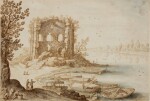
The Ruins of the temple of Diana at Bacoli near Pozzuoli, Bay of Naples
Vente aux enchères clôturée
January 31, 05:59 PM GMT
Estimation
15,000 - 20,000 USD
Description du lot
Description
Guilliam van Nieulandt the Younger
Antwerp 1584 - 1635 Amsterdam
The Ruins of the temple of Diana at Bacoli near Pozzuoli, Bay of Naples
Pen and brown ink and brown, gray and blue wash over traces of black chalk;
signed and dated, lower right: G.v.NIEVLANT 1621
167 by 247 mm; 6 ½ by 9 ¾ in.
by descent to the present owners
In 1604, the artists' biographer Karel van Mander wrote, in his account of the activities of Paul Bril, that '..for a year he had as his pupil [in Rome] Guilliaem van Nieuwlandt, of Antwerp, 22 years of age, presently living in Amsterdam, who took on his master's manner very naturally.'1During his three years in Rome, 1601-1604, Nieulandt did indeed work closely with, and in the manner of, Bril (see the following lot), but also developed his own, personal style, combining refined and precise penwork and delicate brown and blue washes with a rather creative approach to topography. Of his relatively few surviving drawings like this, depicting the monuments of ancient Rome, some are topographically correct - mostly those executed during his stay in Rome, around 1603-4 - while others, such as this, are essentially capricci, placing real ruins and monuments in fictitious locations; here, the temple of Minerva Medica, in reality located on the Esquiline Hill, is shown on the banks of the river Tiber. As Schatborn has noted, this is one of just three Roman views by Van Nieulandt dating from the 1620s; another, a View of the Colosseum from the Caelian Hill, dated 1620, is in Leiden.2
The allocation of drawings between Van Nieulandt and his artist uncle, also Guilliam van Nieulandt (1560-1626), with whom he lodged in Rome, has sometimes been debated, but some of those signed in capitals in this manner are dated after the Elder van Nieulandt's death, and it therefore seems reasonable to conclude, as Schatborn did, that all the drawings signed in this way are by Guilliam the Younger.
1. Karel van Mander, The Lives of the Illustrious Netherlandish and German Painters, ed. Hessel Miedema, 6 vols., Doornspijk 1994-99 (original publication 1604), vol. 1, p. 427, fol. 292r, vol. VI, pp. 16-17
2. Leiden, Prentenkabinet van de Universiteit, inv. AW 1087
Vous pourriez aussi aimer


