
Property from a Swiss Private Collection
German, Christoph Ritter II, Nuremberg, circa 1610
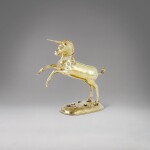
A Silver-Gilt Cup in the Form of a Leaping Unicorn
Auction Closed
February 2, 05:19 PM GMT
Estimate
100,000 - 200,000 USD
Lot Details
Description
German, Christoph Ritter II, Nuremberg, circa 1610
Silver-Gilt Cup in the Form of a Leaping Unicorn
height: 7 ½ in.; 19 cm.
377. 8 g
raised on its hind legs about to leap, the detachable head with short mane, and goatee below the open mouth, raised frisky tail, the shallow, domed oval base chased with rocks and grasses, and applied with three frogs, a small tortoise, a snail and a crayfish, maker’s mark (Karin Tebbe no. 729) and city mark struck on neck and rim of base
Parisian Art Market, circa 1970-1980;
Private Collection, Belgium.
Seneffe, Musée de l'orfèvrerie de la Communauté française de Belgique, Le Banquet des animaux, 9 October 2004 - 30 January 2005.
A. Morre and J. Lefrancq (ed.) Le Banquet des animaux, exhibition catalogue, Seneffe 2004, p. 25;
K. Tebbe et al, Nurnberger Goldschmiedekunst, p. 345, 729, no. 19.
Christopher Ritter II was born in 1548, became master in 1577 and died in 1616, prolific maker of major silver works, including models of animals such as horses, stags, elephants and camels. A leaping stag by him Nuremberg, 1580-85 was included in the Exhibition Schatze Deutscher Gold-schmiedekunst von 1500-Bis 1920, Germanishes National Museum 1992, cat. 24, illus. p. 28, which shows similar characteristics and construction.
Probably the most romantic of all mythical creatures, the unicorn has fascinated artists and storytellers for centuries. The unicorn has appeared in a variety of notable depictions throughout art history, from Raphael’s Portrait of a Lady with a Unicorn, c.1505 to Gustave Moreau’s Les Licornes (The Unicorns), c.1887 and even Damien Hirst’s The Dream, 2008. Perhaps the most famous are The Unicorn Tapestries, 1495-1505 at The Met Cloisters, which describe the hunt of the unicorn that can only be captured by a virgin, as legend states. Though dismissed in the early seventeenth century, the unicorn’s horn was believed to possess healing capabilities in the Middle Ages. Most known throughout Europe and North America, the unicorn can further symbolize power, purity, luxury, and Christ himself. It has also become an emblem of royalty, with its placement as a supporter of the Royal coat of arms to represent Scotland alongside England’s lion, and even with King Charles choosing it as his secret service device today.