
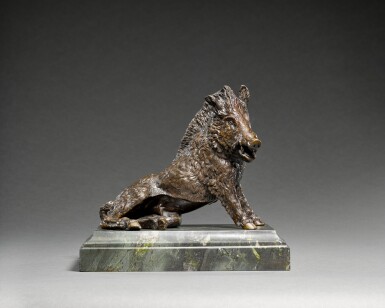
Attributed to Gianfrancesco Susini (Florence circa 1585-1653)
Il Porcellino (Wild Boar)
Auction Closed
February 2, 05:19 PM GMT
Estimate
30,000 - 50,000 USD
Lot Details
Description
Attributed to Gianfrancesco Susini (Florence circa 1585-1653)
1585 - 1653
Il Porcellino (Wild Boar)
bronze, on a green marble base
bronze: 6 ½ by 7 ¾ in.; 16.4 cm. by 19.7 cm.
base: 1⅝ in by 9⅝ in.; 4 cm. by 23.2 cm.
This exquisite bronze of the iconic Florentine wild boar, also known as Il Porcellino, is modelled after the Hellenistic marble of a boar first recorded in 1556 by Ulisse Aldrovaldi (1522-1605) as excavated in the vineyard of Paolo Ponti in Rome and gifted by Pope Pius IV to Cosimo de' Medici in 1568. The marble is still considered one of the most significant rediscovered antique statues, praised for its beautiful naturalism and copied by several renowned Italian sculptors. A life-size bronze version was cast by Pietro Tacca (1577-1640), commissioned by the Grand Duke Cosimo II for the Mercato Nuovo in Florence, where it stood until 2004 and which is now in the Uffizi gallery.
The present boar is expertly cast and bears the stylistic and technical hallmarks of the celebrated Florentine sculptor Gianfrancesco Susini (1585 - c.1653). The biographer Filippo Baldinucci (1624-1697) recorded that Gianfrancesco produced a reduced version of the antique marble, which was then exhibited in the Palazzo Pitti, Florence. He trained in the workshop of his famous uncle, Antonio Susini (1558-1624), who was Giambologna's (1529-1608) closest assistant.
Convincing parallels can be drawn between an important but unsigned cast of Il Porcellino attributed to Gianfrancesco in the Museo Nazionale del Bargello, Florence. While the Bargello bronze is placed on a tall base decorated with pietra dura and surrounded by four bronze statuettes, the boar compares closely to the present cast in its expert modelling with a dynamically textured pelt and finely chased surface, as well as in the smooth outline of the boar’s physique and the animal’s precise proportions. In addition, the rich patina with warm brown hues with remains of reddish-gold translucent lacquer, is characteristic of fine Florentine bronzes of the period.
It is important to note that Antonio Susini also cast bronze reductions of il Porcellino which compare in detail to the present bronze attributed to his nephew: the naturalistic proportions and the treatment of the lively and finely textured surface relate closely to the boar signed by Antonio Susini in the Staatliche Museen in Berlin (inv. no. 17/75). A second similar cast is in the Victoria & Albert Museum in London (inv. no. A.153-1910), previously attributed to Antonio Susini, and now given to his workshop.
RELATED LITERATURE
Y. Hackenroch, Bronzes other metalwork and sculpture in the Irwin Untermyer collection, London, 1962, p.xxix, fig. 61;
L. S. Olschki, Bronzetti Italiani del Rinascimento, exh. cat. Palazzo Strozzi, Firenze, 1962, no. 128;
C. Avery and A. Radcliffe, Giambologna, Sculptor to the Medici, exh. cat. Arts Council of Great Britain, London, 1978, p.196-197, no.187;
F. Haskell and N. Penny, Taste and the Antique: The Lure of Classical Sculpture 1550‒1900, New Haven and London, 1981, p. 161-162, no.13;
B. P. Strozzi (ed.), Bronzetti dal XV al XVII secolo, Museo Nazionale del Bargello, Firenze, 1989, p.36, fig.35;
https://collections.vam.ac.uk/item/O88553/the-florentine-boar-statuette-susini-antonio/, 03/01/2024