A SELECTION FROM THE COLLECTION OF BERNARD DESCHEEMAEKER WORKS OF ART, ANTWERP | SÉLECTION PROVENANT DE LA COLLECTION DE BERNARD DESCHEEMAEKER WORKS OF ART, ANVERS
Jean III Pénicaud
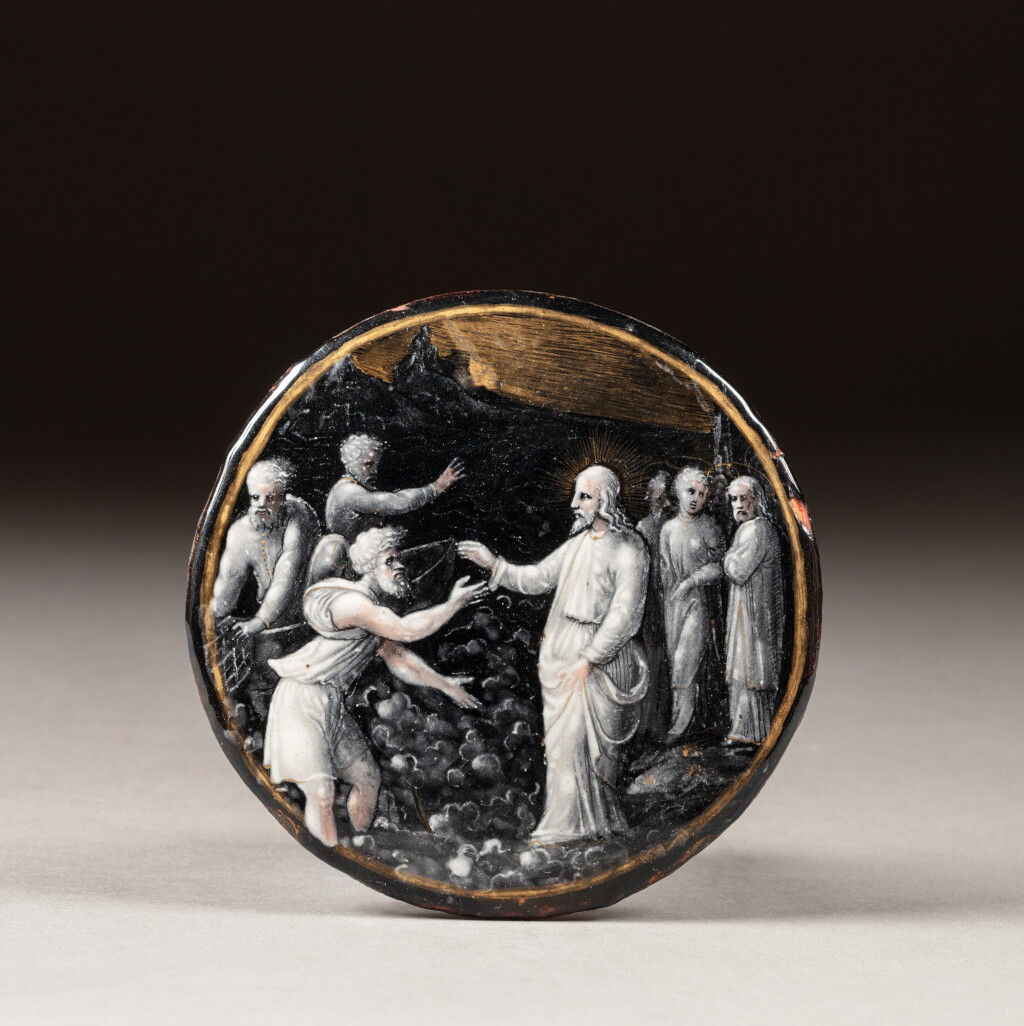
Medallion with Christ walking on the water | Jésus Marchant sur l'Eau
Lot Closed
November 25, 12:21 PM GMT
Estimate
4,000 - 6,000 EUR
We may charge or debit your saved payment method subject to the terms set out in our Conditions of Business for Buyers.
Read more.Lot Details
Description
A Selection from the collection of Bernard Descheemaeker Works of Art, Antwerp
Jean III Pénicaud
circa 1515 - 1588
French, Limoges, circa 1555 - 1560
Medallion with Christ walking on the water
grisaille painted enamel on copper, with gilt highlights
the reverse monogrammed with a crowned P
10.7cm., 4¼in. diameter
____________________________________________
Sélection provenant de la collection de Bernard Descheemaeker Works of Art, Anvers
Jean III Pénicaud
vers 1515 - 1588
Limoges, vers 1555 - 1560
Jésus marchant sur l'eau
médaillon en émail peint en grisaille sur cuivre, à rehauts d'or
le revers monogrammé d'un P couronné
Diam. 10,7 cm ; 4 ¼ in.
Private collection, Milan, until 2019.
____________________________________________
Collection particulière, Milan, 2019.
The gospel of Matthew (14: 22-33) records that at the Sea of Galilee, Jesus instructed the apostles to take a boat to the other side. He followed them, a while later, walking over the water. When Saint Peter went to meet Him, also walking on water, he almost drowned, prompting Christ to stretch out His hand to him and together they were able to reach and join the other disciples in the boat. The reverse of this plaque is stamped with a crowned capital P. That mark permits the attribution of this medallion to Jean III Pénicaud and a dating to the middle of the 16th century.
It is highly likely that a plaque with Christ and the Scribes in the Temple in the Victoria and Albert Museum1 originally belonged to the same ensemble. Both medallions, with identical dimensions, represent a scene from The Childhood and the Public Life of Christ, which are themes very rarely found in Limoges enamelling. In addition, both of them can be attributed to Jean III Pénicaud and must have been executed in approximately 1555-1560. It may well be possible to relate an Entombment from the former Gabrielle Kopelman collection in New York2, likewise by Jean III Pénicaud, with these two medallions. In view of their specific shape, it seems likely that all three were originally part of the frame (of a larger plaque), which was decorated with a number of smaller enamel medallions. The original ensemble could well be reminiscent of a frame such as the one surrounding a Resurrection plaque in the Hermitage3.
Another plaque, representing Christ Walking on the Water, similarly attributed to Jean III Pénicaud, but which is rectangular in shape, is in the Hermitage Museum, Saint Petersburg4.
1 Inv. no. 790-1877; P. Verdier, Four Sixteenth-Century Painted Enamels, in: Annual Bulletin…, 6, 1982-1983, p.2.
2 Likewise marked, on the reverse, with a crowned P ; New York, priv. coll.; P. Verdier, op. cit., p.2, ill.8. - This plaque belonged to the former Louis Fould collection ; see: A. Chabouillet, Description des antiquités… de M. Louis Fould, Paris, 1861, no. 2010, pl.XXXIV.
3 inv. no. Ф-280; T. Rappé and L. Boulkina, Les Émaux peints de Limoges…, Saint-Petersburg, 2005, no. 32.
4 Rappé-Boulkina, op. cit., no.38.
____________________________________________
L'évangile selon Matthieu (14, 22-33) raconte qu'au bord de la mer de Galilée, Jésus demanda aux apôtres de prendre une barque afin de passer sur l'autre rive. Un peu plus tard, il les suivit en marchant sur l'eau. Lorsque saint Pierre vint à sa rencontre, marchant lui aussi sur l'eau, il manqua de se noyer, ce qui incita le Christ à lui tendre la main et, ensemble, ils parvinrent à rejoindre les autres disciples dans la barque. Le revers de cette plaque est frappé d'un P couronné, marque qui permet d'attribuer ce médaillon à Jean III Pénicaud et de le dater vers le milieu du XVIe siècle.
Il est fort probable qu'une plaque représentant le Christ et les scribes dans le temple , conservée au Victoria and Albert Museum1, ait appartenu à l'origine au même ensemble. Les deux médaillons, de dimensions comparables, représentent une scène de l'Enfance et la vie publique du Christ, thèmes rarement rencontrés dans l'émaillerie de Limoges. De plus, tous deux peuvent être attribués à Jean III Pénicaud et furent certainement exécutés vers 1555-1560. De plus, il est possible de rapprocher de ces deux médaillons d'une Mise au tombeau provenant de l'ancienne collection Gabrielle Kopelman à New York2, également réalisée par Jean III Pénicaud. Compte tenu leur forme spécifique, il semble probable que tous trois faisaient à l'origine partie du cadre (pour une plaque de plus grande dimension), qui était agrémenté de plusieurs petits médaillons émaillés. L'ensemble devait rappeler le cadre qui entoure une plaque de la Résurrection (musée de l'Ermitage)3. Une autre plaque, représentant le Christ marchant sur l'eau, également attribuée à Jean III Pénicaud, mais de forme rectangulaire, se trouve également au musée de l'Ermitage4.
1 N° inv. 790-1877 ; P. Verdier, 'Four Sixteenth-Century Painted Enamels', in: Annual Bulletin…, 6, 1982-1983, p. 2.
2 Portant le même monogramme P couronné au revers ; New York, coll. privée ; P. Verdier, op. cit., p.2, ill.8 - Cette plaque appartenait à l'ancienne collection Louis Fould ; voir : A. Chabouillet, Description des antiquités... de M. Louis Fould, Paris, 1861, n° 2010, pl.XXXIV.
3 n° inv. Ф-280 ; T. Rappé et L. Boulkina, Les Émaux peints de Limoges, Saint-Pétersbourg, 2005, n° 32.
4 Rappé-Boulkina, op. cit., n° 38.
You May Also Like