
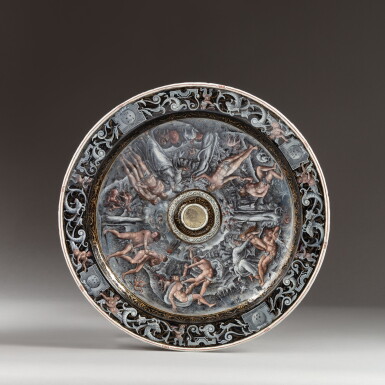
A SELECTION FROM THE COLLECTION OF BERNARD DESCHEEMAEKER WORKS OF ART, ANTWERP | SÉLECTION PROVENANT DE LA COLLECTION DE BERNARD DESCHEEMAEKER WORKS OF ART, ANVERS
Workshop of Pierre Reymond, circa 1555 - 1560 | Atelier de Pierre Reymond, vers 1555 - 1560
Ewer basin with five scenes from Genesis | Bassin d'aiguière avec cinq scènes de la Genèse
Auction Closed
November 22, 02:50 PM GMT
Estimate
15,000 - 26,000 EUR
Lot Details
Description
A Selection from the collection of Bernard Descheemaeker Works of Art, Antwerp
Workshop of Pierre Reymond (1513 - 1584)
French, Limoges, circa 1555 - 1560
Ewer basin with five scenes from Genesis
painted enamel ewer basin on copper, with gilt and fleshtones highlights
with a gilt copper plaque at the centre, engraved with a coat-of-arms and the initials: BB
the rim inscribed: ENE / ** / I, ENE / ** / II, ENE / ** / III and ENE / ** / IV
diameter: 47.5cm., 18¾in.
height: 6cm., 2⅜in.
____________________________________________
Sélection provenant de la collection de Bernard Descheemaeker Works of Art, Anvers
Atelier de Pierre Reymond (1513 - 1584)
Limoges, vers 1555 - 1560
Bassin d'aiguière avec cinq scènes de la Genèse
grand bassin d'aiguière circulaire en émail peint en grisaillle sur cuivre, avec des rehauts de carnations roses et dorés
avec au centre une plaque en cuivre doré, gravée d'un blason et des initiales BB
le marli inscrit ENE / ** / I, ENE / ** / II, ENE / ** / III et ENE / ** / IV
Diam. 47,5 cm ; 18 ¾ in.
Haut. 6 cm ; 2 ⅜ in.
Private collection, Belgium, until 2022.
____________________________________________
Collection particulière, Belgique, jusqu'en 2022.
From a long line of enamellers, Pierre Reymond (active between 1537 and 1578) was one of the leading exponents of this art in Limoges. The technique of painted enamels, which had originated in the previous century, was considerably perfected in the 16th century, and the works of Pierre Reymond, many of which are preserved in prestigious institutions around the world, bear witness to a high level of technical skill. The artist produced high-quality pieces of various types (saltcellars, ewers, plates and bowls), illustrating religious, mythological and secular subjects. Most of his work was produced using the grisaille technique, as in this large ewer basin.
As Limousin artists sought to diversify their models, they drew much of their inspiration from the great artists of the Italian and French Renaissance, as well as from the Northern schools. The present ewer basin is inspired by a series of engravings by Lucas van Leyden (1494 - 1533) dating from 1529 and depicting the story of Adam and Eve in Genesis (see, Rijksmuseum, inv. nos. RP-P-OB-1570, RP-P-OB-1571, RP-P-OB-1572, RP-P-OB-1575). The ewers and their basins, made by Pierre Reymond and his workshop, are now generally separated. Comparable examples of ewer basins can be found in the Louvre (The Story of Moses and Jethro, inv. no. N 1280), the Musée des Beaux-Arts in Lyon (Moses and Jethro, inv. no. H 459), the Walters Art Gallery in Baltimore (Scenes from Genesis, inv. no. 44.208), or the Hermitage Museum with iconography also inspired by the Lucas van Leyden series (inv. no. Ф-288).
RELATED LITERATURE
P. Verdier, Catalogue of the painted enamels of the Renaissance, Walters Art Gallery, Baltimore, 1967, pp. 245-248;
S. Baratte, Les Émaux peints de Limoges, cat. Musée du Louvre, Paris, 2000, p. 250
_________________________________________________________________________
Issu d’une longue lignée d’émailleurs, Pierre Reymond (actif entre 1537 et 1578) fut l’un des principaux représentants de cet art à Limoges. La technique des émaux peints née au siècle précédent, se perfectionne considérablement au XVIe siècle et les œuvres de Pierre Reymond, dont bon nombre sont conservées dans des institutions prestigieuses à travers le monde, sont les témoins d’une grande technicité. L’artiste s’est illustré dans des pièces de forme de grande qualité et de natures variées (salières, aiguières, assiettes ou coupes), illustrant à la fois des sujets touchant à l’histoire religieuse, mythologique ou profane. L’essentiel de sa production est réalisé suivant la technique de la grisaille, comme pour ce grand basin d'aiguière.
Les artistes limousins du XVIe siècle cherchant à diversifier leurs modèles puisent l’essentiel de leur inspiration après des grands artistes de la Renaissance italienne et française, ainsi qu’auprès des Écoles du Nord. Ici, ce basin d'aiguière s'inspire d'une série de gravure de Lucas van Leyden (1494 - 1533) datant de 1529 et relatant l'histoire d'Adam et Ève dans la Genèse (voir, Rijksmuseum, n° inv. RP-P-OB-1570, RP-P-OB-1571, RP-P-OB-1572, RP-P-OB-1575). Les aiguières et leurs basins, réalisés par Pierre Reymond et son atelier, sont aujourd'hui générament séparés. Quelques exemples comparables de basins d'aiguière peuvent être trouvés au Louvre (l'Histoire de Moïse et Jethro, n° inv. N 1280), au musée des Beaux-Arts de Lyon (Moïse et Jethro, n° inv. H 459), à la Walters Art Gallery de Baltimore (Scènes de la Genèse, n° inv. 44.208), ou encore au musée de l'Ermitage avec une iconographie également inspiré de la série de Lucas van Leyden (n° inv. Ф-288).
RÉFÉRENCES BIBLIOGRAPHIQUES
P. Verdier, Catalogue of the painted enamels of the Renaissance, Walters Art Gallery, Baltimore, 1967, p. 245-248 ;
S. Baratte, Les Émaux peints de Limoges, cat. Musée du Louvre, Paris, 2000, p. 250.