Giovanni Francesco Susini
The Dragon Ladon
Lot Closed
July 2, 02:38 PM GMT
Estimate
15,000 - 20,000 GBP
Lot Details
Description
Workshop of Giovanni Francesco Susini (Florence 1585 - 1653)
Italian, Florence, 17th century
The Dragon Ladon
bronze, on an ebonised wood base
bronze: 26cm., 10¼in.
overall: 35cm., 13¾in.
Kenneth Jay Lane, New York, USA;
Sotheby Parke Bernet, New York, 21 October 1977, lot 456;
John Abbott and Peter Guggenheim, Hudson River Valley, USA;
Sotheby's New York, 27 January 2011, lot 427;
Prof. Thomas Olbricht, Berlin;
Private collection, United Kingdom
San Francisco, M. H. de Young Memorial Museum, The Fine Arts Museum of San Francisco, Renaissance & Baroque Bronzes from the Abbott Guggenheim Collection, 1988;
Berlin, Falling Fictions, Olbricht Collection, 2015;
Essen, Museum Folkwang, Gediegenes und Kurioses aus der Sammlung Olbricht, 2016
L. Camins (ed.) Renaissance & Baroque Bronzes from the Abbott Guggenheim Collection, exh. cat. The Fine Arts Museum of San Francisco, 1988, pp. 94-95, no. 32
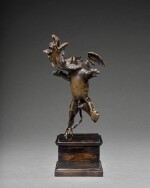
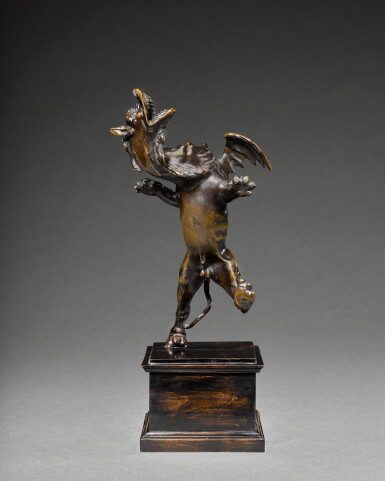
According to legend, Hercules defeated the dragon Ladon, the guardian of the golden apples in the Garden of the Hesperides, to complete his eleventh labour. A group owned by Louis XIV, now in the Chateau de Versailles, shows the present model together with the figure of Hercules, as it must have been originally conceived. The present bronze isolates the figure of the Dragon with a dynamic pose, looking upwards, just before being struck by Hercules.
Giambologna made a series of twelve statues depicting the twelve Labours of Hercules for Francesco de’ Medici in 1581. It is thought that Giambologna originally conceived the model of Hercules and the dragon in Chateau de Versailles, as the composition compares closely to his group of Samson Slaying a Philistine in the Victoria and Albert Museum, London (inv. no. A.7-1954).
However, an independent bronze of Hercules, without the dragon, was mentioned in a bill of lading for bronzes designed by Pietro Tacca, Giambologna’s apprentice, and sent to Henry Prince of Wales in 1612. The biographer Filippo Baldinucci recorded that Tacca made Four (unspecified) Labours of Hercules, which were sold in France. It is therefore plausible that the model of Hercules and the dragon in Versailles constitutes one of those Four Labours. Tacca made several models of fantastical beasts, and stylistic comparison can be made with his fountain figures in the piazza della Santissima Annunziata in Florence, and his fantastical fountain spout in the Museo del Bargello (inv. no. 458-459B).
The soft modelling and fine finish of the present bronze recall the characteristics of Giovanni Francesco Susini, suggesting the bronze was made in his workshop. Susini trained in the workshop of his famous uncle, Antonio Susini (1558-1624), who was Giambologna's (1529-1608) closest assistant. The present cast relates to several of Giovanni Francesco's works; the open mouth, well defined eyes with pupils and the pointed ears compare to Susini’s hybrid creatures on the base of his Sleeping Hermaphrodite, now in the Metropolitan Museum of Art, New York (inv. no. 1977.339). Moreover, the smooth mane of the dragon is similarly modelled to the hair of David in Susini’s group of David and Goliath in the collection of the Prince of Liechtenstein, Vienna (inv. no. SK565).
This expressive bronze was included in several exhibitions, notably the important show of Renaissance & Baroque Bronzes from the Abbott Guggenheim Collection in the Fine Arts Museum of San Francisco in 1988, where it was attributed to Giovanni Francesco Susini, after a model by Tacca, second quarter of the 17th century. The present cast is expertly modelled with a finely chased surface. The rich patina, with warm brown hues and remnants of a reddish-gold translucent lacquer, is characteristic of fine Florentine bronzes of the period.
RELATED LITERATURE
C. Avery and A. Radcliffe, Giambologna. Sculptor to the Medici, exh. cat., Edinburgh, London, Vienna, 1978, no. 84; Les Bronzes de la Couronne, exh. cat., Musée du Louvre, Paris, 1999, pp. 89-90, no. 58
You May Also Like


