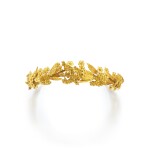

Revival: A Unique Collection of 19th-century Jewels
Castellani
Gold tiara, second half of the 19th century
Auction Closed
November 13, 11:17 AM GMT
Estimate
26,000 - 45,000 CHF
Lot Details
Description
Designed as a flowering laurel wreath, inner circumference approximately 380mm, unsigned, fitted case stamped Castellani in Greek lettering.
Cf.: Susan Weber Soros and Stefanie Walker (eds.), Castellani and Italian Archeological Jewelry, New York, pg. 133-134, fig. 5-19 and 5-13, for a tiara and comb in similar taste attributed to Alessandro Castellani.
Castellani
Fortunato Pio Castellani, an Italian jeweller, was a key figure in the archaeological revival movement during the mid-19th century. He founded his jewellery business in Rome in 1814. In 1826, he met Michelangelo Caetani, who would become a lifelong friend and collaborator.
By the early 1830s, Fortunato Pio had begun creating jewellery in the archaeological style. In 1836, following the discovery of the Etruscan Regolini-Galassi tombs, dating from 680 to 650 BC, papal authorities invited him to examine the jewellery found there. During the 1840s and 1850s, Fortunato and two of his sons, Alessandro and Augusto, gained access to the vast collection of antiquities amassed by Marchese Fiolanni Pietro Campana, the director of the papal savings bank. This collection provided the Castellanis with valuable insights into ancient jewellery techniques, particularly how ancient artisans used granulation and wirework to enhance metalwork, rather than carving or cutting the metal.
In the 1860s, as public fascination with archaeological discoveries grew, Castellani's reputation soared. Exiled from Rome in 1860 due to his political views, Alessandro, the elder son, focused on promoting the firm abroad. He established a presence on the Champs-Elysées in Paris, lectured widely on ancient jewellery, and socialised with Parisian elites, even presenting a collection of Castellani pieces to Napoleon III. Alessandro also arranged for the firm to participate in international exhibitions, including those in Florence (1861) and London (1862).
The Castellani firm became renowned for incorporating elements from various historical periods into their designs, including ancient, medieval, and modern intaglios, cameos, Egyptian scarabs, and micro-mosaics. Jewellery historians note that the firm was the first to incorporate micro-mosaics, often featuring Early Christian, Byzantine, and Egyptian motifs, into frames designed in the archaeological style.
The firm’s popularity continued to grow, with archaeological-style jewellery dominating displays at the 1867 international exhibition in Paris. Castellani's success reached its peak in the 1870s. By the 1880s, the Italian firm was handed over to Alfredo, Augusto’s son, while his father spent his later years documenting the progression of Italian goldsmithing from ancient times to the present. Castellani’s legacy came to an end in 1930 when Alfredo, the last of the Castellani jewellers, passed away, leading to the firm’s closure.
You May Also Like


