Joseph Beuys
Cuprum 0.3% unguentum metallicum praeparatum
Auction Closed
October 17, 05:45 PM GMT
Estimate
15,000 - 20,000 EUR
Lot Details
Description
Joseph Beuys
1921 - 1986
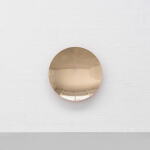
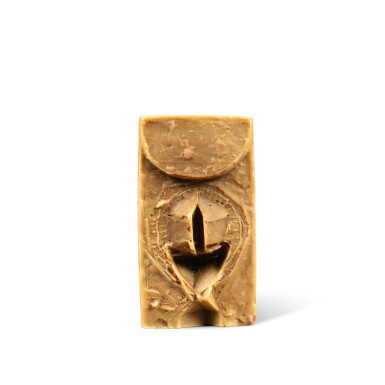
Cuprum 0.3% unguentum metallicum praeparatum
stamped with the artist’s name and numbered A.P. (on the right side)
cast beeswax with finely dispersed copper
19 x 10,5 x 10,5 cm; 7 ½ x 4 ⅛ x 4 ⅛ in.
Conceived in 1978 and executed in 1986, this work is an artist's proof from an edition of 18 plus 5 artist's proofs.
_________________________________________________________
Joseph Beuys
1921 - 1986
Cuprum 0,3 % unguentum metallicum praeparatum
estampillé du nom de l'artiste et numéroté A.P. (sur le côté droit)
cire d'abeille coulée avec du cuivre finement dispersé
19 x 10,5 x 10,5 cm ; 7 ½ x 4 ⅛ x 4 ⅛ in.
Conçue en 1978 et exécutée en 1986, cette œuvre est une épreuve d'artiste d'une édition en 18 exemplaires plus 5 épreuves d'artiste.
Acquired directly from the artist in 1986 by the present owner
Munich, Schellmann Art Gallery, Eine farbige Welt. Objekte, Plastiken, Drucke. 1970-1986 (A Colorful World. Objects, Sculptures, Prints. 1970-1986), June 2011; catalogue, no. 26, pp 72-73, illustrated in colour
Jörg Schellmann, Joseph Beuys: The Multiples, Catalogue Raisonné of Multiples and Prints, Munich 1997, no. 556, pp. 406-407, illustrated in colour (another example)
Schellmann Art and ars publicata (ed. Jörg Schellmann and Nanke Schellmann), Joseph Beuys – The Multiples Catalogue raisonné of multiples and prints 1965 – 1986, 9th edition 2022, no. 556, illustrated in colour (online)
"The sculpture consists of a rectangular block of wax bearing an impression in negative relief of the crystalline form of a miner's lamp. This 'image' represents a combination of archaic signs and naturally occurring forms. Bowl, flame, pentagram, sun disc and crystal converged into a single shape, evoking a multiplicity of interpenetrating levels of meaning and potential associations. The title of the piece is the name of a homeopathic salve which Beuys often used himself." Jörg Schellmann, in Jörg Schellmann, Forty Are Better Than One, 2009.
Early programmatic works by Joseph Beuys, such as Bienenkönigin 2 (1952) and Fettplastik (transponiert) Wachs (1964), featured in the Beuys Block at the Hessisches Landesmuseum in Darmstadt, are made of wax. Beuys frequently used wax, particularly beeswax, in his works due to its ability to exist in both liquid and solid states, symbolizing transformation and the potential for change. This material, for Beuys, reflected his interest in processes of metamorphosis and fluidity, both in nature and in society. The object "Cuprum 0.3% unguentum metallicum praeparatum" consists of beeswax mixed with finely distributed copper. The title refers to a homeopathic preparation, suggesting healing properties, while the combination of beeswax and copper hints at an alchemical process, where materials undergo transformation.
This multiple, like many of Beuys' works, incorporates everyday substances imbued with symbolic meaning. Copper, known for its conductive properties, further reinforces the idea of energy flow, transformation, and connection, central themes in Beuys' artistic philosophy. By blending beeswax with copper, Beuys explores the relationship between natural materials, healing, and the potential for societal change through art, reflecting his broader concept of soziale Plastik—the idea that art can shape and transform society.
___________________________________________________
« La sculpture se compose d'un bloc de cire rectangulaire portant une impression en relief négatif de la forme cristalline d'une lampe de mineur. Cette « image » représente une combinaison de signes archaïques et de formes naturelles. Bol, flamme, pentagramme, disque solaire et cristal convergent en une seule forme, évoquant une multiplicité de niveaux interpénétrés de signification et d'associations potentielles. Le titre de l'œuvre est le nom d'une pommade homéopathique que Beuys utilisait souvent lui-même ». Jörg Schellmann dans Jörg Schellmann, Forty Are Better Than One, 2009.
Les premières œuvres programmatiques de Joseph Beuys, telles que Bienenkönigin 2 (1952) et Fettplastik (transponiert) Wachs (1964), présentées dans le bloc Beuys du Hessisches Landesmuseum de Darmstadt, sont faites de cire. Beuys utilise fréquemment la cire, en particulier la cire d'abeille, dans ses œuvres en raison de sa capacité à exister à la fois à l'état liquide et à l'état solide, symbolisant la transformation et le potentiel de changement. Ce matériau reflète l'intérêt de Beuys pour les processus de métamorphose et de fluidité, tant dans la nature que dans la société. Cuprum 0,3% unguentum metallicum praeparatum est composé de cire d'abeille mélangée à du cuivre finement réparti. Le titre fait référence à une préparation homéopathique, suggérant des propriétés curatives, tandis que la combinaison de la cire d'abeille et du cuivre fait allusion à un processus alchimique, où les matériaux subissent une transformation.
Ce multiple, comme beaucoup d'œuvres de Beuys, incorpore des substances quotidiennes imprégnées d'une signification symbolique. Le cuivre, connu pour ses propriétés conductrices, renforce encore l'idée de flux d'énergie, de transformation et de connexion, thèmes centraux de la philosophie artistique de Beuys. En mélangeant la cire d'abeille et le cuivre, Beuys explore la relation entre les matériaux naturels, la guérison et le potentiel de changement sociétal à travers l'art, reflétant son concept plus large de Plastik soziale - l'idée que l'art peut façonner et transformer la société.