
Property from a Prestigious European Private Collection
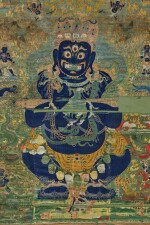
A monumental Imperial silk brocade thangka of Mahakala, Mark and period of Yongle
Auction Closed
March 21, 03:26 PM GMT
Estimate
800,000 - 1,200,000 USD
Lot Details
Description
明永樂 御製寶帳大黑天織錦唐卡
《大明永樂年施》單行六字楷書款
Height 134 in., 340 cm; Width 87 in., 221 cm
Himalayan Art Resources item no. 23430.
Spink and Son Ltd., London, 1989.
Collection of Judy and Michael Steinhart.
Christie’s New York, 29th March 2006, lot 275.
Spink and Son Ltd.,倫敦,1989年
Judy 及 Michael Steinhart 伉儷收藏
紐約佳士得2006年3月29日,編號275
The Art of Textiles, Spink and Son Ltd., London, 1989, cat. no. 23.
Heavens’ Embroidered Cloths, One Thousand Years of Chinese Textiles, Hong Kong Museum of Art, Hong Kong, 1995, cat. no. 26.
《The Art of Textiles》,Spink and Son Ltd.,倫敦,1989年,編號23
《Heavens’ Embroidered Cloths, One Thousand Years of Chinese Textiles》,香港藝術館,香港,1995年,編號26
Valrae Reynolds, 'The Silk Road: From China to Tibet–and Back', Orientations, May 1995, pp 50-57, pl. 11.
Valrae Reynolds, 'Buddhist Silk Textiles: Evidence from Patronage and Ritual Practice in China and Tibet,' Orientations, April 1997, pp 52-63, pl. 9.
Julie Seagraves, 'The Judy and Michael Steinhardt Collection of Chinese Textiles,' Arts of Asia, November 1999, pp 68-79, pl. 12.
Valrae Reynolds,〈The Silk Road: From China to Tibet–and Back〉,《Orientations》,1995年5月,頁50至57,圖版 11
Valrae Reynolds,〈Buddhist Silk Textiles: Evidence from Patronage and Ritual Practice in China and Tibet〉,《Orientations》,1997年4月,頁52至63,圖版9
Julie Seagraves,〈The Judy and Michael Steinhardt Collection of Chinese Textiles〉,《Arts of Asia》,1999年11月,頁68至79,圖版12
This extraordinary textile masterpiece depicting Panjarnatha Mahakala, created as a gift from the Yongle Emperor to a high-ranking Tibetan lama, probably the Sakya hierarch Tegchen Chogyal Kunga Tashi (1349-1425), is one of a group of just seven that survive. It shines amongst the greatest ritual works of art created throughout China’s long Imperial history, and amongst the most ambitious textile masterpieces ever created by any civilization.
Of the seven extant examples, only three others are of the same monumental size (3.4 metres high) as the present image of Mahakala. Two depicting Vajrabhairava and Chakrasmavara, preserved in the collection of the Johkang Monastery, Lhasa, are illustrated in Michael Henss, ‘The Woven Image: Tibeto Chinese Textile Thangkas of the Yuan and Early Ming Dynasties’, Orientations, November 1997, p. 33-34. The third, which depicts Raktayamari and was originally in the same private American collection as the present example, commanded the highest price of any Asian work of art when it was sold at Christie’s Hong Kong, 26th November 2014, lot 3001, and is now in the collection of the Long Museum, Shanghai.
The other known examples include an image of Chakrasamvara in the Cultural Relics Administrarive Center, Chanang Zong, illustrated in Hirmer Verlag, Tibet: Kloster Offnen Ihre Schatzkammern, Hirmer Verlag GmbH, 2006, pp 323-327, and two unpublished examples identified by the scholar Luo Wenhua: an image of Vajrabhairava in the Potala Palace and an image of Raktayamari at the Jokhang Monastery.
All extant examples share the same treatment of iconography, with a central wrathful deity against a flaming nimbus on a lotus base, in brilliant gold and color, and with a Yongle six-character presentation mark at the top right corner. The present example is brocade, woven with gold and colored thread, as are the Potala Vajrabhairava, the Johkang Raktayamari and the Chanang Zong Chakrasamvara. The remaining three are all embroidered. Despite the losses over time, the central image, mark and much of the important iconography is very well preserved. The only other surviving lampas examples ever to have been in private hands appear to be five fragments of lampas thangkas in the Riboud Collection, now preserved in the Musée Guimet, Paris, illustrated in Valrae Reynolds, 'Buddhist Silk Textiles: Evidence from Patronage and Ritual Practice in China and Tibet', Orientations, April 1997, p. 52-63, pls 10, 12, 13, 14 and 15.
The production of this lampas woven thangka, likely to have been at Hangzhou, would required a very large team converging carefully to ensure every aspect of its creation was perfectly coordinated. The sheer precision of the image and its complex iconography left no room for error, and such a production would have been very expensive. This demonstrates the high value attached by the Yongle court to their relationships with senior Tibetan hierarchs.
Unlike the other surviving examples, which represent the iconography common to the teachings of Tsongkhapa and the Gelug tradition - Chakrasamvara, Vajrabhairava and Rakta Yamari - the current example represents the protector deity Panjarnata Mahakala common to the Khon family and the Sakya Tradition, with specific Sakya lineage of Panjarnata. It is therefore likely to have been created for the Sakya hierarch Tegchen Chogyal Kunga Tashi (1349-1425) after his visit to the Yongle Emperor while he was still in Nanjing in 1413, where it is documented that he received many gifts.
本寶帳大黑天織錦唐卡極爲珍罕,由大明永樂帝贈予一重要上師(或為薩迦派主持貢噶扎西堅贊,1349-1425 年),乃現存僅餘七例之一。堪稱中國宮廷宗教藝術史上最傑出作例之一,亦屬人類文明史上最具雄心之其中一件織品絕作。
本品尺幅龐大,現存七唐卡當中僅三例可媲美(3.4 公尺高)。拉薩大昭寺珍藏大威德金剛、勝樂金剛兩例,圖載 Michael Henss ,〈 The Woven Image: Tibeto Chinese Textile Thangkas of the Yuan and Early Ming Dynasties〉,《Orientations》,1997 年 11 月,頁 33-34 。第三例為明永樂御製紅閻摩敵刺繡唐卡,與本品出自同一美國私人收藏,2014 年 11 月 26日售於香港佳士得,創下當時亞洲藝術品世界拍賣記錄,編號 3001,現藏上海龍美術館。
其他現知作例包括:勝樂金剛唐卡,扎囊县文物管理中心收藏,圖見 Hirmer Verlag,《Tibet-Kloster Offnen Ihre Schatzkammern、Kulturstiftung Ruhr Essen》,Villa Hugel,2006 年,頁 323-327 ,另比兩例,無文獻記載,由學者羅文華鑑定,其一為大威德金剛唐卡,布達拉宮藏,其二為紅閻摩敵,大昭寺珍藏。
所有現存作例構圖處理相同,中央本尊顯忿怒相,背倚赤焰身光,下承蓮座,金光燦爛,色彩絢麗,右上角綉永樂六字款。布達拉藏大威德金剛、大昭寺紅閻摩敵及扎囊县藏勝樂金剛以及本品均屬織錦唐卡,以金線和彩線織成,其餘三幅皆為刺繡。雖然唐卡部份因年代久遠而有破損,中央大黑天像、年款及畫面當中許多重要圖像仍然保存完好。除本品外,唯一現存私人收藏織錦唐卡作例似為Riboud收藏殘片,現存於巴黎吉美博物館,圖見 Valrae Reynolds,〈Buddhist Silk Textiles:Evidence from Patronage and Ritual Practice in China and Tibet 〉,《Orientations》,1997 年 4 月,頁 52-63 ,圖版10、12、13、14 及 15。
此錦織唐卡或製於杭州,程序極其複雜精細,需耗大量人力,必需各方完美協調,窮巧匠心血方成。本織錦畫面精細準確,構圖複雜,不容半點差池,製作花費極其高昂,由此可見,永樂一朝對朝廷與西藏上師關係之重視。
本品刻劃寶帳大黑天乃薩迦派及昆氏家族供奉之本尊,其他現存作例(勝樂金剛、大威德金剛及紅閻摩敵唐卡)則有所不同,屬宗喀巴及格魯派。
薩迦派主持貢噶扎西堅贊(1349-1425 年)曾朝見永樂帝,至 1413 年仍然在南京,據載,永樂帝厚贈上師多件珍貴禮品,本唐卡很可能便在其中。
An Imperial Yongle Textile Mahakala
BY JEFF WATT, DIRECTOR OF HIMALAYAN ART RESOURCES
There are seven examples of large format textiles produced in the early Ming dynasty by the Yongle Emperor (1360-1424). The textiles are of Chinese imperial production, woven in a kesi weaving technique, measuring three meters in height. All four of the larger published examples follow the same basic compositional style with a dominant single large central figure representing a Tantric Buddhist meditational deity. Each is complex, detailed and idealized. Along the top of each example is a line of smaller figures. In some examples they are human figures representing a lineage of teachers and in others portraying various buddhas and symbolic attendant deities.
Along the bottom of the composition on the present textile are seven dancing female figures each holding aloft a specific offering substance. The seven are the more commonly known of the Eight Offering Goddesses. Starting from the left is green Arghuam, green Padya, white Pushpe, blue Dupe, green Aloke, green Gandhe, and yellow Naivedye. The substances they hold are a white conch with water for drinking, again a white conch with water for washing, a bowl of flowers, a bowl of incense, a lamp with flickering flames, a white conch with scented water and finally a bowl of food (peaches). The eighth and final offering goddess would be Shapda and she typically holds a musical instrument. This is a common practice to omit the offering goddess Shapda on two-dimensional art and replace her with the sound of a ringing ritual bell. Each of the goddesses hold their own offering up with one hand while performing a dance gesture with the other hand, all the while standing in a dance posture with either the right leg or left leg raised. Between the four examples the colors of the offering goddesses can vary depending on differences between the ritual source texts.
'...the great Vajra Mahakala, blazing, with one face, two hands, in the right a curved knife and in the left a skullcup filled with blood, held above and below the heart. Held across the middle of the two arms is the 'Gandhi of Emanation.' With three eyes, bared fangs, yellow hair flowing upward, a crown of five dry human skulls and a necklace of fifty wet, blood dripping, adorned with six bone ornaments and snakes, having a lower garment of tiger skin, flowing with pennants and streamers of various silks, in a posture dwarfish and thick, standing above a corpse. To the right is a black crow, left a black dog, behind a wolf, in front a black man, above a garuda, emanations of messengers issue forth, with Akshobhya as a crown, standing in the middle of a blazing fire of pristine awareness.' (Konchog Lhundrub, 1497-1557).
A thick flaming halo surrounds Mahakala with black garuda birds at the top, black ravens, crows, wolves, jackals and foxes. At the upper left is the meditational deity Bhutadamara Vajrapani, standing, with four arms, two extended outward. On the right side is the standing female protector Ekajati, holding a vase with the two hands. At the lower left side is Copper Knife Mahakala, holding a skull bowl. On the right side is the thin and emaciated, one-faced, four-armed, female protector deity Shri Devi, with one face and four arms, riding a donkey. The iconographic program of the five central figures is highly symbolic with a structured ritual component that alternates between the two categories of meditational deity and protector deity.
The Yongle Emperor had a number of interactions with notable Tibetan teachers beginning with the 5th Karmapa, Deshin Shegpa (1384-1415), in 1407. The second Tibetan teacher of note was Tegchen Chogyal Kunga Tashi (1349-1425), a member of the Sakya Khon family, the court chaplains to the Mongol rulers of China during the Yuan dynasty. The third Tibetan teacher of prominence to visit the Yongle Emperor was Jamchen Choje, Shakya Yeshe (1354-1435), the founder of Sera Monastery. He visited the Yongle Emperor in 1415 and continued to frequent the emperor until his demise in 1424. Furthermore, Shakya Yeshe continued to visit and serve the next two emperors of China. All three of these teachers received extensive gifts from the emperor. The 5th Karmapa and Shakya Yeshe both enjoyed the gift of an ornate black hat, decorated with a double vajra or images of the Five Symbolic Buddhas. According to the biography of Shakya Yeshe (b.1354 - d.1435) he was also given by the emperor a set of textiles depicting Shakyamuni and the Sixteen Elders. Each of these was approximately a meter and a half in length. Upon his return to Tibet, these were then given to his teacher Tsongkapa. Some of the compositions from the set are still known to reside at Ganden Monastery outside of Lhasa to the east. The Sakya teacher Kunga Tashi received a red and gold hat marked with a double vajra.
Of the four known large format textiles of this size, three represent the iconography common to the teachings of Tsongkhapa and the Gelug tradition - Chakrasamvara, Vajrabhairava and Rakta Yamari. These three compositions are most likely to have been gifts intended for Shakya Yeshe, a devout follower of Tsongkhapa. The fourth textile is of the protector deity Panjarnata Mahakala common to the Khon family and the Sakya Tradition. This composition also contains at the top the specific Sakya lineage of Panjarnata. Further to that, the central five deities are positioned in a unique Sakya iconographic program. It is very possible that with the passing of time, and the current and ongoing cataloguing of the Potala Palace Collection of art, more Yongle textiles and gifts proffered to Tibetan teachers will become known.
永樂御製寶帳大黑天刺繡唐卡
傑夫•瓦特,喜馬拉雅藝術資源中心主任
明朝初年,永樂帝請製大尺幅刺繡唐卡,共有七幅,皆為宮廷御製,採用緙絲技法,高約一丈。其中較大四幅(均高逾三米)經出版載錄,構圖均以一密宗本尊居於正中,紋飾繁密,細節精美,無懈可擊。上界列有一排小像,或為各派上師、賢聖,或為諸佛、護法。
此幅唐卡下界為天女七尊,各執供物,婀娜起舞,從左至右分別表徵瑜伽供、濯足供、妙花供、熏香供、光明供、塗香供及饌食供,世人多稱其為「八大供養天女」;第八尊原為妙樂供,依照傳統,乃以搖法鈴出音聲代替描繪,故畫幅中未見。天女均單手托舉供物,單腿立地作舞蹈姿。前述出版四幅中,隨法會因由不同,供養天女身色各異。
主尊寶帳大黑天倚烈焰背光,頭頂左右各見一迦樓羅,另有渡鴉、烏鴉、狼、豺、狐狸等靈禽異獸,皆為黑色。肩側各作一立像,四臂伏魔金剛手在左,兩臂外展,一髻佛母在右,雙手持寶瓶;下方,持鉞刀大黑天在左,捧嘎巴拉盌,吉祥天母在右,單面四臂,形容清瘦,騎坐驢身。本尊及護法共計為五,以此格局分佈於構圖中央,乃合儀軌。
1407年,五世噶瑪巴德新謝巴(1384-1415)與永樂帝會面傳法,自此開啟永樂帝與西藏上師頻繁交流。釋迦也失(1354-1435)為第二位重要上師,曾創建色拉寺,1415年應永樂之詔初次入朝,自此數度面聖,直至1424年永樂駕崩,後又為宣德、正統弘法。貢噶扎西堅贊(1349-1425)為第三位重要上師,乃元朝帝師薩迦昆氏後裔。此三上師皆獲永樂厚賜。德新謝巴與釋迦也失各得黑色僧帽,紋飾華貴,有十字金剛杵及五智如來。據釋迦也失生平傳記,永樂另賜他釋迦牟尼佛與十六羅漢刺繡唐卡一組,各長約半丈,歸藏後轉贈祖師宗喀巴;此組唐卡仍有部分現供於拉薩東郊甘丹寺。貢噶扎西堅贊亦得僧帽,色為紅、金,帶十字金剛杵。
前文提及四幅刺繡唐卡經出版,尺寸與此相當,其中三幅描繪勝樂金剛、大威德金剛及閻摩敵,常見於宗喀巴及格魯派教法。該三幅或為獻予釋迦也失之禮,因釋迦也失乃宗喀巴弟子。第四幅則為寶帳大黑天,受昆氏家族及薩迦派篤奉。該幅上界列有薩迦派祖師,中央五尊亦依薩迦派儀軌排佈。假以時日,隨布達拉宮寶蓄珍藏編理成書,或有更多永樂刺繡唐卡及賜贈之物將重光於世。
You May Also Like