
Property from an Erudite Collector
Paul Ditisheim
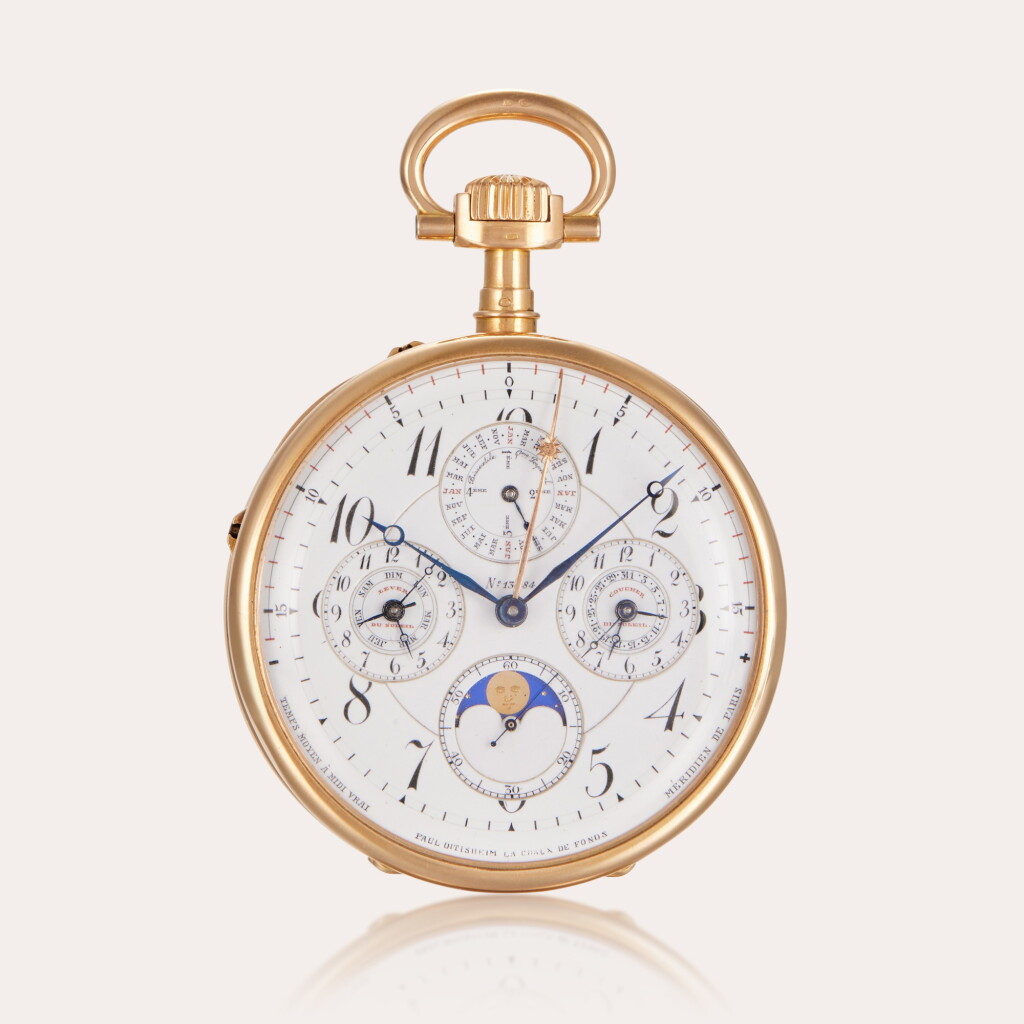
A highly important astronomical chronometer rated precision watch with perpetual calendar, equation of time calculated for the Paris Meridian, sunrise/sunset indication and moon phases | Circa 1899 | No. 13784
Auction Closed
November 10, 01:01 PM GMT
Estimate
85,000 - 175,000 CHF
Lot Details
Description
· 21’’’ frosted gilded three-quarter plate movement, straight line lever escapement, 21 jewels, bi-metallic compensation balance with gold and platinum screws, palladium hairspring with Philips terminal curve, index regulator, back plate engraved Bulletin de 1ère Classe de l’Observatoire, no. 13784
· white enamel 9-piece dial, Arabic numerals, minute ring with adjacent sector for equation of time indication centred at 12 o’clock, subsidiary dial at 12 displaying each month within the four year leap-year cycle, two further subsidiaries at 9 and 3 o’clock calibrated in French respectively for times of sunrise (lever) sunset (coucher) in hours and minutes with inner discs for day and date, subsidiary seconds at 6 o’clock combined with aperture for moon phases, blued steel Breguet hands, gold sun-tipped equation hand, dial numbered to the centre 13784 and signed Paul Ditisheim, La Chaux de Fonds, further described to the edge ‘Temps Moyen à Midi Vrai, Méridien de Paris’
· 18ct yellow gold Empire case, deeply reeded band, gold case back with sunburst engine-turning emanating from small J.F. monogram within oval cartouche, gold cuvette, astronomical and calendar work adjusted via two olivette push pieces to band, gold cuvette engraved No. 13784 Bulletin de 1ère Classe de l’Observatoire de Neuchâtel, Fabrique par Paul Ditisheim à La Chaux de Fonds, Grand Prix Exposition Universelle Paris 1900, inside case back with Swiss Helvetia head assay mark, Crown assay, French owl import mark, inside back and cuvette interior both numbered 13784 and with PD punch mark, pendant and inside back rim with Helvetia head, pendant, inside back rim and bow with French owl import mark
diameter 61mm
Accompanied by a copy of the Neuchâtel Observatory Chronometer Certificate, along with a detailed record of the watch’s timekeeping performance during the tests. Also with a fitted wooden box with brass bound edges to lid, central brass plaque engraved J.F., purple silk lining to lid with gilt lettering ‘Idrac-Leroy, Horloger, 22 Rue du Bouloi, Paris.
Auktionen Dr. H. Crott, Frankfurt, No. 56, 16 May 1998, Lot 517.
Exposition Nationale (Suisse) 1914. Description des Chonomètres et Montres d’Art Construits Par les Atelier Paul Ditisheim a La Chaux-de-Fonds (Suisse). This model described on p. 28 with further illustration showing another example on frontispiece.
“Not since Breguet has any one man so successfully assembled so much talent or directed it with so much enlightenment and genius, and it is doubtful if we shall look upon his like again… [and] for his human qualities, his hospitality, kindness, and friendship, his friends will remember him with gratitude and affection.” Professor D. S. Torrens [Paul Ditisheim, A Tribute to a great Horologist, Horological Journal, Vol. 87, No. 12, December 1945, p. 420.]
“Mr Paul Ditisheim has again been distinguishing himself at the recent Watch Trials at the Neuchâtel Observatory. See also his record in the Kew Watch Trials…Mr Ditisheim’s records year by year are really extraordinary.” [Horological Journal, Vol. 56 No. 9-10, May 1914, p. 144.]
“Mr. [George L.] Miller showed a copy of a marvellous rate record of a lever watch manufactured by Ditisheim, a Swiss maker. This watch, from August 1 to September 14, 1912, was tested continuously in all positions, and at a temperature varying from 40 degrees (in refrigerator) to 90 degrees. The average error was proved to be less than approximately one-tenth of a second per day.” [Horological Journal, Vol. 56 No. 9-10, May 1914, p. 144.]
Few watchmakers can claim to have received such consistently high praise, respect and reverence as Paul Ditisheim (1868-1945). His extraordinary talent for precision watchmaking rightly earned him the reputation as one of the greatest watchmakers of the late nineteenth and early twentieth centuries. The exceptional complication watch shown here is one of Ditisheim’s most important creations. In a book produced for the 1914 Swiss National Exhibition titled Chonomètres et Montres d’Art Construits Par les Atelier Paul Ditisheim à La Chaux-de-Fonds, this watch model was described as the most complicated and expensive ever made by Ditisheim and carried a list price of CHF 5,200. An almost identical example was illustrated on the frontispiece of the book and described on page 28. It is believed that just three examples of the model were made. No. 20312 made for Mr Leon Shuster of Paris was sold at Antiquorum, 14 October 1990 lot 481. Shuster’s watch was used in an attempt to determine the exact longitude of Paris and Neuchâtel. The present watch was entered into the Neuchâtel Observatory trials in 1899 where it won third prize within the best 12 Chronometers of category B and C, it was timed by U. Wehrli from La Chaux-de-Fonds.
An extraordinary tour de force, in addition to the perpetual calendar and indication for the Equation of Time, it is the displays for the times of sunrise and sunset in hours and minutes that are particularly remarkable. Adjusting automatically throughout the year as the watch’s timekeeping advances, the minute and hour hands of the subsidiary sunrise/sunset dials also advance incrementally in tandem with the calendar corrector pusher to the band. Housed in an impressive and large 61mm diameter case, the 9-part white enamel dial is captivating – its relatively slim bezel allows for a particularly broad display, providing a clearly defined area and set of calibrations for each of the indications.
Paul Ditisheim (1868-1945) was one of the leading watchmakers of his generation. Initially studying at the horological school in La Chaux-de-Fonds, Switzerland, Ditisheim spent time working for a maker of tourbillon watches near Le Locle before travelling to Paris and Berlin to further his experience. He then moved to England where he worked as a technician at Rotherhams, receiving a First-Class Certificate from the British Horological Institute in 1891. In 1892 he had returned to his native La Chaux-de-Fonds where he set up his own watch manufacturing business, seeking out and employing fine watchmakers from Switzerland, Paris and London. Ditisheim prided himself on the exceptional quality and performance of his watches and won numerous awards. His first successes came in 1895 when he won the second and third prizes at the Neuchâtel Observatory. In 1898 he won First Prize at Neuchâtel in the prestigious Deck Watch category, beating all previous records. In 1900 he was awarded a Grand Prix at the Paris Exposition Universelle and began the study of the effects of barometric pressure on watches. At the Neuchâtel Observatory in 1901, Ditisheim entered 12 watches for testing, between them they had an average daily variation of just 0.23 seconds.
In 1903 he received first place at the Kew Observatory with a tourbillon watch fitted with a Guillaume balance – the watch broke the record for the highest mark achieved to date scoring 94.9. In 1912, Ditisheim broke the Kew record once again with watch no. 36175, a two-day going lever watch with Guillaume balance no. 36175. The astonishing accuracy of the watch was such that, over the full 45 days of the trial, the mean daily variation of the movement’s rate was just +/- 0.13 seconds. It was awarded an ‘Especially Good’ Class A certificate with 96.1 marks given for superior merit. In 1911 and 1912, the watch underwent further trials at the Swiss Observatory in Neuchâtel where it won first prize in the first -class pocket chronometer trial (1911), and first class in the deck watch trial (1912). In 1918, Ditisheim exceeded his record at Kew once again, achieving 96.2 marks at its new Teddington location with his watch number 36162 setting a new record for the ‘Kew’ trials. In the year from April 1917-March 1918, Ditisheim’s watches won the top seven places and 14 of the top 26 performing watches were by Ditisheim in that year. In the Kew/Teddington tests of 1919-20 and 1923-24 Ditisheim again won first place, setting new records in both years.