
Property from an Erudite Collector
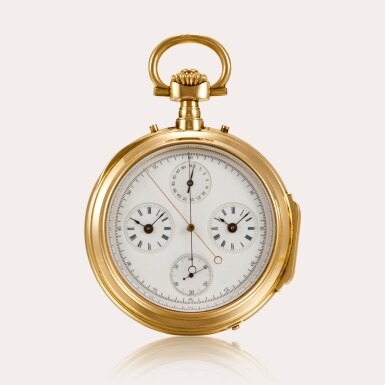
An extremely rare and unusual 18ct pink gold two-train open-faced watch with independent centre seconds and additional central chronograph jumping seconds hand with subsidiary dial for progressive minute/hour register, Attributed to Audemars Frères, Circa 1890
Auction Closed
December 6, 09:17 PM GMT
Estimate
10,000 - 15,000 USD
Lot Details
Description
· Two-train movement with differential winding, the second train controlling the chronograph and register, damascened decoration, straight line lever escapement, 25 jewels, bi-metallic compensation balance, blued steel Breguet hairspring, gold wheel train, unsigned
· White enamel dial, four subsidiary dials, dial at 9 o’clock indicating mean time, dial at 3 o’clock for progressive minute and hour recording, date at 12 and constant seconds at 6, two central seconds hands with counterpoised ‘moon’ tipped tails indicating to outer track calibrated to fifths
· 18ct pink gold case with chamfered bezel, slide beside 5 o’clock for starting the seconds hands, pusher through crown for stopping/resetting jumping chronograph seconds, case back with decoratively engraved monogram, two pushers either side of pendant (left) for adjusting time and (right) for re-setting chronograph subsidiary register, hinged glazed cuvette, inside case back numbered 17323, stamped 18k and with A.F. & Ce. in square cartouche with cut corners, bow stamped twice with French owl import assay mark
No. 17323
diameter 55mm
Habsburg, Feldman, Antiquorum Geneva, 15 October 1989, lot 52.
This is a most interesting and unusual watch with two central seconds hands, one of which acts for the chronograph. The chronograph jumping seconds hand is activated via the slide set to the case side at 5 o’clock. When in motion, the chronograph seconds can be stopped and reset via the pusher mounted through the crown. The subsidiary dial at 3 o’clock, which may at first glance appear to be a secondary time zone, is in fact a progressive 60-minute/12-hour register for the chronograph. A Czapek & Cie pocket watch with movement attributed to Louis Audemars that features a similar configuration to the dial including chronograph subsidiary minute/hour register dial, but single chronograph seconds hand to the centre, can be found at the Patek Philippe Museum (inv. P-847) and is illustrated in Patek Philippe Museum, Patek Philippe Watches, Vol I, p. 52.
After the 1885 bankruptcy of Louis Audemars & Cie, the company was divided into three successor firms managed by various family members: Audemars Frères, F. Audemars Fils, and Louis Audemars (the latter later based in London). Audemars Frères, alongside its sister companies, inherited part of the original firm’s tooling and stock, allowing it to continue watchmaking and maintain connections with previous clients. Each branch operated independently, with Audemars Frères contributing to the industry’s rich heritage through precision manufacturing and its expertise in complications and other innovative mechanisms. Though each successor focused on distinct markets or specialties, Audemars Frères played an essential role in sustaining the Audemars family’s influence on horology through its dedication to quality craftsmanship and technical advancements.