Property from the Doros Collection
Steuben Glass Works
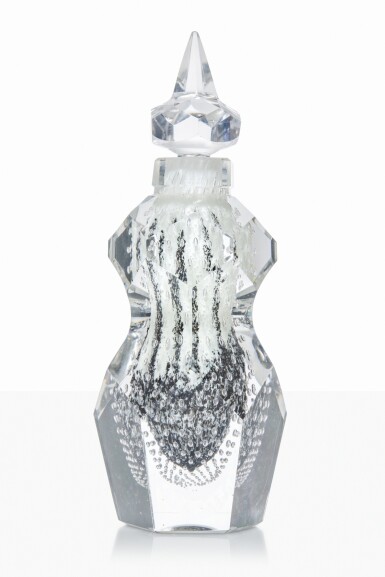
Cintra Scent Bottle
Auction Closed
June 6, 04:43 PM GMT
Estimate
7,000 - 10,000 USD
Lot Details
Description
Steuben Glass Works
Cintra Scent Bottle
circa 1925
comprising one bottle and one stopper
glass
engraved Steuben
11 in. (27.9 cm) high
Sotheby Parke-Bernet New York, April 11, 1981, lot 358
Acquired from the above by the present owner
Vanity Vessels: The Story of the American Perfume Bottle, Museum of American Glass at Wheaton Village, Millville, New Jersey, February 19-November 15, 1999
Tom P. Dimetroff, Frederick Carder and Steuben Glass, Atglen, PA, 1998, p. 140, no. 6.11 (for a drawing of a related example)
Paul Gardner, The Glass of Frederick Carder, Atglen, PA, 2001, p. 242, no. 6945 (for a drawing of the form)
My parents, Micki and Jay Doros, are perhaps best remembered for their amazing assemblage of the works of Louis Tiffany and his affiliated companies. Close friends and fellow collectors knew, however, that the Tiffany represented only part of what was essentially a museum-like survey of late 19th and early 20th century American art glass. Superior examples of Libbey Amberina, Mt. Washington Crown Milano, Quezal and Durand filled several display shelves, but perhaps no grouping outside of the Tiffany brought more pleasure to my parents than their Steuben pieces.
Frederick Carder and Louis Tiffany reacted very differently when American tastes changed after World War I, as the curvilinear motifs of Art Nouveau succumbed to the geometric shapes of Art Deco. Tiffany retired from Tiffany Studios in 1918 and created the Louis Comfort Tiffany Foundation in an attempt to counter modern art trends. Carder, on the other hand, remained in his managerial role at Steuben and praised the glass creations of René Lalique, Maurice Marinot and Orrefors. Although trained as a classicist, he always appreciated glass that revealed the highest levels of quality and design. What Carder was vehemently opposed to, however, was the diminished role of the glassmaker and the rise of machine-made, mass-produced glass objects. Carder had no difficulty adapting to contemporary decorative trends, as long as Steuben’s exceptional level of quality would not be compromised.
The Steuben Cintra scent bottles are among the most stunning objects made by the company during the 1920s. The near-optical quality of the leaded glass was also a precursor to the material the glasshouse would use exclusively beginning with the following decade. Featuring striking color combinations, controlled trapped air bubbles and facet cut exteriors, these rare creations have long found favor with advanced collectors. Carder, interviewed at the age of 98, was asked why he made the bottles of such thick glass. He cheerfully replied, with his typical puckish sense of humor, “Why, in case a husband got his wife angry at night in the bedroom, she would have something heavy to throw at him.”
-Paul Doros
You May Also Like