
Property from the Fleisher Collection
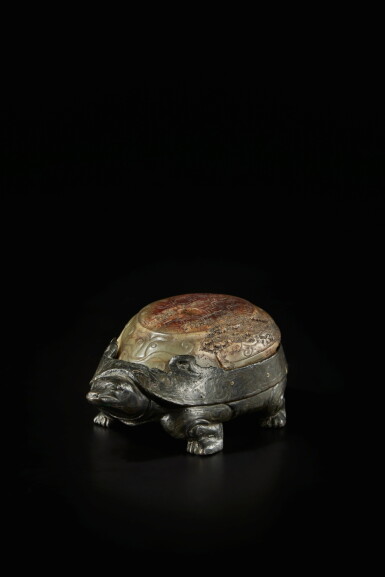
An extremely rare gold and silver-inlaid bronze tortoise-form box and jade cover, Song dynasty | 宋 銅錯金銀龜形鎮連玉蓋
Auction Closed
March 20, 05:40 PM GMT
Estimate
30,000 - 50,000 USD
Lot Details
Description
(2)
Length 4⅝ in., 11.8 cm
Collection of Wilfred Fleisher (1897-1976), acquired in Japan in the 1920s to early 1930s, and thence by descent.
來源:
Wilfred Fleisher (1897-1976) 收藏,1920年代至1930年代初得於日本,此後家族傳承
Celadon Jade, The National Museum, Stockholm, 1963.
Chinese Jade Throughout the Ages, Victoria and Albert Museum, London, 1975, cat. no. 276.
展覽:
《Celadon Jade》,國立博物館,斯德哥爾摩,1963年
《Chinese Jade Throughout the Ages》,維多利亞與阿爾伯特博物館,倫敦,1975年,編號276
Desmond Gure, 'Selected Examples from the Jade Exhibition at Stockholm, 1963', Bulletin of the Museum of Far Eastern Antiquities, vol. 36, Stockholm, 1964, p. 153, pl. 30.1.
出版:
Desmond Gure,〈Selected Examples from the Jade Exhibition at Stockholm,1963年〉,《Bulletin of the Museum of Far East Antiques》,卷36,斯德哥爾摩,1964年,圖版30.1
The present lot was attributed to the Song dynasty in the 1963 exhibition at the Museum of Far Eastern Antiquities in Stockholm. Desmond Gure, however, in his post-exhibition article notes that 'further investigation since then has resulted in a Han attribution for the bronze part' (see 'Selected Examples from the Jade Exhibition at Stockholm, 1963', Bulletin of the Museum of Far Eastern Antiquities, vol. 36, Stockholm, 1964, p. 153, pl. 30.1). Compare a Han dynasty gilt-bronze tortoise-shaped weight inset with a seashell in the Idemitsu Collection, published in Ancient Chinese Arts in the Idemitsu Collection, Tokyo, 1989, pl. 242. See also a gold and silver-inlaid bronze tortoise weight, attributed to late Warring States to early Han dynasty, from the collection of Anthony Hardy, published in Li Xueqin, Zhongguo qingtongqi cuishang / The Glorious Traditions of Chinese Bronzes, Singapore, 2000, pl. 80, and later sold at Christie's New York, 16th September 2010, lot 907.
Recent scholarship on later Chinese bronzes, however, suggests that a Song dynasty attribution is more accurate. The overall patina of the bronze, with traces of the artificial encrustation on the surface, is consistent with known Song dynasty examples, such as a gold and silver-inlaid bronze pouring vessel in the form of a goose, patinated in a similar style, in the Victoria and Albert Museum, London, illustrated in Rose Kerr, Later Chinese Bronzes, London, 1953, p. 16, figs 4 and 5, where the author notes the artificial patination on the bronze; and also a gold and silver-inlaid bronze figure of a tapir with a similar patina, exhibited in the Burlington Fine Arts Club, London, in 1915, sold at Christie's Paris, 12th June 2012, lot 286.