
Snuff Bottles from the Christopher Sin Collection
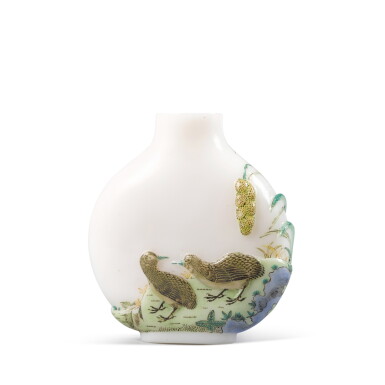
A relief-decorated famille-rose-enameled opaque white glass 'quails and millet' snuff bottle, Qing dynasty | 清 料胎畫琺瑯雕嵗嵗平安圖鼻烟壺 《古月軒》款
Auction Closed
March 20, 05:40 PM GMT
Estimate
10,000 - 15,000 USD
Lot Details
Description
the base with a three-character Guyuexuan mark in iron red
Height 2¼ in., 5.6 cm
Heavenly Creations, University Museum and Art Gallery, The University of Hong Kong, Hong Kong, 2005, cat. no. 107.
展覽:
《天地造化》,香港大學美術博物館,香港,2005年,編號107
Humphrey Hui, An Addicted Dedication: Chinese Snuff bottles Christopher Sin's Collection, vol. I, Hong Kong, 2013, pl. 171.
出版:
許建勳,《An Addicted Dedication: Chinese Snuff bottles Christopher Sin's Collection》,卷一,香港,2013年,圖版171
The present bottle, intricately enameled with quails, belongs to a group that share similar design elements, but are all ultimately unique. The imagery of quails and grain refer to the Chinese rebus suisui ping’an, which translates to ‘may there be peace year after year’. The molding and enameling on this example are both of stellar quality, as is the treatment of the flowers. One notable feature is the extension of the painting from the molding to the body, thereby providing a sense of fluidity to the two scenes. Another enameled glass ‘quails’ snuff bottle with guyue xuan mark from the Joe Grimberg Collection was sold in these rooms, 14th September 2010, lot 11.
The Guyue Xuan has been the focus of much debate. Peter Lam, in The Imperial Connection: Court Related Chinese Snuff Bottles The Humphrey K.F. Hui Collection, Hong Kong, 1998, p. 36, writes: 'There had been a glass factory in the Yuanming Yuan since Yongzheng times, and the painting academy, Ruyi Guan was also situated in the 'Dongtian Shenchu' in Yuanming Yuan. And therefore it is probably not too far-fetched to theorize that the Qianlong Emperor had ordered glass wares to be used in this particular garden'. The blanks of the glass objects were produced by the glass factory, and afterwards they were decorated by the court painters in the Ruyi Guan. Guyue Xuan would be the place where these glass wares were used, and from which it derived its name. It is therefore possible that in the late Qianlong through the Jiaqing reigns, some glass pieces, including snuff bottles were marked with the studio name of Guyue Xuan. This early Guyue Xuan marked group all came from the Imperial Household Workshop and should have the same characteristics as those earlier ones with Qianlong reign marks.'