
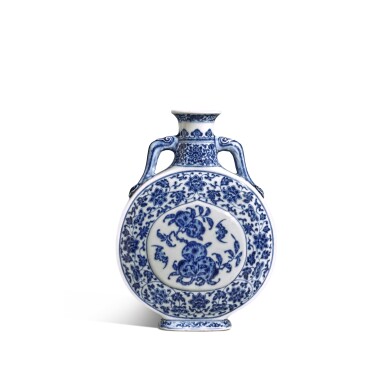
A rare blue and white 'peach and bat' moonflask, Seal mark and period of Qianlong | 清乾隆 青花纏枝蓮紋杏圓開光式福壽圖雙耳扁壺 《大清乾隆年製》款
Auction Closed
March 20, 05:40 PM GMT
Estimate
150,000 - 200,000 USD
Lot Details
Description
the base with a six-character seal mark in underglaze blue
Height 9⅝ in., 24.4 cm
Property of a Gentleman.
Marchant, London, 28th July 1966.
來源:
紳士收藏
馬錢特,倫敦,1966年7月28日
This moonflask has been masterfully executed to resemble the celebrated blue and white wares of the early 15th century through the use of the 'heaped and piled' technique to render the designs. With a keen attention to detail, the craftsman successfully replicated the uneven blue tones characteristic of the early Ming period. The technique, achieved through meticulous manipulation of cobalt pigment, mirrors the natural variations resulting from the firing process. Its flattened globular form, tall and gently waisted neck, and two handles draw inspiration from early Ming prototypes. For example, see a Yongle reign moonflask adorned with flower sprays, formerly in the collection of the Ottoman Sultans and now in the Topkapi Saray Museum, Istanbul, illustrated in Regina Krahl, Chinese Ceramics in the Topkapi Saray Museum, Istanbul, vol. 2, London, 1986, pl. 613.
The design of peaches and bats, with its highly auspicious message, appears to have originated in the Yongzheng reign and gained popularity during the Qianlong period. The combination of the bat (fu) and peach (shoutao) creates the auspicious pun fushou shuangquan ('May you have both blessings and longevity'). This symbolism, rooted in Chinese culture, makes the moonflask particularly fitting as a meaningful gift, especially on occasions such as birthdays.
Qianlong mark and period moonflasks of this type are held in important museums and private collections worldwide; see one in the National Palace Museum, Taipei (accession no. 中瓷003549N000000000); another in the Nanjing Museum, illustrated in The Official Kiln Porcelain of the Chinese Qing Dynasty, Shanghai, 2004, cat. no. 220; see also one in Newfields (formerly known as the Indianapolis Museum of Art), Indianapolis, included in the Museum's exhibition Beauty and Tranquility: The Eli Lilly Collection of Chinese Art, Indianapolis, 1983, cat. no. 116; and a fourth, included in the exhibition Ch'ing Porcelain from the Wah Kwong Collection, Art Gallery, The Chinese University of Hong Kong, Hong Kong, 1973, cat. no. 66. Further examples include one from the collection of R.I.C. Herridge, sold in our Hong Kong rooms, 29th November 1978, lot 235; another sold in the same rooms, 7th October 2015, lot 3725; and a third, sold in our London rooms. 9th November 2011, lot 201.