
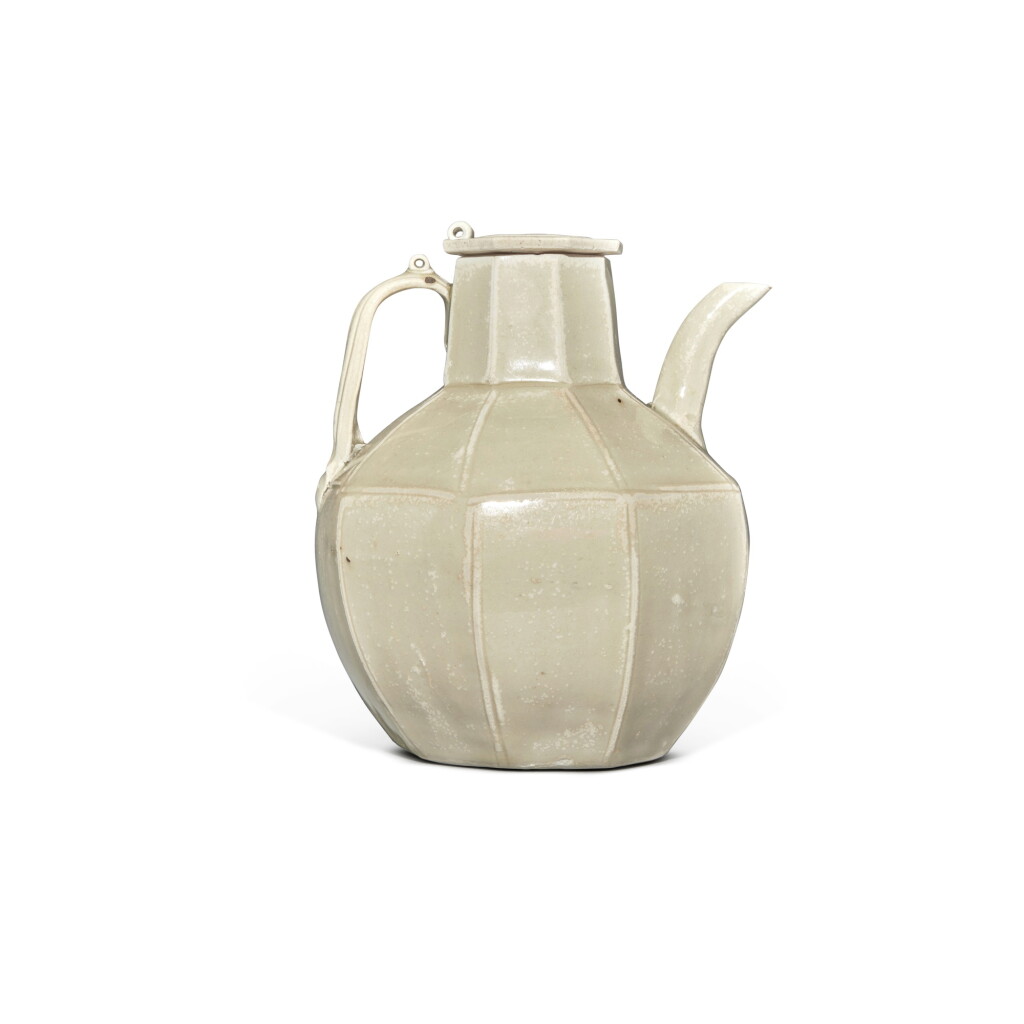
A Qingbai octagonal ewer and cover, Northern Song dynasty | 北宋 青白釉八方連蓋執壺
Auction Closed
March 20, 05:40 PM GMT
Estimate
50,000 - 70,000 USD
Lot Details
Description
Japanese inscribed wood box (4)
Height 6⅝ in., 16.8 cm
Kashogama Family Collection, Kyoto, circa 1960s.
來源:
Kashogama家族收藏,京都,約1960年代
Qingbai-glazed ewers were popular among the gentry of the Northern Song period. The present piece is notable for its octagonal form and well-preserved cover. Numerous contemporary paintings depict ewers of this type being used to serve wine; see, for example, three related ceramic ewers and their matching bowls portrayed in the hanging scroll Literary Gathering, attributed to the Huizong Emperor (1101-1125 BC) in the National Palace Museum, Taipei, illustrated in the catalogue to the Museum’s exhibition Precious as the Morning Star, Taipei, 2016, cat. no. 41.
Two qingbai ewers with their bowls were excavated in Anhui province, one unearthed from the tomb of Wu Zhengchen and his wife in Susong county, Anhui province, datable to the second year of the Yuanyou period (1087), illustrated in Historical Relics Unearthed in New China, Beijing, 1972, pl. 175; the other, recovered from a tomb dated in accordance with 1086, published in Fujio Koyama, Sekai tōji zenshū/ Ceramic Art of the World, vol. 12, Tokyo, 1977, pl. 152.
Another closely related Qingbai ewer of octagonal form, but lacking a cover in the Seikado Bunko, Tokyo, was included in the exhibition Twin Peaks: The Sublime Art of Song Ceramics and the Sophistication of Official Kiln of Qing, Tokyo, 2023, cat. no. 31.
The signature on the box details how the ewer was previously in the Kashogama family collection, who have been producing high quality pottery for three generations since the establishment of a kiln at Gojozaka, Kyoto, in 1914.