
Property from a Washington, D.C. Private Collection
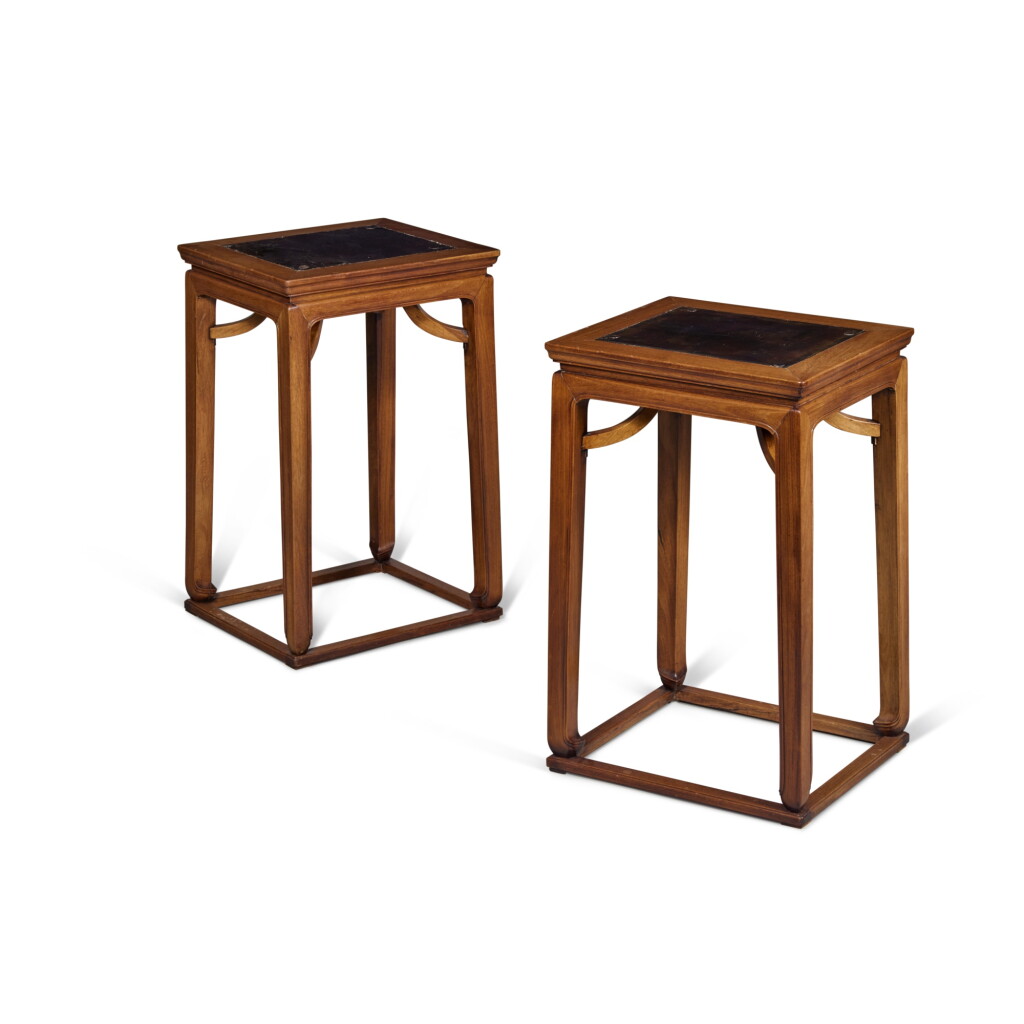
A pair of large 'Huanghuali' rectangular incense stands (Xiangji), 17th / 18th century or later | 十七 / 十八世紀或以後 黃花梨有束腰長方香几一對
Auction Closed
March 20, 05:40 PM GMT
Estimate
50,000 - 70,000 USD
Lot Details
Description
(2)
Height 33 in., 83.8 cm; Width 21½ in., 54.6 cm; Depth 19 in., 48.2 cm
Australian Private Collection.
Robert Hatfield Ellsworth, New York, circa 1961.
The Biddle Collection
來源:
澳大利亞私人收藏
安思遠,紐約,約1961年
Biddle 收藏
Robert Hatfield Ellsworth, Chinese Furniture, Hardwood Examples of the Ming and Early Qing Dynasties, New York, 1970, pl. 82.
出版:
安思遠,《Chinese Furniture, Hardwood Examples of the Ming and Early Qing Dynasties》,紐約,1970年,圖版82
Tall, sturdy, and elegant forms such as the present pair were used as supporting stands for incense burners during rituals or prayers. A depiction illustrating the typical use of these forms appears in a Yuan Dynasty painting, Vimalakirti and the Doctrine of Nonduality by Wang Zhengpeng (c. 1280-1329), from the Metropolitan Museum of Art, New York, where a Buddhist lion-shaped burner with a lotus stand is placed on a tall table, elegantly draped with an intricate, jewel-encrusted fabric, see Sarah Handler, Austere Luminosity of Chinese Classical Furniture, Berkeley, 2001, p. 296, fig. 17.1. As described in Zhusheng bajian (Eight discourses on a healthful lifestyle) by late Ming literati Gao Lian (1573-1620), stands such as the present example, could serve as supports for other functions, from displaying stones or strange rocks to presenting citrus fruit, and flower-filled vases, in addition to holding an incense burner.
Wang Shixiang, in Connoisseurship of Chinese Furniture, vol. I, Hong Kong, 1990, pp 52-54, expounds on the importance of incense stands, 'In wealthy homes, they were placed in large halls to support censers where all types of exotic fragrances including flower and plant petals, and animal essences were burned,' and continues, 'in temples as well as in private homes, incense stands were designed to fit the scale of the room. This rule was echoed in the Lu Ban Jing which emphasized that incense stands should be in proportion to the room in which they were placed.' Focusing on the significance of their primary function as stands for censers, Sarah Handler (ibid.) examines the use of incense for inspiration, explaining, 'When a scholar prepares to write a poem, paint a picture, or play the zither - activities that assume rapture - incense is indispensable. It is a spiritual stimulant that, when mixed with rare feeling and inspiration, dissipates gloom that would otherwise paralyze the artist's creativity.'
Attesting to the importance of the form, numerous examples of incense stands of various forms can be found in the Palace Museum, Beijing, illustrated in The Complete Collection of Treasures of the Palace Museum - Furniture of the Ming and Qing Dynasties (II), Hong Kong, 2002, pp 167-81, nos 149-63. For examples of how these incense stands would be used in-situ in the Palace, see Ming Qing Gong Jia Ju Da Guan (A Collection of Court Furniture of the Ming and Qing Dynasties Housed in the Palace Museum), Beijing, 2006, pp 668-69, fig. 774, p. 681, fig. 778, and p. 685, figs 780-1. A pair of related stands, lacking the brown lacquer inset panels, from the collection of Sir Joseph Hotung, was sold in these rooms, 22nd March 2023, lot 543. A single table with a burl wood inset sold in our Hong Kong rooms, 7th October 2015, lot 110. See also a similar table with a huamu inset sold at Christie’s New York, 21st March 2013, lot 929.