
Property from a New York Private Collection
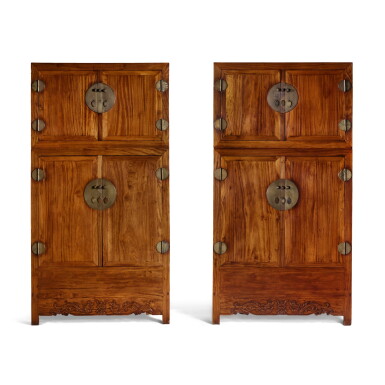
A pair of 'huali' compound cabinets (Sijiangui), 17th / 18th century | 十七 / 十八世紀 花梨雕雙龍紋四件頂箱櫃成對
Auction Closed
March 20, 05:40 PM GMT
Estimate
100,000 - 150,000 USD
Lot Details
Description
(4)
Height 105½ in., 268 cm; Width 55¾ in., 141.5 cm; Depth 22⅛ in., 56 cm
Sotheby’s New York, 15th June 1983, lot 37.
來源:
紐約蘇富比1983年6月15日,編號37
The present imposing pair of cabinets conveys the sophistication of the owner as well as the skills of a master cabinet maker. The towering rectangular forms are ingeniously offset by the shaped horizontal aprons, each deftly carved with a lively pair of confronting chilong centered by a stylized shou character. The formidable size of the cabinets undoubtedly would have impressed visitors, who could only speculate about the fabulous treasures contained within them.
These massive cabinets, often produced in pairs, are the largest type of furniture produced by Ming and Qing cabinet makers. Composed of a tall, square-corner, two-door cabinet with a smaller, similarly formed chest fitted on top, sijiangui emblemizes the functionality, durability, elegance, and simplicity characteristic to classical Chinese furniture. Displayed in inner reception halls or kept in the women's private quarters, their sheer size and angular silhouette were designed to impress. In a passage from the 18th century novel Honglou meng [The Dream of the Red Chamber], Granny Liu, an elderly country woman describing her first impression of the furniture in the Jia family compound enthuses, 'They say that 'great families live in great houses' and truly when I first went into Your Ladyship's apartment yesterday and saw those great chests and cupboards and tables and beds, they took my breath away. That great wardrobe of yours is higher and wider than one of our rooms back home'.
Chinese garments, never hung, were carefully folded into flat rectangles, and stacked in cabinets protected from sunlight, moisture, insects, and other factors that might damage costly silks and furs. The large size of these cabinets provided ample space for treasured textiles and other valued items for both daily, seasonal, and occasional use. Ming dynasty novel Jin Ping Mei [Plum in the Golden Vase], reveals that lady's fur coats were kept in large cabinets (da chu) that could be locked. The upper chests, less accessible would have been ideal for longer-term storage.
The Victoria and Albert Museum in London has a similar large pair of compound cabinets with shaped and carved aprons, but with four-panel fronts and of huanghuali, attributed to the Ming dynasty (accession no FE.73.1983). Compare also two pairs of compound cabinets, one with shaped but plain aprons and the second made of camphor wood and the apron carved with chrysanthemums, formerly in the Museum of Classical Chinese Furniture in California, illustrated in Sarah Handler, 'Proportion and Joinery in Four-part Wardrobes', Chinese Furniture. Selected Articles from Orientations 1984-1999, Hong Kong, 1999, pp 36-7, pls 1 and 2. Two similar huanghuali examples were sold in our Hong Kong rooms, 9th October 2020, lot 88 and a single cabinet with a shaped apron, 7th October 2015, lot 122. See also two pairs sold in these rooms, a pair with plain aprons, 15th March 2016, lot 42 and a pair with carved aprons and stands, 16th September 2009, lot 10.
此對櫃體現主人品味非凡,並聘名匠製作家具,想必為大富人家。 櫃呈矩形,與水平牙條曲綫巧妙相對,牙條巧雕雙龍、中心雕抽象壽字紋,匠心盡顯。櫥櫃尺寸碩大,觀此櫃者無不嘆爲觀止,令人不禁遙想櫃中所藏珍品。
縱覽明清木櫃,當數頂箱櫃最為敦碩,多數成對製作。方角大櫃上設較小頂箱,實用耐久,簡雅素麗,堪稱中式家具儀範。 頂箱櫃或置於內廳,或立於閨房,尺寸醒目,輪廓挺拔,引人油然嘆羨。《紅樓夢》中,村嫗劉姥姥入大觀園,生平頭一回見到賈府家具,只道:「人人都說大家子住大房,昨兒見了老太太正房,配上大箱、大櫃、大桌子、大床,果然威武。那櫃子比我們一間房子還大還高。」
中式衣物不興懸掛,而是折疊平整後放入櫃中,避免陽光、濕氣、昆蟲等損毀珍貴絲綢皮革。此類櫃尺寸龐大,足夠空間存放日常、季節性及偶爾使用之珍貴織品和其他貴重物品。據《金瓶梅》述,婦人所穿貂皮大襖放於帶鎖大櫥裡。頂箱位置存取物件不易,故宜儲放不常用之物。
倫敦維多利亞和阿爾伯特博物館珍藏一對相近作例,牙條造型雕刻紋飾優美,唯正面共四櫃門,由黃花梨木製成,斷代明朝(藏品號 FE.73.1983)。另比兩對例,一對,牙條造型優美,未施雕飾,另一對,樟木造,牙條雕菊花,原中國古典家具博物館所藏,加利福尼亞,見 Sarah Handler,《Proportion and Joinery in Four-part Wardrobes》,刊於《Chinese Furniture. Selected Articles from Orientations 1984-1999》,香港,1999年,頁36-37,圖版1及2;香港蘇富比曾售兩例,黃花梨木造,其一售於 2020年10月9日,編號 88 ,另一單櫃作例售於 2015年10月7日,編號122。另可參考紐約蘇富比出售兩對例,一對牙條無紋飾,售於 2016 年 3 月 15 日,編號 42,一對牙條雕紋飾,連底座,2009 年 9 月 16 日,編號 10。