
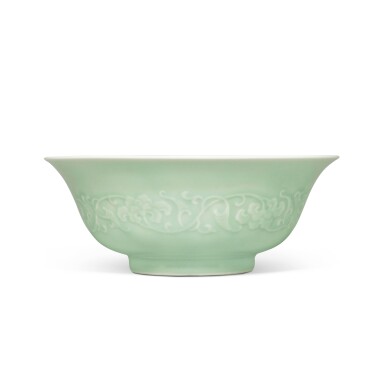
A fine and rare celadon-glazed 'floral' bowl, Mark and period of Yongzheng | 清雍正 粉青釉淺浮雕纏枝花卉紋盌 《大清雍正年製》款
Auction Closed
March 20, 05:40 PM GMT
Estimate
60,000 - 80,000 USD
Lot Details
Description
the base with a six-character mark in underglaze blue within a double circle
Diameter 8¾ in., 22.3 cm
Collection of Carl Gimbel (1881-1946).
來源:
Carl Gimbel (1881-1946) 收藏
The present bowl is remarkable for its lustrous glaze, elegant form and finely delineated floral scrolls to the exterior, epitomizing the celebrated qualities of sophistication and perfection in Yongzheng porcelains. The luminous, jade-like quality of the celadon glaze, which is deeply rooted in the ceramic tradition of the Song dynasty, encapsulates the Emperor's penchant for these early wares and his insistence on outstanding quality.
This bowl belongs to a special group of celadon-glazed bowls, all of this form and size, but with varying design band decoration, made on the order of the Qing Court catering to the Emperor's sophisticated taste and fondness for elegant monochrome wares. A closely related Yongzheng celadon bowl from the collection of Professor Edward T. Hall, inventory no. 541, carved with a ruyi head design, illustrated in Sotheby's Hong Kong Twenty Years, Hong Kong, 1993, cat. no. 314, was sold in our Hong Kong rooms, 2nd May 2000, lot 527. Compare also a similar bowl from the collection of Ira and Nancy Koger, sold in these rooms, 27th November 1990, lot 29. See another decorated with the Eight Buddhist Emblems, sold most recently in our Hong Kong rooms, 9th October 2020, lot 98.
Carl Gimbel (1881-1946) arrived in China in 1908, the last years of the Qing dynasty, to set up the Imperial Waterworks in Beijing, and was professor of mathematics and statistics at the Imperial University, Beijing. In the mid 1910s, he was appointed a district superintendent in the Chinese salt administration, where he served in different part of China until the late 1920s, when he retired and returned to Denmark. He was awarded the rank of Mandarin of the third degree, a rare honor for a foreigner.