
Property from a Private American Collection
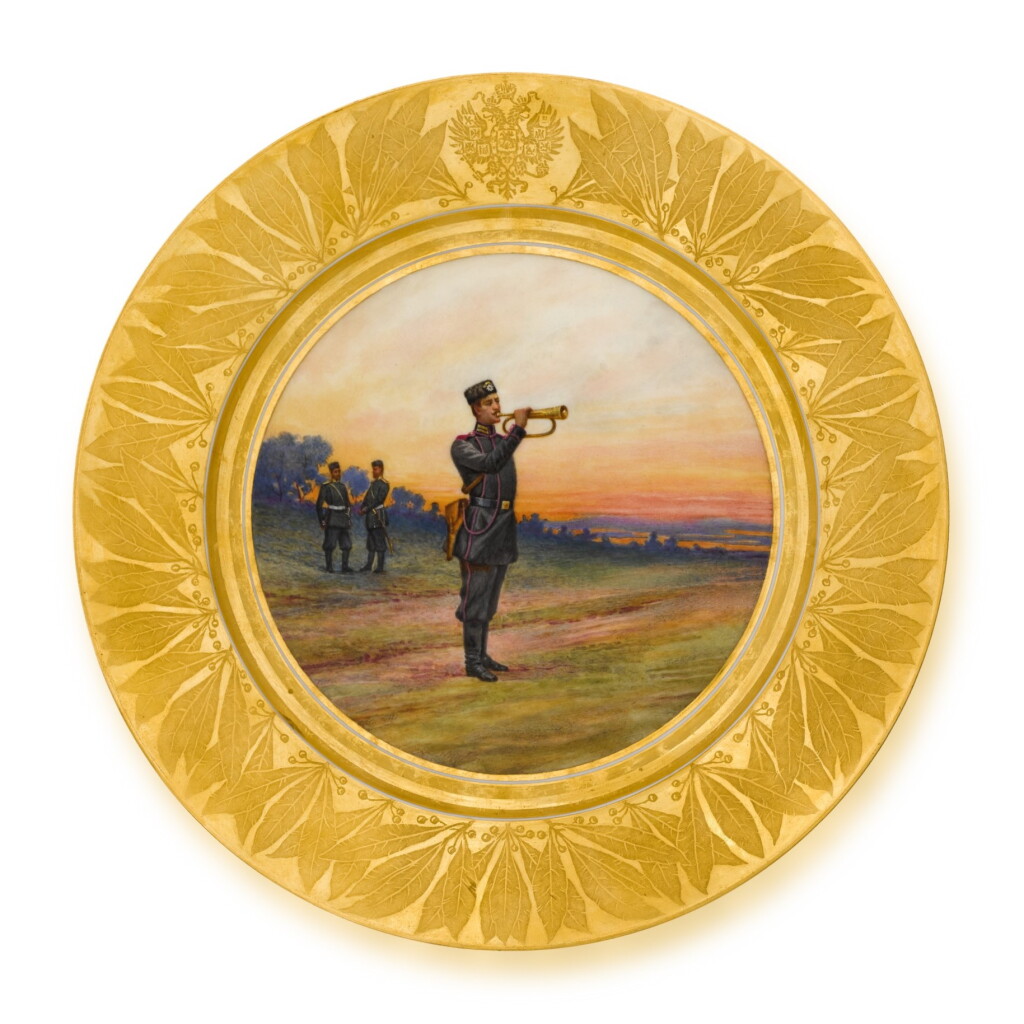
1st Rifle Battalion of His Majesty Life-Guard: a military porcelain plate, Imperial Porcelain Factory, St Petersburg, period of Nicholas II, 1908-1909
Auction Closed
November 26, 05:37 PM GMT
Estimate
10,000 - 15,000 GBP
Lot Details
Description
the border gilt with ciselé laurel wreaths culminating at an imperial double-headed eagle at the upper centre, the cavetto painted with a figure in the foreground sounding the bugle call at sunset, two figures conversing in the background, inscribed on the reverse 'Л.Гь 1-и Стрелковый его величества бат 1893', painted by Y. Goriaev after a design by V.V. Mazurovsky, with green crowned cypher for Nicholas II, signed and dated
diameter 24.3 cm; 9 5/8 in.
As confirmed by the signature, the present plate is Imperial porcelain painter Goriaev's rendition of a work by history painter Viktor Mazurovsky (1859-1923). Polish-born Mazurovsky was well-known for his action-packed battle scenes, often adopting an equally dramatic red sunset as a backdrop to the events in the foreground, such as is depicted here behind the bugle player.
1st Battalion of His Majesty’s Life Guards
The Life-Guards can be traced back to the early 18th century, during the reign of Peter the Great. Initially created to serve as the personal guard of the Emperor, the Life Guards quickly evolved into a highly trained and prestigious segment of the Russian military.
The 1st Battalion of His Majesty’s Life-Guards was part of a larger regiment that included multiple battalions, each tasked with different responsibilities ranging from ceremonial duties to active military engagements. The 1st Battalion was renowned for its rigorous training and strict discipline, ensuring that its soldiers were always ready for any duty required by the Emperor.
This military unit exemplified the grandeur and discipline of the Imperial Russian army. Through their dedication to duty, impressive uniforms, and unwavering loyalty to the Emperor, they played a pivotal role in both the defence and the ceremonial life of the Russian Empire. Their legacy is a testament to the complex interplay between military prowess and royal authority in the waning years of imperial Russia.
The Military Service
In 1827, shortly after the beginning of his reign, Emperor Nicholas I commissioned the first series of 120 plates as part of a military service, possibly inspired by an earlier series of similar wares produced at KPM in Berlin. The Imperial Porcelain Factory, who were charged with the commission, executed two versions of each plate, one intended for the Emperor, and a second for the Tsarevich. Nicholas I later sent more than 200 plates to his father-in-law, King Friedrich Wilhelm of Prussia, who incorporated them in the decoration of his new pavilion at Charlottenburg Palace in Berlin. Military plates remained popular; production continued uninterrupted throughout the 19th century, the last additions made during the reign of Nicholas II, with designs being changed when uniforms were altered.
Their subjects came from a variety of sources, including Sobranie mundirov rossiiskoi imperatorskoi armii (A Collection of Uniforms of the Imperial Russian Army), published in 1830 with lithographs by military draftsmen P. Alexandrov and Lev Belousov. Later on, the factory painters also turned to the series of watercolours by Piratsky depicting Changes in the Clothing and Arms of the Russian Imperial Army during the Reign of Alexander Nicholayevich. Piratsky’s series was a supplement to the famous work by the military historian Alexander Viskovatov Historical Descriptions of the Clothing and Arms of the Russian Army. Many of the original watercolours are held in the Russian Museum in St Petersburg and the series was continued by Pyotr Balashov (1853-1888) after Piratsky’s death. Key Russian historical painters Viktor Vikentevich Mazurovsky and Adolf Iosifovich Charlemagne (1826-1901) also provided much of the imagery which was used as a springboard for the finest painters-decorators from the period working at the Imperial Porcelain Factory, represented in this group from a private American collection (lots 214-217) by Mironov, Tarachkov, Goriaev and Kirsanov. Sometimes, the Imperial Porcelain painters used the watercolours to inspire vignettes and poses on the plates, rather than copying them directly, creating interesting comparisons between the source material and final product.
You May Also Like


