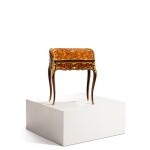
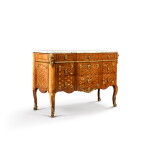
A Louis XIV Gilt-Bronze Mounted Tortoiseshell-Inlaid Ebony, Brass and Blue Stained Horn Boulle Marquetry Small Bureau-Plat attributed to André-Charles Boulle, circa 1700
Auction Closed
February 3, 09:38 PM GMT
Estimate
60,000 - 80,000 USD
Lot Details
Description
alterations to top with later elements; centre of frieze previously with an additional mount
height 26 ½ in.; width 32 in.; depth 15 ¼ in.
67 cm; 81.3 cm; 38 cm
This lot contains endangered species and requires a permit for export outside the US. Please refer to the Department and conditions of business pertaining to endangered species for further guidance.
The collection of François-Michel Haranc de Presle, rue du Sentier, Paris and offered in his sale in Paris, 16 April 1792, lot 409. Subsequently sold in his second sale, Paris, 30 April 1795, lot 257
Almost certainly acquired by either George, 2nd Earl of Warwick (d.1816) or his son Henry, 3rd Earl of Warwick (d.1855) for Warwick Castle, Warwickshire
Thence by descent with the Earls of Warwick until sold anonymously, ('The Property of a Nobleman'), Christie's Geneva, 18 November 1974, lot 43
Sotheby's New York, 13 October 1983, lot 481, acquired by Barbara Piasecka Johnson
Christie's New York, 26 October 1994, lot 134
Christie's New York, 2 November 2000, lot 247
Elegance and Wonder: Masterpieces of European Art from the Jordan and Thomas A. Saunders III Collection, Virginia Museum of Fine Arts, Richmond, Virginia, May 2022-October 2023
Alexandre Pradère, French Furniture Makers, Paris 1989, p. 108 no.299
Alexandre Pradère, 'Harenc de Prese, un banquier collectionneur au Siècle des lumières', L'Estampille-L'Objet d'art, December 2008, p.77
Giacomo Wannenes, Mobili di Francia, Milan, 1988, cat. 155, pp. 90 and and 145
Cabinetmaker to Louis XIV, the Ebéniste, Ciseleur, Doreur et Sculpteur du Roi André-Charles Boulle (1648-1732) was renowned not only for perfecting the technique of brass and tortoiseshell marquetry that came to bear his name, but also for being a great innovator in furniture design, popularising and possibly inventing two of the most iconic types of French furniture: the commode and the bureau plat. The latter model, in the form of a writing desk with a shallow frieze of three drawers on four gently curved legs, referred to in contemporary inventories as pieds de biche, was developed by Boulle in the early years of the 18th century, and is first recorded visually in a portrait of Cardinal Bossuet by Hyacinth Rigaud executed between 1700 and 1705 (Paris, Louvre).
This table relates in size and design to another small writing table in Boulle marquetry with satyr's head masks at the corners, stamped by Dubois as restorer and previously in the Lady Baillie collection at Leeds Castle and subsequently in the Akram Ojjeh collection, sold Sotheby's Monaco, 25-26 June 1979, lot 10 [fig. 1]. Both tables are considerably smaller than the bureaux plats most frequently produced in Boulle's workshop with widths ranging from 120 cm to nearly 2 metres, and they may have been created as an early prototype of the model, when Boulle was working out his ideas for the form and its ornamental elements on a more diminutive level before turning to a larger scale. It relates to a drawing attributed to Boulle in the Musée des Arts Décoratifs, Paris showing a mid-sized bureau plat with a similar mask on the central frieze drawer and bearded satyr's masks angle mounts heading the legs (Inv. 723 B2; illustrated in Jean Nérée Ronfort, André-Charles Boulle (1642-1732): Un nouveau style pour l'Europe, Paris 2009, no.66 p.329).
The satyr's mask mounts, derived from a modello by the sculptor François Girardon, appear on several surviving Boulle bureaux plats, including examples in the Frick Collection, Getty Museum and Windsor Castle, but the distinctive flat acanthus leaf sabots on the lower legs present on the offered lot were only used by Boulle on a few occasions for his writing desks, such as a version at Chatsworth. The combination of satyr mask and acanthus feet mounts are however frequently seen on console tables known as tables à six pieds, a highly popular model Boulle developed circa 1700-1705 and examples of which include a pair in the Wallace Collection (F424-5) and another pair formerly in the Zilkha collection, sold Sotheby's New York, 20 November 2020, lot 89 [fig. 2]. The use of blue-stained horn inlay is relatively rare in Boulle's work but is found in some of his earlier tables decorated with both floral and tortoiseshell and brass and pewter marquetry, two examples of which dated to the 1680s are in the Getty Museum (71.DA.100 and 83.DA.22), and another example was formerly in the Akram Ojjeh and Riahi collections, sold Christie's New York, 2 November 2000, lot 40. Also infrequently encountered is the satyr mask escutcheon with sunburst headress on the centre of all four sides, but an identical mount does appear on a kneehole desk attributed to Boulle in the Frick Collection, of an earlier eight-leg form dated c.1695 [fig.3] (1918.5.101; illustrated in Theodore Dell, The Frick Collection: Furniture, Vol. V, New York 1992p. 187-203). This mask also appears on a design for an inkstand in Plate 3 of Boulle's Nouveaux Deisseins de Meubles et Ouvrages de Bronze et de Marqueterie published by Mariette in c.1720 [fig.3]. All these elements point to a creation date of circa 1700-1705 for the Saunders table.
HARENC DE PRESLE
In the eighteenth century this table was in the renowned collection of François-Michel Haranc de Presle (1710-1802), scion of a wealthy banking family who received a double-edged mention in the memoirs of the historian and encyclopédiste Jean-François Marmontel (d.1799):
Mme Harenc avait un fils unique, aussi laid qu'elle est aussi aimable. C'est ce Mr de Presle qui, je crois, vit encore et qui s'est longtemps distingué par son goût et par ses lumières parmi les amateurs d'art.
In 1753 Haranc de Presle acquired an hôtel particulier at 24, rue du Sentier in the Right Bank of Paris (today no.33), and spent the following five decades filling his residence with an impressive collection of paintings by Italian, French and Flemish masters including Rubens, Watteau and Ricci, sculpture by Girardon and Clodion, gilt-bronze mounted marble and porcelain vases and 'meubles magnifiques' by Boulle, many acquired through the marchand-mercier Claude-François Julliot (Luc Vincent Thiéry, Guide des amateurs et des étrangers voyageurs à Paris, 1787, p.443-48). Suffering from blindness in later life, Haranc decided to put much of his collection up for auction in a sale organised by Jean-Baptiste-Pierre Lebrun on 16 April 1792, with no fewer than sixteen lots of case furniture described as meubles de Boule; ten lots of pedestals, brackets and bases described as meubles de marqueterie by Boulle; six lots catalogued as genre de Boule and one attributed to Boule le Fils. The Saunders table was part of the group said to be by Boulle and offered as lot 409, described as 'attractive an precious' and 'perfectly put together':
Une jolie table à quatre pieds, à masque de satyre, les pieds triangulaires sont enrichis d’ornemens sur les corps, le tiroir est à mascaron d’hommes, fond de cuivre à dessins d’écaille lapis; ce joli et précieux morceau est d’un ensemble parfait
Like numerous lots in the sale, the table failed to sell, a victim of the auction's highly inauspicious timing at the height of the French Revolution, with the Royal Family effectively imprisoned in the Tuileries and the revolutionary government on the brink of war with its European neighbours. A second sale of the collection was held in relatively more favourable circumstances three years later on 30 April 1795, and the bureau was sold as lot 257. Other items of Boulle furniture from the sale that have been securely identified today include a bureau en pente recently in the Al Thani collection at the Hôtel Lambert, sold Sotheby's Paris, 11 October 2022, lot 16 [fig.4]; a pair of cabinets by Dubois incorporating earlier Boulle panels formerly in the collection of Jacques Garcia at the château de Champ de Bataille, Normandy, sold Sotheby's Paris, 16 May 2023, lot 19 [fig.5]; and a table signed Julliot from the Wildenstein Collection, sold Christie's London, 15 December 2005, lot 190.
WARWICK CASTLE
At some stage this bureau passed into the collection of the Earls of Warwick at Warwick Castle, one of England's most iconic and beloved historic properties, described by Sir Walter Scott as 'the fairest monument of ancient and chivalrous splendor which yet remains uninjured by time'. Originally constructed as a timber structure on the banks of the River Avon in Warwickshire by William the Conqueror in 1068 and deeded to Henry de Beaumont, the first Earl of Warwick, in 1088. In the ensuing centuries the edifice was reconstructed and enlarged in stone as an imposing fortress by the de Beaumont and later the de Beauchamp families, who played an influential role as Kingmakers in the turbulent late Middle Ages, before reverting to Crown possession with the execution of Edward Plantagenet, 17th Earl of Warwick, for treason in 1499. In the 16th century it passed to the Dudley family, and subsequently in 1605 was granted by King James I to the poet and statesmen Sir Fulke Greville, later Baron Brooke (1554-1628). His descendent Francis Greville (1719-1773), 8th Baron Brooke and 1st Earl of Warwick under the title's fourth creation, undertook an important campaign of renovating the medieval building, constructing the state apartments and engaging the landscape architect Capability Brown to redesign the gardens and grounds, famously recorded in five paintings by Canaletto during his two visits to England [fig.6].
The bureau was most likely acquired by George Greville, 2nd Earl of Warwick (1746-1816) or his son Henry, 3rd Earl of Warwick (1799-1855), both avid collectors who enriched the estate's holdings with some of its most important works of art, notably the antique Warwick Vase (bought by the 2nd Earl in 1788) and the two pietre dure tables from the Venetian Grimani family (acquired by the 3rd Earl in 1829; sold Sotheby's London, 10 December 2015, lots 201-2). Like many of their aristocratic peers at the time, among them the Dukes of Buccleuch, Buckingham, and Devonshire, the Marquis of Hertford and of course the Prince Regent, the Grevilles assembled an impressive group of Boulle furniture, which had become highly fashionable among British collectors in the early 19th century.
Numerous 19th century publications such as Henry T. Cooke's An historical and descriptive guide to Warwick castle (1851) contain frequent references to fine 'buhl' tables and cabinets throughout the castle's primary apartments, and a photograph of c.1869 [fig.7] shows this table in the centre of the Blue Boudoir, in front of the fireplace over which hung a portrait of Henry VIII attributed to Holbein surrounded by woodcarvings by Grinling Gibbons.
The last Earl of Warwick to reside in the castle, Charles Greville, 7th Earl (1911-1984), transferred ownership to his son David Greville, the future 8th Earl, in 1967, and relocated abroad in 1969. David Greville sold the castle in 1978 to Madame Tussaud's, who transformed the property into a visitor attraction. Both the 7th and 8th Earls removed a significant proportion of the art collections from the castle prior to the sale, and this bureau formed part of a sequence of ten lots of Boulle furniture from auctioned anonymously in Geneva in 1984. The group also included a large bureau plat with female head angle mounts and rectangular floral and Boulle marquetry table now in the Legion of Honor Museum, San Francisco.
You May Also Like