Property from the Collection of the Late Howard Hodgkin (lots 4, 150 and 163)
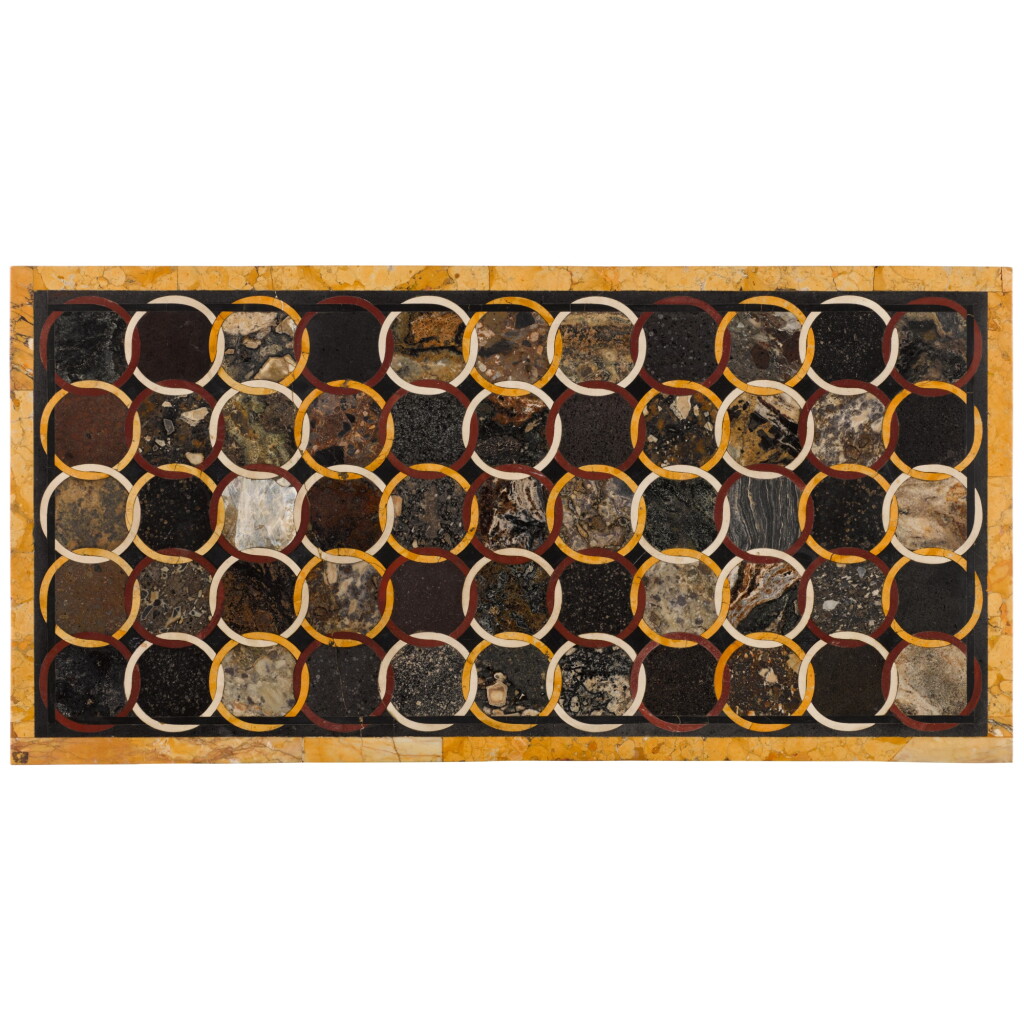
A South Italian specimen marble table top, Naples, late 18th century, on a modern base
Lot Closed
November 12, 03:43 PM GMT
Estimate
8,000 - 12,000 GBP
We may charge or debit your saved payment method subject to the terms set out in our Conditions of Business for Buyers.
Read more.Lot Details
Description
the top inlaid with interlaced red jasper, giallo antico and white marble circles enclosing volcanic marbles, with a siena marble border, with a modern metal base
137.5 by 68.5cm; 54 1/8in. x 27in.
4.5cm thick; 1 3/4in.
The use of specimen marbles arranged in interlocking rings pattern was a favoured technique among Italian marmisti, or marble workers, whose exceptional skills in marble inlay were highly esteemed by 18th-century English Grand Tourists at which time the Palladian architects were following the Italian taste for marble-topped pier tables. A renowned centre for marble tabletops like the present was Naples, suggesting that the volcanic specimens featured in this table likely originated from southern Italy.
The names of a few marmisti in Naples have now been recorded as the authors of these types of slabs, notably Giovanni Atticciati who was employed by the royal court, Tommaso Valenziano and his son Mattia and the Flemish-born Giuseppe Canart (d. 1791) who is known to have produced at least two table tops inlaid with specimen marbles and volcanic stones for the Royal Palace of Naples in the 1780s.
This particular extraordinary marble and volcanic stone top closely relates to a group of similar table tops with interlaced rings brought to England and Scotland by Grand Tourists between the second half of the 18th century and the early 19th century, including Frederick Howard, 5th Earl of Carlisle (1748-1825) at Castle Howard, Brownlow Cecil, 9th Earl of Exeter (1725-1793) for Burghley House, Lincolnshire (inv. FUR0053). A pair of pier tables with similar tops from Aske, home of Sir Lawrence Dundas (1712-1781), is illustrated in A. Coleridge, "Some Rococo Cabinet Makers and Sir Lawrence Dundas", Apollo, September 1967, p. 215.
Furthermore, similar table tops with a giallo antico border were sold at Sotheby’s London, 10 December 2003, lot 175 and at Sotheby’s, London, 28 march 2017, lot 115. Another three specimen tops were sold Sotheby’s, London, 13 June 2001, lot 53; Christie’s London, 6 July 2012, lot 3 and Sotheby’s, London, 24th October 2017, lot 150 also formerly in the collection of Howard Hodgkin.
A related top, described as “undoubtedly Neapolitan, late 18th century” is in the Museo del Prado, Madrid, inv. no. 4981, illustrated in González-Palacios, Las colecciones reales españolas de mosaicos y piedras duras, Madrid, 1990, p. 264.
You May Also Like