Property from a Private Scottish Collection
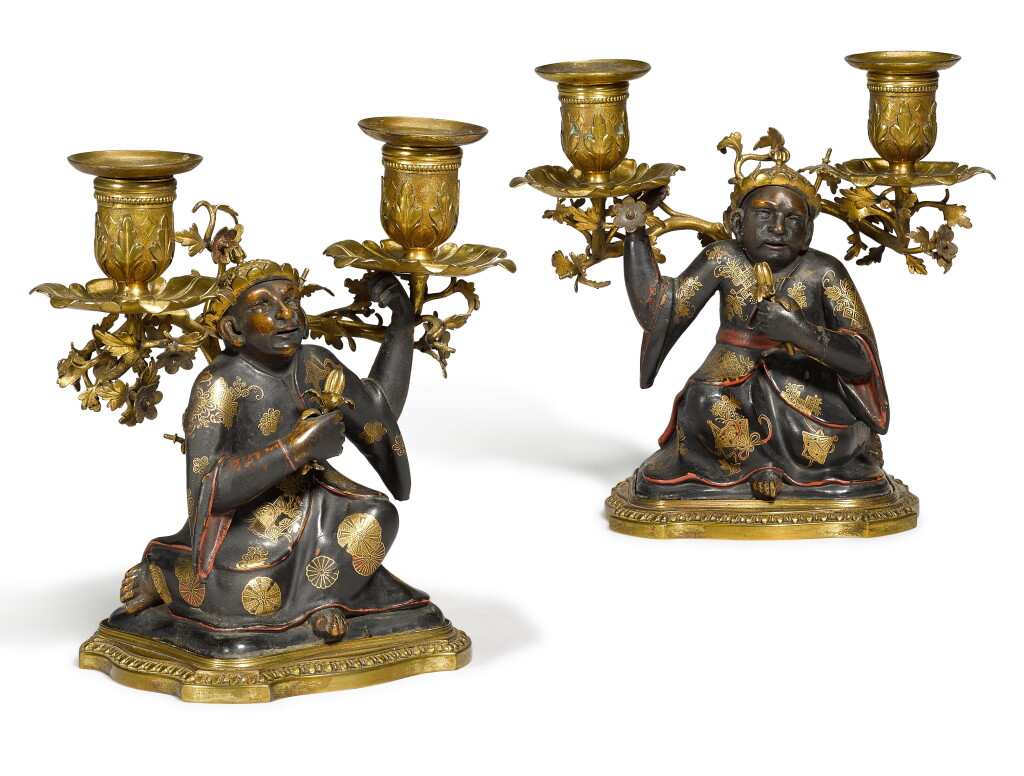
A pair of Louis XV gilt-bronze mounted polychrome japanned carved wood figural two-light candelabra, second quarter 18th century
Lot Closed
November 12, 01:16 PM GMT
Estimate
8,000 - 12,000 GBP
We may charge or debit your saved payment method subject to the terms set out in our Conditions of Business for Buyers.
Read more.Lot Details
Description
each figure carved seated holding a later gilt-bronze sprig in one hand, on a base with canted corners issuing at the back a flowering branch supporting two candleholders, one figure with a handwritten label to the underside reading ‘Ormolu sprig in hand of figure made by H. J. Hatfield & Sons 1928’
16.2cm. high, 16cm. wide, 10cm. deep
By descent in the family of the consignor.
RELATED LITERATURE
Daniëlle Kisluk-Grosheide, "The Reign of Magots and Pagods" in The Metropolitan Museum Of Art Journal, Volume 37, 2002, pp.177-197.
From 1735 onwards, Paris saw the emergence of a production of Chinese japanned figures, probably spurred on by marchands-merciers. These figures (known as pagodes or magots in French) were used extensively to decorate a multitude of extremely refined everyday objects like the present by also including paperweights, wall-appliques, clocks and chenets (see A.Forray-Carlier et M. Kopplin, Les secrets de la laque française. Le vernis Martin, cat. expo., Paris, 2014, pp.100-103). This exotic touch on Western objects illustrates the taste for chinoiserie in the first part of the 18th century.
The decoration of these magots in polychrome varnish imitating lacquer could be the work of the Martin varnishers' workshop, as the name Martin recurs in the descriptions in the sales catalogues of the period. This relief technique, sometimes also referred to as "japonné" or "en Japon", is in contrast to the "faux" cited in Guillaume Martin's after-death inventory in 1749: "quatre figures chinoises en faux, prisées 18 livres pièces ", the term "faux" describing a varnish of inferior quality.
Related candelabra are in the collections of the Metropolitan Museum of Art in New York (inv. 1982.60.87, .88) and in the Musée Carnavalet in Paris (inv. MB425-2 and MB425-1). A pair of candelabra each with two figures was sold at Christie’s, New York, 18th October 2002, lot 361 and another sold at Christie’s (illustrated in Daniëlle Kisluk-Grosheide, "The Reign of Magots and Pagods" in The Metropolitan Museum Of Art Journal, Volume 37, 2002, p.185).
You May Also Like