Property from the Hohler Collection
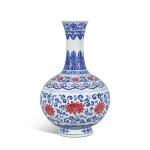
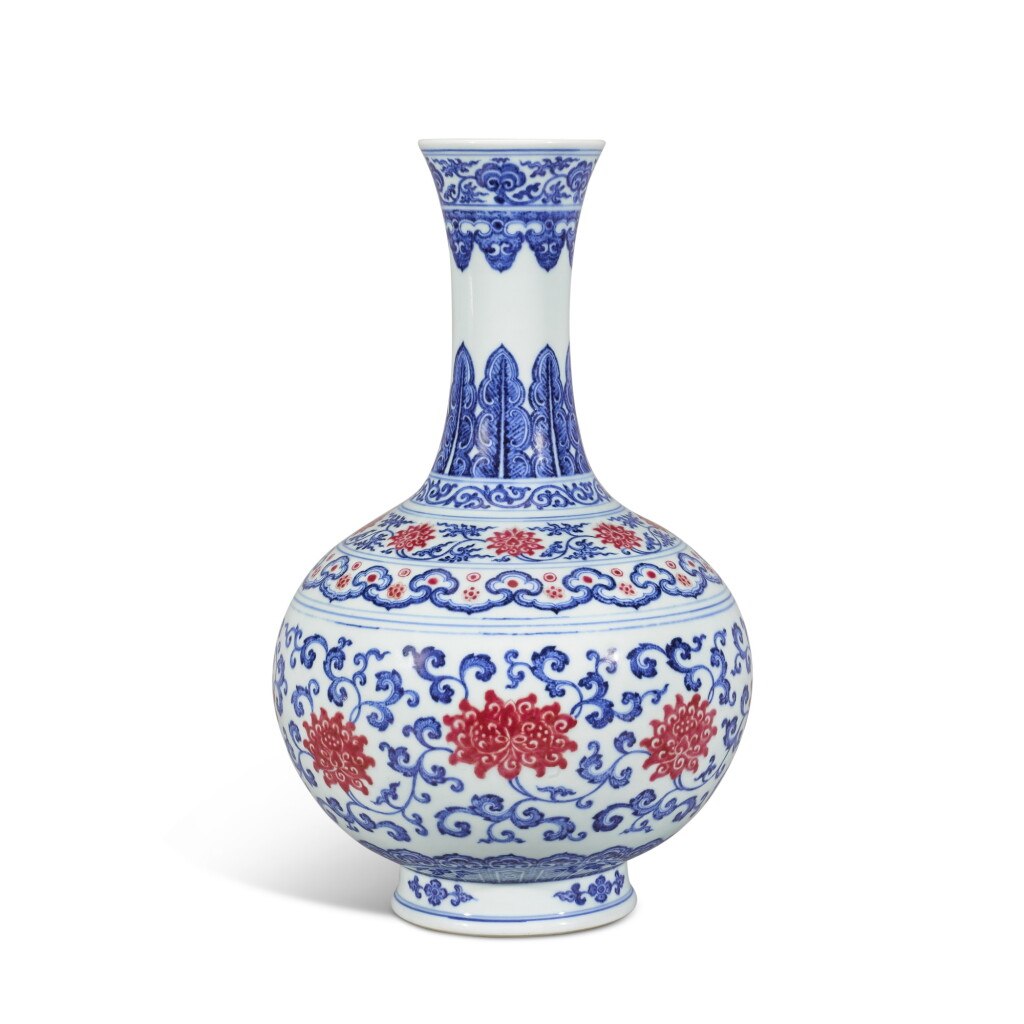
An exceptionally rare underglaze-blue and puce-enamelled 'lotus' bottle vase, Seal mark and period of Qianlong
Auction Closed
November 6, 03:25 PM GMT
Estimate
60,000 - 80,000 GBP
Lot Details
Description
the base with a six-character seal mark in underglaze blue
Height 37.4 cm, 14¾ in.
Collection of Sir Thomas Beaumont Hohler (1871-1946), and thence by descent.
This remarkable vase is a testament to the illustrious tradition of Chinese imperial porcelain production: embracing the innovations and technical advancement of the day while paying homage to the tastes and techniques of days gone by.
Although the shangping form of this vessel is of eighteenth century origin, its floral design, ruyi scrolls and deep variegated blue hues – intended to imitate the ‘heaped-and-piled’ effect of earlier wares – are reminiscent of designs from the height of porcelain production in the Ming dynasty. Compare a Yongle blue-and-white yuhuchunping from the collection of Edward T. Chow (1910 - 1980), which features a similar lotus design and decoration around the neck, sold twice at Christie’s Hong Kong, 1st May 1995, lot 642, and again, 3rd December 2021, lot 2941.
This vibrant combination of red and blue also finds its origins in earlier wares. Monumental vessels painted with contrasting designs in underglaze blue and copper red were first made in Jingdezhen as early as the Yuan dynasty. See, for example, the famous Yuan dynasty guan jar from the Sir Percival David Collection held in the British Museum, London, illustrated in Ye Peilan, Yuan Ciqi [Yuan dynasty porcelain], Beijing, 1998, pl. 155. However, these copper red pigments were (and are) notoriously difficult to fire and required precise control of the firing temperature and kiln atmosphere. As a result, this palette – already rarely used – was largely abandoned by the end of the Xuande reign in 1435 and revived in the Qing dynasty when new techniques were finally developed to allow better control of the pigment.
Yet, even by the Qianlong period, pieces featuring blue-and-red designs were frequently misfired and lacked the desired vibrancy of tone. Even in ‘successfully fired’ pieces, one frequently finds under- or overfired splotches of grey and green within the vivid reds; a fact much bemoaned by the Emperor himself. See, for example, a court record from 1738 in which Qianlong complained that the colour of a copper red meiping was unsatisfactory; see Feng Xianming, Zhongguo gu tao ci wen xian ji shi / Annotated Collection of Historical Documents on Ancient Chinese Ceramics, Taipei, 2000, p. 232.
Never willing to settle for lower standards, the Imperial Workshop devised an alternative to enhance these imperfect pieces: puce enamels. Applied directly on top of the copper red in glossy coats, these pink enamels provided the pieces with an enchanting splash of brightness. As seen on the present lot on the upper petals of the larger flowers and on the smaller, more stylised ones at the shoulder, the intention was not necessarily to cover up the original underglaze design, rather to enhance its beauty and create a more harmonious composition.
A very small group of related Qianlong vases is known with similar forms and designs to the present lot, but in a palette of underglaze blue and copper red without the addition of pink enamels: one in the collection of the Tibet Museum, Lhasa, illustrated in Xizang bowuguan cang Ming Qing ciqi jingping / Ming and Qing dynasties ceramics preserved in Tibet Museum, Beijing, 2004, pl. 122; another sold in our Hong Kong rooms, 17th May 1988, lot 198.; and another from the collection of Katharina (1867-1967) and Joachim S. (1863-1932) Van Wezelsold, sold in our New York rooms, 23rd September 2020, lot 544.
Rarer still are pieces of this design with the addition of puce enamels. Only one other vase of this design with enamels seems to have appeared on the market, exhibited at the Long Museum exhibition, Sheng Qing de shijie: Kang Yong Qian gongting yishu da zhan / Times of Prosperity: The Imperial Art of High Qing, Shanghai, 2015, p. 279. For other examples of puce enamels applied over underglaze red, see a rare pear-shaped vase of Yongzheng mark and period with related red lotus sprays from the Qing court collection, illustrated in The Complete Collection of Treasures of the Palace Museum: Blue and White Porcelain with Underglaze Red (III), Shanghai, 2000, pl. 229 together with an almost identical piece sold at Christie’s New York, 20th September 2002, lot 330; also compare a meiping, with a related ruyi band at the foot and similar lotus flowers enhanced with puce enamel, sold in our Paris rooms, 13th June 2012, lot 186.
You May Also Like