Property from the Hohler Collection
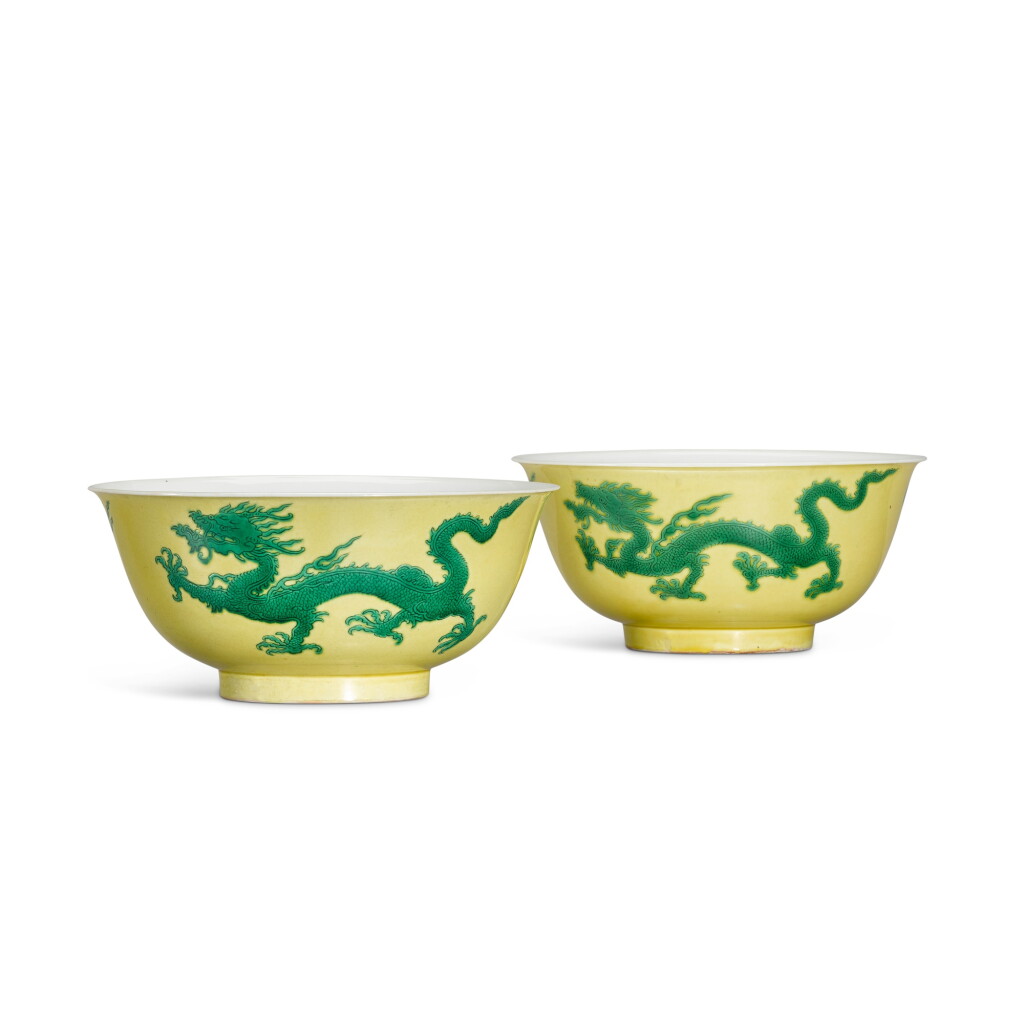
A rare matched pair of yellow-ground green-enamelled 'dragon' bowls, Marks and period of Kangxi
Auction Closed
November 6, 03:25 PM GMT
Estimate
20,000 - 30,000 GBP
Lot Details
Description
the base of each with a six-character mark in underglaze blue within a double circle (2)
Diameters 15 cm, 5⅞ in.
Collection of Sir Thomas Beaumont Hohler (1871-1946), and thence by descent.
Compare a similar bowl in the National Palace Museum, Taipei, published in the Illustrated Catalogue of Ch'ing Dynasty Porcelain in the National Palace Museum: K'ang-hsi Ware and Yung-cheng Ware, Tokyo, 1980, pl. 32; a second from the Powell-Cotton Museum, Birchington-on-Sea, included in the Oriental Ceramic Society's exhibition Iron in the Fire, Ashmolean Museum, Oxford, 1988, cat. no. 76; a third in the Baur Foundation, Museum of Far Eastern Art, Geneva, illustrated in John Ayers, The Baur Collection: Chinese Ceramics, vol. IV, Geneva, 1974, no. A543; and a fourth example, sold in our Hong Kong rooms, 30th April 1996, lot 520.
-----------------------------------------------------------------------------------------------------------------------------------------------
This extensive group of fine Qing dynasty porcelain stands as a tribute to the great diplomat, traveller and collector, Sir Thomas Beaumont Hohler (1871-1946). Born a short distance from our salerooms in the parish of St. George Hanover Square, Sir Thomas dreamed of exploring beyond the smog of Victorian London. Reminiscing on his youth in his autobiography, Diplomatic Petrel (1942), Hohler recalled “longing to see the Orient.” This longing, that first brought Sir Thomas to the diplomatic service in 1894, continued to motivate him throughout his career and surely inspired this fine collection of imperial porcelain which remained his treasured possession until his death in 1946.
From his first days as an aide in Constantinople (now Istanbul), Sir Thomas recalled being struck by the beauty and mystery of art abroad. Taking full advantage of his diplomatic status, he travelled widely wherever he was stationed and even managed to gain access to the very heart of the Sultan’s treasury where he first marvelled at the beauty of Chinese porcelain.
However, Hohler’s journey was far from over in Constantinople. From Egypt to Russia, from Eritrea to Japan, Sir Thomas supported British government interests across the world with discernment and a pursuit of global good. Stationed in Japan from 1902 to 1905, Hohler managed Russo-Japanese relations in Manchuria even at a time when war seemed imminent and many of his colleagues had long fled for safer waters. It was also during this time in Japan that Hohler first began assembling the present collection. Dining with diplomats like Sir Claude Macdonald and Japanese friends from his time at Cambridge, Hohler found himself surrounded by Tokyo high society and, like many of his companions, found pleasure in the pursuit of collecting. Likely consulting the great Japanese dealers of the day in Tokyo and beyond, Hohler took full advantage of the fine works still coming to market in the early years of global collecting and acquired a number of excellent pieces; many of which were then still rarely found outside of China.
Working at the turn of the twentieth century, Hohler faced a rapidly changing modern world emerging from the haze of colonial rule and wrapped up in the chaos of revolution and war. Perhaps the crowning achievement of his illustrious career, Hohler is credited with the interception of the famous ‘Zimmerman Telegram’ that brought the United States into the First World War. Revealing that Germany would soon begin full-scale submarine warfare in the North Atlantic and would turn to Mexico for support should the U.S. cease in its neutrality, the discovery left President Wilson with little choice but to join the conflict and, as such, was a crucial step towards the eventual Allied victory. In a private telegram dated 21st July 1916, then Foreign Secretary Sir Edward Grey (1862-1933) was already well aware of the value of Hohler’s intelligence:
“Your personal influence has been of great advantage (...) and has helped materially to prevent irreparable trouble between the U.S. and Mexico, and the energy and ability that you have shown in most difficult circumstances are very highly appreciated by His Majesty Government.” (Diplomatic Petrel, 1942, p. 226)
Even after the War, Hohler continued to work with gusto and dedication. After leaving Mexico, he was restationed in Washington; sent to Turkey in 1918 as Minister and Political Head of the High Commission to Constantinople; to Budapest in 1920 as High Commissioner; to Bogota as head of the Commercial delegation in Colombia, and to Denmark where he served as Minister from 1928. Retiring to his beloved family home at Fawkham Manor in the Kent countryside, Sir Thomas continued dreaming of his faraway journeys and composed Diplomatic Petrel, the first volume of his tragically unfinished autobiography, in 1942.
The present collection of Qing porcelain tells the story of a figure dedicated to peace and prosperity in the final years of the age of empire. Studying these objects from another lost era of imperial splendour, one can almost picture the statesman in his study lost in thought, admiring his great collection and dreaming of his years of adventure and service.
You May Also Like


