
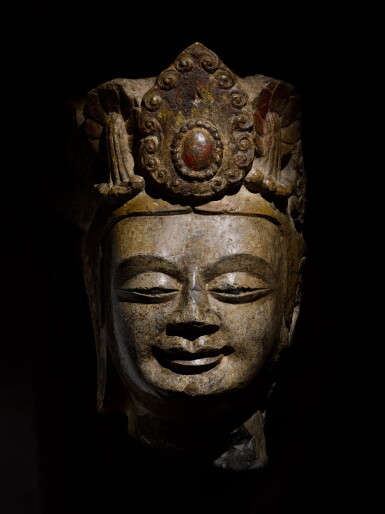
A carved limestone head of a bodhisattva, Northern Qi / Northern Zhou dynasty
Auction Closed
November 6, 03:25 PM GMT
Estimate
80,000 - 120,000 GBP
Lot Details
Description
Height 34.5 cm, 13⅝ in.
Yamanaka Shunkodo, Osaka, by 1930.
Collection of James and Marilynn Alsdorf.
Bonhams New York, 20th September 2021, lot 182.
Kobijutsu kenkyū shiryō. nihon, Yamanaka Shunkodo, Osaka, 1930, cat. no. 80.
Looking out with a serene smile, this enigmatic head is a fascinating example of late Northern Dynasties sculpture; a symbol of calm and religious devotion amidst the chaos of warring states. Although the figure’s torso has long since been lost to history, the large size of the present head is indicative of what once must have been a grand and imposing figure, likely commissioned by a wealthy local patron.
A number of figures and fragments with related ornate headpieces have been attributed to the Northern Qi period caves of Xiangtangshan in modern-day Hebei Province. Compare a head preserved in the Metropolitan Museum of Art, New York, illustrated in Chinese Sculpture in The Metropolitan Museum of Art, New York, 1944, cat. no. 28, pl. 60; and another from the Penn Museum, Philadelphia, illustrated in Osvald Sirén, Chinese Sculpture from the Fifth to the Fourteenth Century, London, 1925, pl. 475C alongside three standing figures, pls 477 and 478.
However, looking beyond the headpiece, the present lot also shares many features with the sculptural style of the Northern Zhou. With a flattened nose, large almond-shaped eyes and a face imbued with a subtle plumpness and warmth, the present lot differs somewhat from the more typical coolness of Northern Qi sculpture. Compare two heads more typical of the Northern Zhou, illustrated in Sirén, op. cit., pls 304A and B and a standing figure with a closely related headdress from the Takahashi Collection, ibid., pl. 305B. These decorative styles were, of course, neither monolithic nor confined to one specific reign, rather one observes in the exceptional sculpture of this period a vast and enthralling variance: compare, for example, the famous standing Buddha preserved in the Nezu Museum, Minato, which, while sharing many of these plump features, is nonetheless attributed to the Northern Qi; see Saburo Matsubara, Chūgoku bukkyō chōkokushi ron [Historical discussion of Chinese Buddhist sculpture], vol. 2, Tokyo, 1995, pl. 493.
You May Also Like


