
Property of a Lady | 女史收藏
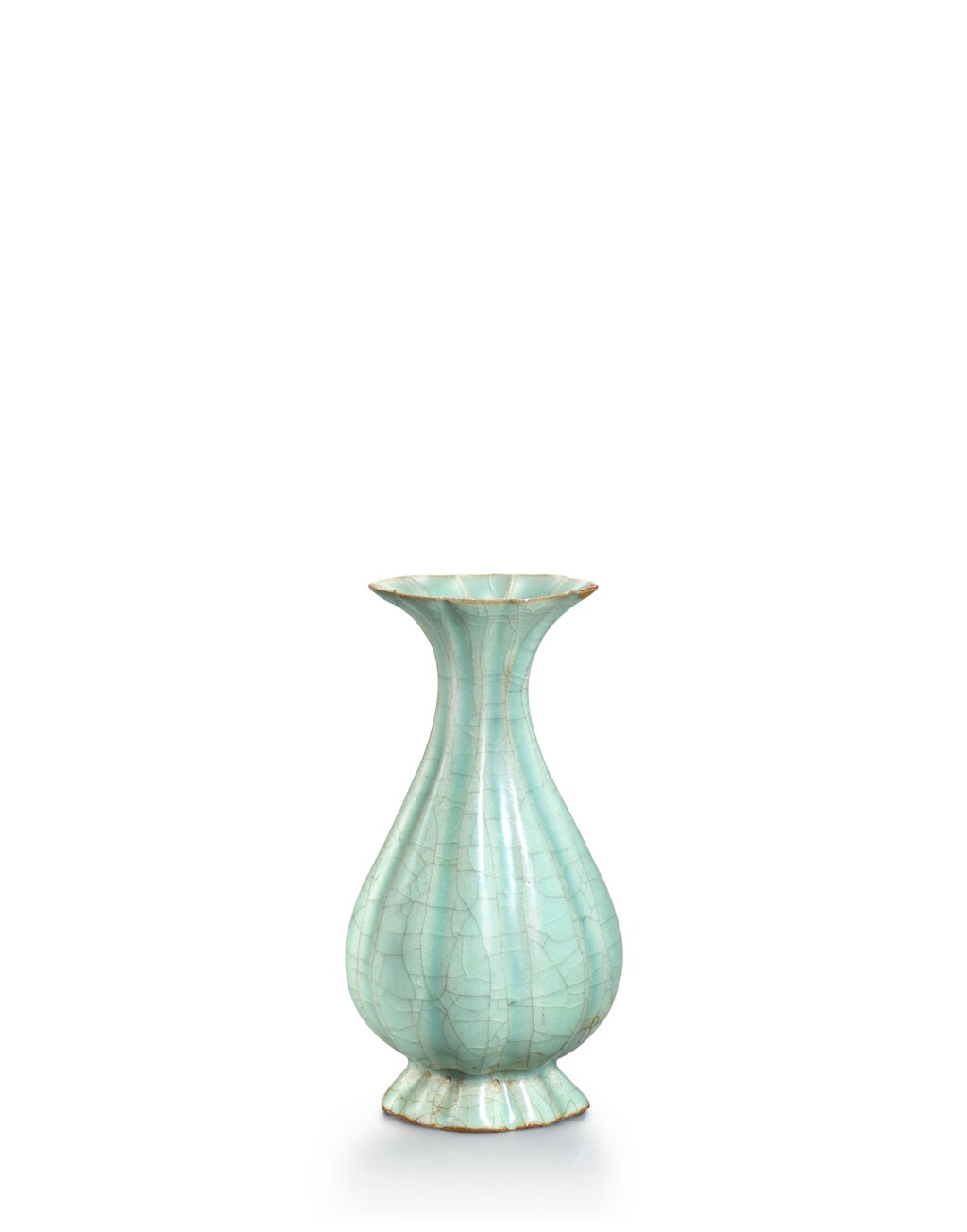
A rare celadon-glazed lobed pear-shaped vase, Southern Song dynasty Japanese lacquer box and wood box | 南宋 青釉海棠式瓜棱瓶
Auction Closed
November 26, 08:41 AM GMT
Estimate
500,000 - 700,000 HKD
Lot Details
Description
Property of a Lady
A rare celadon-glazed lobed pear-shaped vase,
Southern Song dynasty
女史收藏
南宋 青釉海棠式瓜棱瓶
Japanese lacquer box and wood box
17 cm
Okayama Art Club, according to the label.
A Japanese private collection, by repute.
岡山美術倶楽部(標籤)
傳日本私人收藏
This elegant vase captures the essence of Song aesthetics with its delicately formed lobed body and precise, graceful outlines, achieved using an uncommon method of vertical moulding in two halves. Coated in a rich, jade-like glaze, this vase belongs to a select group of refined celadon wares designed to resemble the renowned guan (official) wares made in Hangzhou for the imperial court during the Southern Song dynasty.
A related Longquan vase was discovered in a hoard at Jinyu village near Suining in Sichuan province, an area invaded by the Mongols in 1234, with the town eventually falling in 1242. Refer to Fūin sareta Nansō tōki ten / Newly Discovered Southern Song Ceramics: A Thirteenth-Century "Time Capsule", Odakū Museum, Tokyo, 1998, cat. no. 17, and also Zhu Boqian, Longquan yao qingci / Celadons from Longquan Kilns, Taipei, 1998, pl. 18.
For comparison, see a slightly larger fragmentary guan vase of similar shape, unearthed at the Jiaotanxia kiln complex and illustrated in Sekai tōji zenshū / Ceramic Art of the World, Tokyo, 1955, vol. 10, p. 191, fig. 28c. Another guan example is illustrated in George J. Lee, Selected Far Eastern Art in the Yale University Art Gallery, New Haven, 1970, pl. 37. Additionally, a vase in the Tokyo National Museum was included in the Museum’s exhibition Chinese Arts of the Sung and Yüan Periods, 1961, cat. no. 189. Another example, with a grey body and a muted crackled grey-green glaze, believed to have been produced by the Jiaotanxia kilns, can be found in James Spencer, Selected Chinese Ceramics from Han to Qing Dynasties, Chang Foundation, Taipei, 1990, cat. no. 43. A lobed wall vase of similar form was excavated in Hangzhou, and illustrated in Ma Yichao, Nansong Hangzhou Xiuneisi guanyao yanjiu / Study on Southern Song Xiuneisi Imperial Kilns Hangzhou, Hangzhou, 2006, p. 148, no. 112.