Property from the Bodhimanda Foundation | 菩提曼拏羅基金會典藏
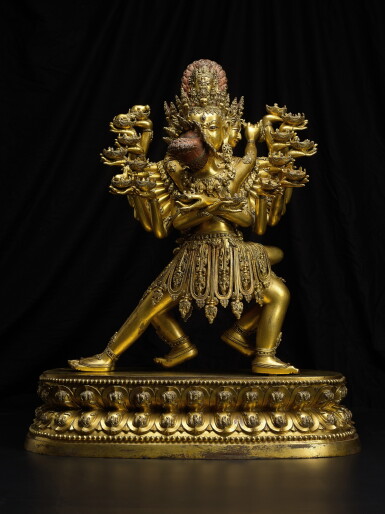
A monumental gilt-bronze figure of Kapaladhara Hevajra, Early Ming dynasty | 明初 鎏金銅喜金剛立像
Premium Lot
Auction Closed
November 26, 08:41 AM GMT
Estimate
12,000,000 - 15,000,000 HKD
Lot Details
Description
Property from the Bodhimanda Foundation
A monumental gilt-bronze figure of Kapaladhara Hevajra,
Early Ming dynasty
菩提曼拏羅基金會典藏
明初 鎏金銅喜金剛立像
Himalayan Art Resources (himalayanart.org), item no. 15003.
喜馬拉雅藝術資源網,編號15003
overall h. 67.5 cm
Collection of Eduardo Lingero, Brussels, until March 1979.
A European private collection.
Gifted to the Bodhimanda Foundation, The Netherlands, 2011.
Eduardo Lingero 收藏,布魯塞爾,1979年3月
歐洲私人收藏
贈予菩提曼拏羅基金會,荷蘭,2011年
Wereldmuseum, Rotterdam, 2011-2020.
Bronze, Royal Academy of Art, London, 15th September to 9th December 2012.
世界博物館,鹿特丹,2011-2020年
《Bronze》,皇家美術學院,倫敦,2012年9月15至12月9日
Jacques Van Goidsenhoven, Art Lamaïque Art Des Dieux, Bruxelles, 1970, pp. 126-127.
Erik Bruijn, Tibet-China & Japan, Wereldmuseum, Brussels and Rotterdam, 2011, pp. 55-57.
Bronze, Royal Academy of Art, London, 2012, cat. no. 76.
Michael Henss, 'Sacred Spaces and Secret Visions: Tibetan Buddhist Art from the Bodhimanda Foundation', Orientations, January/February 2012, pp. 68-69.
Jacques Van Goidsenhoven,《Art Lamaïque Art Des Dieux》,布魯塞爾,1970年,頁126-127
Erik Bruijn,《Tibet-China & Japan》,世界博物館,布魯塞爾及鹿特丹,2011年,頁55-57
Michael Henss,〈Sacred Spaces and Secret Visions: Tibetan Buddhist Art from the Bodhimanda Foundation〉,《美成在久》,2012年1/2月,頁68-69
The dynamic tantric group depicts the Vajrayana Buddhist meditational deity Hevajra with eight faces, four legs, and sixteen arms, a skull bowl (Skt. kapala, Tib. thod-pa) in each hand, some retaining separately-cast attributes including a cat, a lion, and a horse. Hevajra is wearing regal jewelry, skull crowns, a garland of severed heads and a bone apron with pendant bells, his consort Nairatmya (Tib. Dagmema) holding a skull bowl and flaying knife (Skt. kartika, Tib. drigu), and wearing a skull crown, a human skull necklace, and a bone apron with pendant bells, the deities stepping to the right (Skt. alidhasana) on a double lotus pedestal, the consecration cavity within the figures sealed with a gilt-bronze plug disguised as a section of jewelry in the middle of Hevajra’s back.
This rare and finely cast gilt-bronze is the largest recorded Hevajra and consort from the early Ming dynasty, and a highly important imperial commission. While at least five Yongle gilt-bronzes of Hevajra are known – all cast in the small transportable size typical of imperial gifts, three of which are in Tibetan monastery collections, see Ulrich von Schroeder, Buddhist Sculptures in Tibet, Hong Kong, 2001, vol. II, pls 347C-F, this large temple sculpture is likely to have been commissioned for a shrine within China. Compare the skull and chakra-wheel crowns, aprons, jewelry, and lotus pedestals of seven large early Ming tantric gilt-bronzes formerly in the Gumpel Collection that were offered at Hôtel Drouot in 1904, all of which were likely commissioned for shrines in China, including an 80 cm Vajrabhairava and consort later sold in our New York rooms, 25th March 1999, lot 122; a 98.8 cm early Ming gilt-bronze Ekavira Vajrabhairava sold at Christie’s Hong Kong, 30th November 2016, lot 3234; a 94 cm Vajrabhairava and consort at Nagel Auktionen, 23rd June 2021, lot 8; a 70 cm Shadbhuja Mahakala and a Guhyasamaja in Ulrich von Schroeder, Indo-Tibetan Bronzes, Hong Kong, 1981, pls 151A-D; a Mahachakra Vajrapani now in the Linden-Museum, Stuttgart, ibid, pl. 151B; and an Ekavira Vajrabhairava present whereabouts unknown but see Jeff Watt, www.himalyanart.org, item no. 30430. Compare also a 57.8 cm early Ming gilt-bronze Chaturbhuja Mahakala sold in our New York rooms, 26th March 1998, lot 161: and the Bodhimanda Foundation Panjarnata Mahakala in this catalogue (lot 3815).
Stylistic details seen only on these large-scale Ming works include the decoration of Hevajra and Nairatmya’s belts with the distinctive alternating rosette and jewel motif, similar to that of the Musée Cernuschi Yongle period 136 cm standing gilt-bronze bodhisattva from Qutansi monastery, Qinghai Province, identified by Karl Debreczeny as having been commissioned for the Qutansi monastery, see Faith and Empire: Art and Politics in Tibetan Buddhism, Rubin Museum of Art, 2019, cat. no. 1.17: on the 79 cm mahasiddha Virupa in the Victoria and Albert Museum, see Ming: 50 Years That Changed China, The British Museum, London, 2014, cat. no. 204: and on the 57.8 cm Chaturbhuja Mahakala sold in our New York rooms, 26th March 1998, lot 161, which also features similar anklets to the Hevajra with jewels widely spaced within beaded bands. The lotus-pedestal design is also closely comparable to the Musée Cernuschi bodhisattva, with a tapering lower rim, the recess above with a string of large pearls, the double row of wide lotus petals with a triple flourish at the tips, and a second string of slightly smaller pearls above, all typical characteristics of large scale early Ming Buddhist bronzes. Stylistically, the bases of large-scale Yongle and Xuande mark and period bronzes are virtually indistinguishable, as seen for example on a 57.1 cm Xuande Amitayus, first sold in these rooms, 25th March 1999, lot 121, and more recently at Christie’s Hong Kong, 31st May 2010, lot 1961, compared with the Musée Cernuschi Yongle bodhisattva.
此組造像塑密宗本尊喜金剛,八面、四腿、十六臂,各手捧一嘎巴拉盌,部分盌上另設法器,可見一貓、一獅、一馬尚存,皆單獨鑄造。喜金剛著錦衣華服、珠寶瓔珞,頭頂骷髏冠,肩披人頭花環,腰裹骨圍裙,裙襬垂鈴,所擁無我明妃持嘎巴拉盌及金剛鉞刀,亦戴骷髏冠、人頭項鍊並穿垂鈴骨圍裙。主尊以右展立姿站於雙層蓮台上,內膛中空,可藏經卷,以銅鎏金板封印,封板與瓔珞融為一體,位於喜金剛脊背中央。
遍覽明初造像記錄,此尊喜金剛擁妃像尺寸魁碩無雙,鑄工上乘,實屬御製傑作。且比永樂銅鎏金喜金剛像五尊,皆小巧易攜,乃典型皇家禮賜,其中三尊奉於西藏寺院,見烏爾里希.馮.施羅德,《西藏佛教雕塑》,香港,2001年,卷2,圖版347C-F;此尊大像必龕於寺,或專為漢地佛寺所造。有明初銅鎏金藏傳造像七尊,均為漢地佛寺定造,尺寸碩大,頭冠、圍裙、瓔珞及蓮台可比此尊。七尊皆由 Gumpel 收藏釋出,1904年在德魯奧大樓拍出:其一,擁妃大威德金剛,80公分,後售於紐約蘇富比1999年3月25日,編號122;其二,獨雄大威德金剛,98.8公分,後售於香港佳士得2016年11月30日,編號3234;其三,擁妃大威德金剛,94公分,後售於德國納高2021年6月23日,編號8;其四、其五,六臂大黑天、密集金剛,各70公分,錄於烏爾里希.馮.施羅德,《印度與西藏的銅造像》,香港,1981年,圖版151A-D;其六,大輪金剛手,現藏斯圖加特林登博物館,錄前述出處,圖版151B;其七,獨雄大威德金剛,現存處不詳,可見傑夫.瓦特,喜馬拉雅藝術資源網,編號30430。另比較明初銅鎏金四臂大黑天一尊,57.8公分,售於紐約蘇富比1998年3月26日,編號161;亦可比菩提曼拏羅基金會珍藏寶帳大黑天,同場呈獻(拍品編號3815)。
喜金剛與無我明妃腰帶處作寶珠花結,乃明代大規格造像所獨有,可參考賽努奇博物館藏永樂銅鎏金菩薩立像,高136公分,原奉青海瞿曇寺,據杜凱鶴研究,此例乃為瞿曇寺定造,見《Faith and Empire: Art and Politics in Tibetan Buddhism》,魯賓藝術博物館,紐約,2019年,編號1.17。此紋飾亦見於大成就者毘魯巴像一尊,79公分,藏維多利亞與艾爾伯特博物館,展於《明:盛世皇朝五十年》,大英博物館,倫敦,2014年,編號204,且見於前述四臂大黑天,57.8公分,售於紐約蘇富比1998年3月26日,編號161;該四臂大黑天踝鐲碩寶疏朗,夾於兩圈小珠之間,與此尊喜金剛相類。蓮台式樣亦與賽努奇永樂菩薩頗似,下沿收窄,添飾小珠,蓮瓣寬展,瓣尖作三股卷紋,上沿再飾小珠,種種皆是明初大規格造像之典型。若論大規格造像底座紋飾風格,永宣別無二致,參考一宣德無量壽佛,57.1公分,先後售於紐約蘇富比1999年3月25日,編號121,及香港佳士得2010年5月31日,編號1961,同樣與賽努奇永樂菩薩相似。