
Property of a Lady | 女史收藏
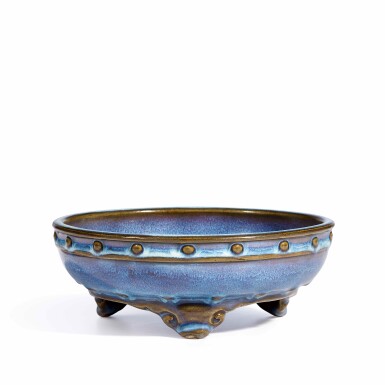
A fine and brilliantly splashed lavender-glazed Junyao narcissus bowl, Early Ming dynasty | 明初 鈞窰天藍釉鼓釘三足水仙盆 底刻「四」字
Auction Closed
November 26, 08:41 AM GMT
Estimate
3,000,000 - 5,000,000 HKD
Lot Details
Description
Property of a Lady
A fine and brilliantly splashed lavender-glazed Junyao narcissus bowl,
Early Ming dynasty
女史收藏
明初 鈞窰天藍釉鼓釘三足水仙盆
底刻「四」字
the base incised si ('four'), wood stand
20 cm
Christie's Hong Kong, 25th October 1993, lot 705.
Sotheby's New York, 18th March 2008, lot 100.
香港佳士得1993年10月25日,編號705
紐約蘇富比2008年3月18日,編號100
'Jun' ware derives its beauty from the striking and thick opaque glaze of varied bright blue colouration that becomes almost translucent around the rim and the edges of the vessel, where the glaze thins significantly. Although 'Jun' wares are known as one of the five 'classic wares' of the Song period, mould-made flower vessels, such as the present narcissus bowl, are now overwhelmingly attributed both by Chinese and Western scholars to the types made at Yuzhou, Henan province, an area formerly known as Junzhou, from the Jin (1115-1234), Yuan (1279-1368) or the Ming period onwards. Regina Krahl in Chinese Ceramics from the Meiyintang Collection, vol. 3, pt. II, London, 2006, p. 456, notes that 'Jun' is not mentioned in any pre-Ming text, and although it was later ranked among the five 'classic wares' of the Song, the exact identity of Song 'Jun' is still a matter of debate. It was a ware that seems to have appealed particularly to the elite from the Jin Dynasty onwards, when some of the most spectacular and complex pieces were being made.
The present narcissus bowl is arguably one of the finest examples of 'Jun' vessels of this type. It is covered with an especially thick and rich opaque blue glaze of striking blue colouration that characteristically pools, forming a prominent edge below the 'drum-nail' bosses around the rim and the base. Although the glaze is of an unusually rich texture, it is expertly applied to expose the moulded decoration. It is comparable to a narcissus bowl with sky-blue glaze and the numeral yi (‘one’) in the Qing court collection, included in the exhibition catalogue Selection of Jun Ware. The Palace Museum's Collection and Archaeological Excavation, Palace Museum, Beijing, 2013, cat. no. 115.
Mould-made vessels of this type are frequently identified with numbers from one to ten on the base. The significance of the numbers inscribed on the vessels remains an enigma. The numbers coincide roughly with different sizes, yi ('one') being the largest and shi ('ten') the smallest version of the shape. This would help to match sets of flower pots and their stands but does not explain the appearance of numbers on the base of vases and bulb bowls, as seen on the present bowl, which generally comes on their own. For further information, see George J. Lee, 'Numbered Chun Ware', Transactions of the Oriental Ceramic Society, vol. 21, 1945-46, p. 61, where five 'numbered Jun' vessels from the collection of Ernest B. and Helen Pratt Dane, possibly one of the most important collectors of 'numbered Jun' wares outside China, and now in the Harvard University Art Museums, Cambridge, Mass., are recorded.
Bulb bowls of this form, with the same numeral on the base, are included in the Illustrated Catalogue of Sung Dynasty Porcelain in the Palace Museum: Ju Ware, Kuan Ware, Chun Ware, Tokyo, 1973, pls. 64 and 66, both with purple splashes added to the glaze; and two blue-glazed examples inscribed with the numeral yi ('one') are illustrated ibid., pls. 65 and 67, the latter with the so-called 'moon-white' glaze. A blue-glazed bulb bowl with the numeral si ('four'), from the Reach Family Collection and the collection of Dr. W. Kilgenberg, Bonn, was included in the exhibition Chinese Art from the Reach Family Collection, Eskenazi, London, 1989, cat. no. 24, and sold in these rooms, 2nd May 2000, lot 590; and one from the collections of Harcourt Johnstone and Enid and Brodie Lodge was sold in our London rooms in 1940 and 1972 and again in these rooms, 30th April 1996, lot 306.
A further larger blue-glazed example can be found in the Idemitsu collection, Tokyo, illustrated in Chinese Ceramics in the Idemitsu Collection, Tokyo, 1987, pl. 104; and fragments of what appears to be a slightly smaller vessel is included in the Museum of History publication The Ancient Kilns of Henan Province, Taipei, 2002, p. 196. Compare also a slightly larger bowl, from the T.Y. Chao collection, sold in these rooms, 19th May 1987, lot 210; and a much smaller vessel inscribed with the numeral jiu ('nine') but covered with a closely related brilliant blue glaze, from the J.M. Hu Family collection, sold in these rooms, 26th March 1996, lot 154.
鈞瓷釉彩美妙多變,釉厚處發色天藍純濃,耀耀動人,器沿邊角處,釉薄澄淨透明,彷若可見瓷胎。 鈞瓷為宋五大名窰之一,而如同此件水仙盆之模造器物,中西學者多斷為河南禹州所造,金元明時舊名鈞州。康蕊君於《玫茵堂中國陶瓷》,卷3 [II],倫敦,2006年,頁456,提及明以前典籍未見鈞瓷,雖被訂為宋代五大名瓷之一,宋代鈞瓷之界定仍未定論,金代以降,鈞瓷備受權貴喜愛,因而造就了許多華美富麗之器。
此件水仙盆屬同形鈞窰器中最精美之例,天藍釉層厚濃明豔,器身口沿及足部鼓釘下,積釉潤澤欲滴,巧工之下,仍無掩器身模造裝飾細節。本拍品與北京清宮舊藏的一件刻「一」字的天藍釉鼓釘三足水仙盆較為接近,展覽於《鈞瓷雅集:故宮博物院珍藏及出土鈞窰瓷器薈萃》,故宮博物院,北京,2013,編號115。
此類模造鈞瓷底部常見刻有一至十數字,其實際用意仍未明,然數字彷似與器物尺寸相關,「一」為最大尺寸,「十」為同形中最小尺寸者,如此備註似能用於陳設時,對應同尺寸花器與器托,卻無法解釋瓶與盌等器形,為何亦有數字款銘。相關討論可見 George J. Lee,〈Numbered Chun Ware〉,《東方陶瓷學會會報》,卷21,1945-46年,頁61,此處提及 Ernest B. and Helen Pratt Dane 伉儷所藏五件有數字銘之鈞瓷。夫妻二人雅蓄,屬當時最知名的海外鈞瓷收藏,現存麻省劍橋市哈佛藝術博物館。
與此相類之數字銘鈞瓷水仙盆,可見數例,錄於《故宮宋瓷圖錄:汝窰、官窰、鈞窰》,東京,1973年,如圖版64及66,二件均帶紫斑,另圖版65及67,刊載二件藍釉鈞窰水仙盆,皆銘「一」字,後者釉色月白。Reach 家族及德國波恩 Dr. W. Kilgenberg 珍藏一件藍鈞小盆,帶「四」字銘,展於《Chinese Art from the Reach Family Collection》,Eskenazi,倫敦,1989年,編號24,2004年5月2日售於香港蘇富比,編號590。另一例曾為 Harcourt Jonhstone 及 Enid and Brodie Lodge 伉儷珍藏,於1940年、1972年二度由倫敦蘇富比售出,1996年4月30日售於香港蘇富比,編號306。
東京出光美術館藏有一件尺寸較大天藍釉作例,錄於《中國陶磁:出光美術館藏品圖錄》,東京,1987年,圖版104。器形稍小之鈞瓷殘片,見有載於歷史博物館出版之《河南古代瓷窰》,臺北,2002,頁196。亦可比較趙從衍舊藏品,尺寸略大,1987年5月19日售於香港蘇富比,編號210。胡惠春家族也珍藏一件鈞瓷小盆,有「九」字銘,釉色豔藍類同此件,由香港蘇富比1996年3月26日售出,編號154。
You May Also Like


