
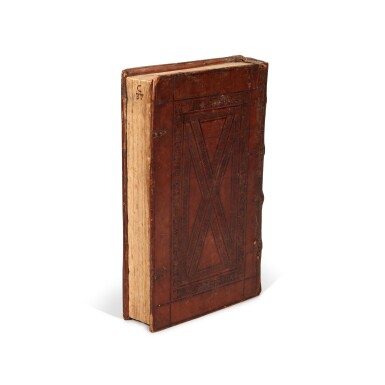
Burchardus Urspergensis, Chronicum abbatis Urspergensis, Strassburg, 1538, contemporary Oxford blindtooled calf
Auction Closed
December 10, 04:10 PM GMT
Estimate
6,000 - 8,000 GBP
We may charge or debit your saved payment method subject to the terms set out in our Conditions of Business for Buyers.
Read more.Lot Details
Description
BURCHARDUS URSPERGENSIS. Chronicum Abbatis Urspergensis, a Nino rege Assyriorum magno, usque ad Fridericum II. Romanorum imperatorem, ex optimis autoribus, Iosepho, Eusebio, Orosio, Historia tripartita, Eutropio, Procopio, Beda, Iornande, Historia rerum Geticarum, Vuitichindo, Eginhardo, & plerisque aliis... Paraleipomena rerum memorabilium, a Friderico II. usque ad Carolum V. Augustum, hoc est, ab anno domini M.CC.XXX. usque ad annum M. D. XXXVII. ex probatioribus qui habentur scriptoribus in arctum coacta, & historie Abbatis Urspergensis per eundem studiosum annexa [by Kaspar Hedio]. Cum iconibus imp. et principum ad vivum expressis. (Strassburg: Crato Mylius), March 1538
A chronicle of early Imperial German history, written by Burchardus and his successor as provost of Ursperg Abbey, Conrad of Lichtenau, edited by Philipp Melanchthon, with the continuation up to 1537 written from a Protestant viewpoint. The sources, both printed and manuscript, are listed at the end of the text. The medallion portraits of rulers from Julius Caesar to Ferdinand, King of the Romans, also include Scanderbeg; these have been attributed to Heinrich Vogtherr the elder.
There is no exact match for this issue in VD16, though both B 9801 and B 9802 are close matches. The second section, the Paraleipomena, also has different issues, and the present version is closer to the text in B 9802.
The two flyleaves are from a late-twelfth century English Missal, written in a fine book hand, 34 lines, double column, containing parts of the masses for Friday and Saturday before Passion Sunday (1), and Palm Sunday (2), decorated with large initials in one or two colours (the margins a little cropped but with no loss of text, and a crease from a previous fold in the first leaf).
Folio (307 x 198 mm), Roman type with marginalia in italics and Greek quotations: 55 lines plus headline. collation: *4 A-Z a-d6 e-f4; [2]A-O6 P4 Q6: 144 + 94 leaves (*4 blank). Woodcut printer’s device on title-pages and on final verso (otherwise blank), woodcut initials, white-on-black woodcut medallion portraits within wreaths, a few early annotations (by L’Estrange?).
binding: Contemporary Oxford blind-tooled calf over wooden boards (326 x 219 mm), outer frame of a roll tool dated 1537 [Oldham RC.c(1)], a simpler roll of a quadrilobe in a lattice used for the inner frame and a double cross in centre [Oldham Dl.a(5)], blind fillets around bands on spine, plain edges with shelf mark C 37 at head of fore-edge, traces of two clasps, flyleaves from a late twelfth-century English manuscript missal. (Binding slightly rubbed, rebacked retaining most of original spine, repairs around joints and the location of the clasps, new pastedowns.)
provenance: Hamon L’Estrange (perhaps the historian and theologian, 1605-1660), inscription at head of title-page dated 1638 with price 8 shillings — Charles William Dyson Perrins (1864-1958), bookplate, sale, Sotheby’s, 11 March 1947, lot 648 — Sotheby’s, 15-16 December 1969, lot 79, £60, bought by — Alan G. Thomas, sold to — Patricia Milne-Henderson (1935-2018), sale, Sotheby’s, 18 July 2016, lot 10. acquisition: Purchased at the preceding sale. references: cf Dekesel L21 (under Lichtenau, dated March 1537 but with continuous pagination); VD16 B 9801 (dated 1537 on title, but otherwise almost identical to the first part of this copy) & H 933