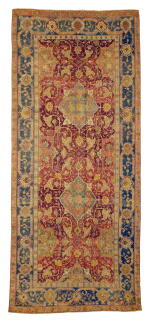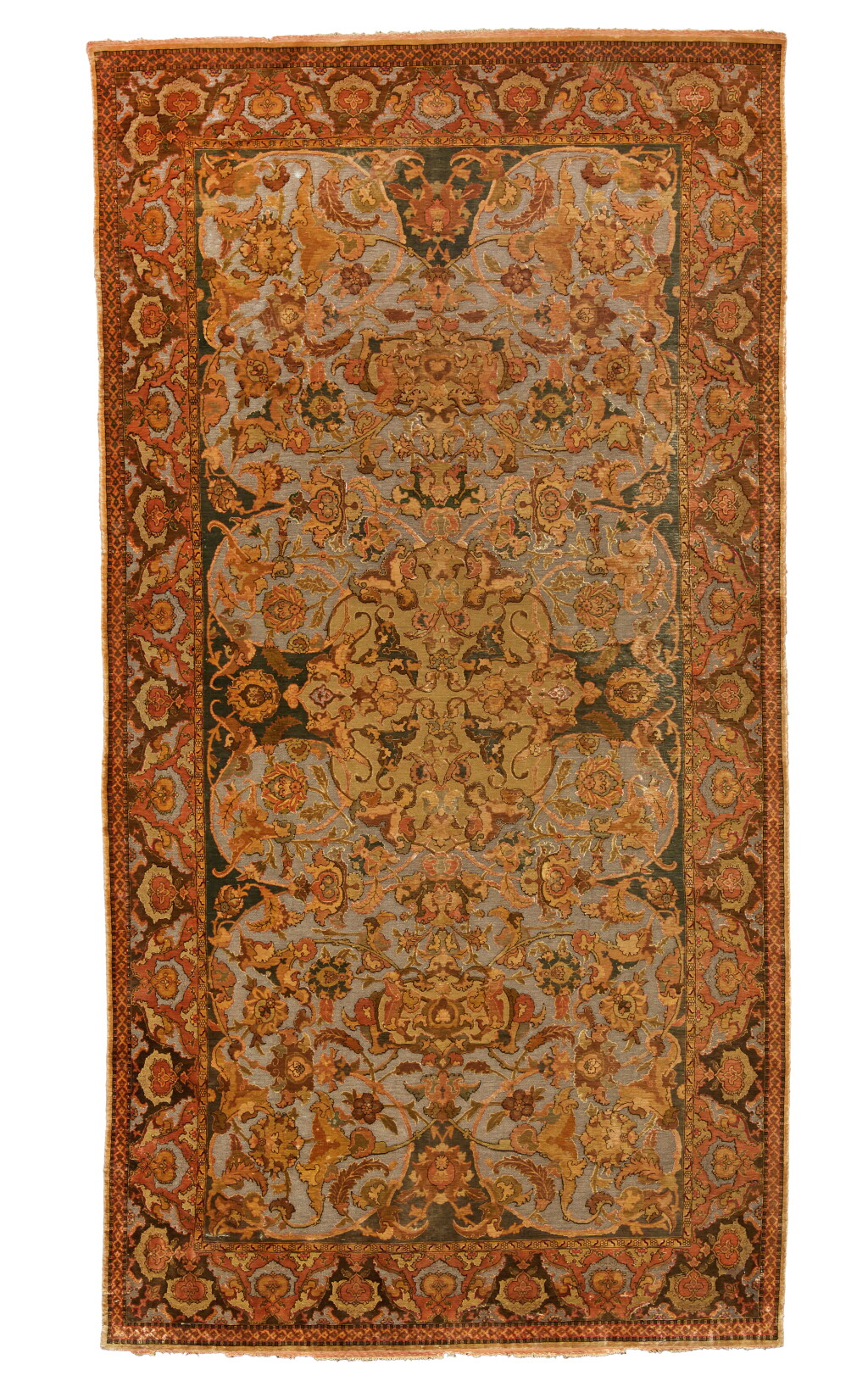
A silk and metal-thread Koum Kapi carpet of 'Polonaise' design, attributable to Zareh Penyamin, Turkey, Istanbul, circa 1910
Auction Closed
April 24, 03:45 PM GMT
Estimate
30,000 - 50,000 GBP
Lot Details
Description
234 by 122cm. approx.
The advent of the fine silks of Istanbul, termed Koum Kapi (literal translation ‘Sand Gate’) after the location of the workshop, in the late nineteenth and early twentieth century, is largely indebted to two great masters, Hagop Kapoudjian (d.1946) and Zareh Penyamin (1890 - 1949). Not a great deal is known about these men, originally from Kayseri, aside from the research undertaken by Pamela Bensoussan and George F. Farrow (1916-2001), both of whom were assisted by Duncan Miller and Arto Keshishian - whose father, Karnik Keshishian, knew the early masters personally.
A cartoonist for the Ottoman Court, Zareh was a perfectionist who oversaw and curated all aspects of any single work with the utmost attention to detail, demanding the highest standards from his weavers. His designs were based on sixteenth and seventeenth century carpets of the Ottoman and Safavid courts, that he most likely viewed whilst in the Sultan’s employ.
The present example is based upon ‘Polonaise’ carpets woven in Central Persia in the early seventeenth century. The peach-orange, pistachio-green and deep sea-green of the present example refers back to its Safavid predecessors (see, for example, The "Doria" Polonaise carpet in the MET, New York, acc.no.50.190.5), however, the softer tones reflect a late nineteenth and early twentieth century taste for pastel colours, rather than the rich and vibrant colours of the Safavid pieces. The carpet incorporates two tones of metal-thread adding a sense of depth to the overall design.
The carpet can be attributed to the atelier of Zareh Penyamin on account of another carpet woven from the same cartoon bearing his signature in five places, sold at Christie’s, London, 29 April 1993, lot 325. Further, unsigned examples of the same design have been sold at Sotheby's, London, 12 October 1991, lot 19 and Christie’s, London, 28 April 1995, lot 495.
For a further discussion on Zareh Penyamin, see G. Farrow, ‘Zareh's Legacy,’ HALI, 1991, no.58, p.112 and P. Bensoussan, ‘The Masterweavers of Istanbul’, HALI, 1985, no.26, pp.34-41.
You May Also Like