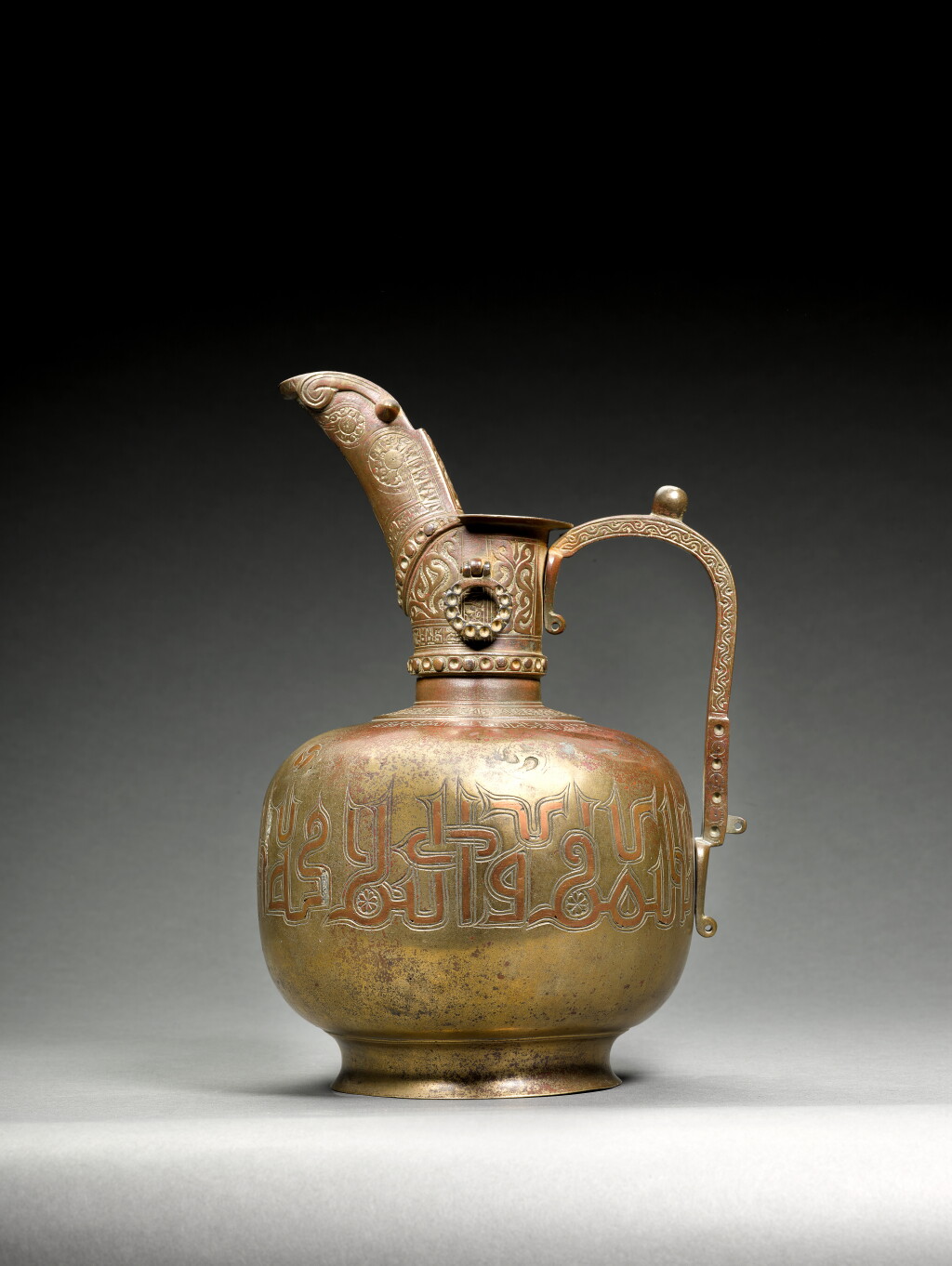
A Khurasan silver and copper-inlaid bronze ewer, North Eastern Persia, late 12th/early 13th century
Auction Closed
April 24, 03:45 PM GMT
Estimate
200,000 - 300,000 GBP
Lot Details
Description
the body of flattened globular shape, on a short concave foot, the cylindrical neck ridged above the shoulder, the rim encircled by a flange terminating in a pair of birds heads, the slightly curved spout protruding on one side from an oblique ridge, its inner lower section enclosed with an openwork panel, the tip with raised decoration and a pair of pointed bosses, the curved handle with a bud-form finial, the neck with a pair of ringed loops, the body decorated with a broad band of inlaid Kufic with further smaller bands of incised and inlaid Kufic, the neck with panels of chiselled foliate designs, the ridges inlaid with copper studs
33cm. high
inscriptions
Around the body, in large Kufic:
bi’l-yumn wa al-barakah al-tammah al-sur[u]r al- …
‘With good-fortune and entire blessing, joy …’
Above the large inscription, in silver:
'amal abi nasr
‘The work of Abu Nasr’
Around the shoulder, incised:
bi’l-yumn wa al-barakah al-tammah al-sur[u]r wa al- … / al-salamah wa al-sa‘adah al-baqiyah wa al-dawa[lah?]
‘With good-fortune and entire blessing, joy and … / well-being and lasting happiness and good turn of fortune (?)’
Around the base of the neck, in relief:
al-barakah wa al- … wa al-surur wa al-sa‘adaa [sic] al-baqiyah … wa al-ni‘mah al-baqa wa al-ghibtah (?) wa al- …
‘Blessing and … and joy and lasting happiness … and (God’s) grace and long-life and gladness and …’
Repeat of similar benedictory terms around the spout, neck and handle.
Christie's, London, 8 April 2008, lot 70
Sotheby's, London, 13 April 2000, lot 64
The period spanning from the eleventh to the thirteenth century witnessed significant developments in court artistry, under the hospices of the comparatively peaceful rule of the Seljuqs. Under their patronage, a large volume of metal vessels were produced, some of traditional Sassanian and early Islamic shapes, but many others adopting entirely original shapes thus demonstrating an unprecedented taste for innovation. Ewers from this period are particularly representative of these changes, with the example at hand imposing itself as a most dashing display of inlay mastery (Fehervari 1976, p.56).
This ewer belongs to a well-documented group, showing a variety of subglobular or cylindrical bodies with plain, faceted or fluted surfaces but all sharing a distinctive high neck with oblique projecting spout. Other common features include an slanted ridge under the spout and a similar ridge border above the shoulder, as well as small loops around the neck presumably to suspend or transport the ewers. The example at hand retains two rings designed for this purpose, with the same punched decoration as its two ridged bands.
These vessels are commonly attributed to eastern Iran and sometimes modern Afghanistan, where copper and silver inlay began to be used together from the middle of the tweflth century to create lavish polychromatic surfaces (Ward 1993, p.174). Two ewers of comparable shape are illustrated in Eva Baer's Metalwork in Medieval Islamic Art, one of which was found in Maimana, Afghanistan (see cats. no.72 & 73, pp.95-96). On the other hand, three similar bronze examples in the Aron collection (inv. nos.A 201, A 194 & A 205) are all attributed to twelfth century Khurasan. In quality and complexity however, the present ewer finds a better counterpart in a bronze specimen with traces of silver inlay in the Metropolitan Museum of Art (inv. no.59.53), attributed to Iran and bearing a large Kufic band in high relief around the body and similar benedictory inscriptions throughout. The ewer at hand nevertheless stands out as the most remarkable example from the group, by its extensive use of inlay and the intricacy of its decoration.
You May Also Like