Property from a European Private Collection
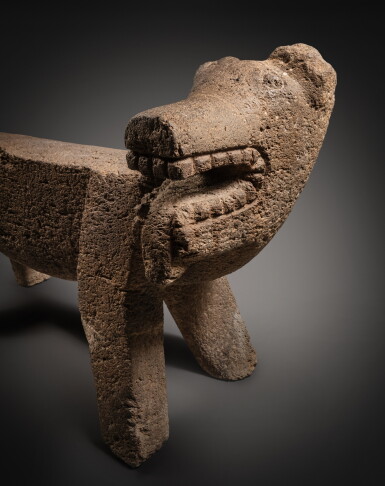
Michoacán Stone Coyote Throne
Postclassic, circa AD 900 - 1200
Auction Closed
December 12, 04:12 PM GMT
Estimate
40,000 - 60,000 EUR
Lot Details
Description
Property from a European Private Collection
Michoacán Stone Coyote Throne
Postclassic, circa AD 900 - 1200
Length: 53 in (134.6 cm), height: 27 ½ in (69.8 cm)
Harry Franklin, Beverly Hills
European Private Collection, acquired from the above on December 31, 1966
Thence by descent
Reportedly loaned to the The Natural History Museum of Los Angeles County in 1966
The powerful yet whimsical canine carved in an unbroken single piece of basalt as abstract, planar elements with the head rotating ninety degrees to the right to present a frontal face, reminiscent of the Maya Chacmools, with mouth agape and tongue exposed.
Coyotes played a significant role in the mythology of the Purepecha people (called the Tarascans by the Spanish) and inhabiting the region of Michoacán. They were a symbol of astuteness, worldly wisdom, pragmatism, male beauty and youthfulness. For the contemporaneous Aztec, Huēhuehcoyōtl was an auspicious, shape-shifting deity sharing some of the characteristics of the trickster Coyote of the indigenous peoples of North America.
Such a flat-backed animal effigy seat would have served as a ritual seat for an elite personage or shaman-priest harkening back to the jaguar pelt covered thrones of the Maya.
For highly similar examples see Wolfgang Haberland, American Indian Art: A Descriptive Catalogue, Museum Rietberg Zurich, Atlantis Verlag, 1971, p. 130 - 131, acc. RMA 18; see also Fernando Gamboa, Masterworks of Mexican Art, From Pre-Columbian Times to the Present, Los Angeles County Museum of Art, October 1963 - January 1964, p. 53, cat. no. 360, illus., p. 57.
You May Also Like