
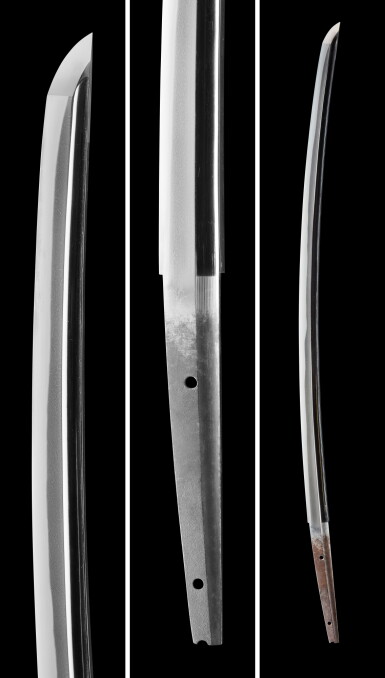
The Property of a Gentleman
A katana | Attributed to the Ko-Uda school | Kamakura – Nambokucho period, 13th – 14th century
Lot Closed
November 5, 01:53 PM GMT
Estimate
50,000 - 70,000 GBP
We may charge or debit your saved payment method subject to the terms set out in our Conditions of Business for Buyers.
Read more.Lot Details
Description
The Property of a Gentleman
A katana
Attributed to the Ko-Uda school
Kamakura – Nambokucho period, 13th – 14th century
Sugata [configuration]: shinogi-zukuri, iori-mune, relatively deep curvature, chu-kissaki
Kitae [forging pattern]: pronounced itame with some nagare and ji-nie
Hamon [tempering pattern]: hiro-suguha-cho in ko-nie-deki with a rather subdued nioiguchi that is mixed with ko-notare, a few ko-gunome, many sunagashi, and kinsuji
Boshi [tip]: sugu with a small rounded turnback and hakikake
Horimono [carvings]: thick grooves on both sides that runs as kaki-toshi through the tang
Nakago [tang]: suriage, kirijiri, kiri-yasurime, two mekugi-ana, mumei
Habaki [collar]: carved, chased and engraved copper-gilt, double clad
In shirasaya plain wood scabbard]
Nagasa [length from kissaki to machi]: 70.1 cm., 27⅝ in.
Sori [curvature]: 2.1 cm., ⅞ in.
Saki-haba [width at the yokote]: 2.1 cm., ⅞ in.
Moto-haba [width at the machi]: 3 cm., 1⅛ in.
Kissaki-nagasa [length of the tip]: 3.2 cm., 1¼ in.
Nakago-nagasa [length of the tang]: 17.7 cm., 7 in.
Accompanied by a certificate of registration as Juyo Token [Important Sword], no. 1352 issued by the Nihon Bijutsu Token Hozon Kyokai [Society for the Preservation of the Japanese Art Sword], dated Heisei 30 (2018).
The Uda School was founded by the smith Konyudo Kunimitsu who moved from the Uda district of Yamato Province (present-day Nara Prefecture) to the Uda district of the same name in Etchu Province (present-day Toyama Prefecture) where his school then flourished from the end of the Kamakura period (1185-1333) until the shinto era (1597-1780). Works and smiths from the end of the Kamakura to the Nanbokucho period (1336-1392) are referred to as Ko-Uda and famous masters from this group were, apart from the aforementioned Kunimitsu, Kunifusa and Kunimune. Incidentally, it is said that Kunifusa has been a student of Norishige. This blade is o-suriage mumei. It shows Yamato characteristics, but with local rural features common with works from Etchu Province.
The sayagaki attestation by Tanobe Michihiro has been translated as:
Designated as Juyo [Important Sword] at the 13th Juyo-shinsa [Examination for Important Swords]
Ko-Uda from Etchu Province
This blade is o-suriage mumei. It shows an exquisite itame that features plenty of ji-nie and much chikei and is hardened in a nie-laden suguha with a wide nioiguchi and is mixed with nie-ashi. Also, the ha is intertwined with sunagashi and kinsuji and thus we have here a masterwork of this school which does not date later than Nanbokucho and which appears to aim at its local predecessor Go Yoshihiro.
Blade length: 70 cm.
Attested by Tanzan at the beginning of spring of the Year of the Boar of this era (2019) and kao [cursive monogram]
Dai jusankai juyo-token shiteihin
Etchu no Kuni Ko-Uda
O-suriage mumei nari. Ji-nie o atsuku shiki chikei o shikiri ni orinasu seimyo naru itame no hada-ai ni nienioi shinko naru suguha o yaki nie-ashi hairi sunagashi, kinsuji karami sanagara dokoku no sakitachi Go Yoshihiro ni narai taru omomuki o kamosu Nanbokucho-ki o kudaranu doha no yuhin nari.
Nagasa 2 shaku 3 sun 1 bu yo
Jizai tsuchinoto-i moshun
Tanzan shirusu [kao]
You May Also Like


