
Property from an Important American Collector
Harriet Whitney Frishmuth
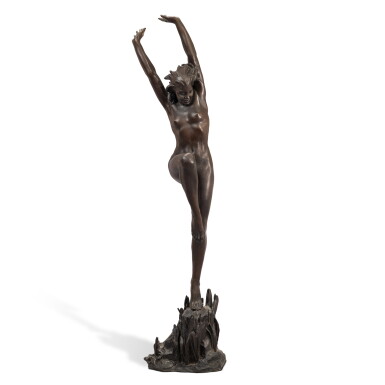
Joy of the Waters
Auction Closed
January 19, 07:25 PM GMT
Estimate
80,000 - 120,000 USD
Lot Details
Description
Property from an Important American Collector
Harriet Whitney Frishmuth
1880 - 1980
Joy of the Waters
inscribed Harriet W. Frishmuth Sc. / 1912 (on the base); inscribed Roman Bronze Works. Inc. N.Y. (on the base)
bronze
height: 61 in. (154.9 cm.)
Conceived in 1912.
Private Collection, San Marino, California
Butterfield & Butterfield, San Francisco, 16 February 1984, lot 222 (consigned by the above)
Private Collection, Portola Valley, California (acquired from the above)
Sotheby's, New York, 23 May 2007, lot 116 (consigned by the above)
Acquired from the above by the present owner
Beatrice Gilman Proske, Brookgreen Gardens Sculpture, Murrell's Inlet, South Carolina 1968, p. 224
Charles N. Aronson, Sculpted Hyacinths, New York 1973, pp. 26, 107-109, 206, illustration of another example
Janis Conner and Joel Rosenkranz, Rediscoveries in American Sculpture: Studio Works 1893-1939, Austin, Texas 1989, pp. 37, 410-41, illustration of another example
Dick Kagan, "Sentinels of the Garden," Art at Auction, April 1996, p. 67
Janis Conner, Leah Rosenblatt Lehmbeck, and Thayer Tolles, Captured Motion: The Sculpture of Harriet Whitney Frishmuth, A Catalogue of Works, New York 2006, no. 1917:3, pp. 28, 66, 86, 200, 236, 277, 278, illustrated
Harriet Whitney Frishmuth first exhibited Joy of the Waters in the 1925 Women’s World Fair, Chicago, while at the height of her career. The fair aimed to uplift women's accomplishments in the arts, commerce, and industry, attracting over 160,000 visitors. Joy of the Waters springs into the air with an agile, symbolic leap into action, exhibiting the grace and athleticism that characterizes Frishmuth's work. The artist felt that “the unrestrained freedom of a figure’s pose was an expression of life within” (as quoted in Janis Connor, et al., Captured Motion: The Sculpture of Harriet Whitney Frishmuth, New York, 2006, p. 28).
Frishmuth created two versions of the piece—an original Roman Bronze Works cast, which includes the subject work, and a smaller 44-inch version three years later.