
Property from the Collection of Alan E. and Marianne Schwartz
Maya Carved Cylindrical Vase
Chocholá Style, Late Classic, circa 550 - AD 950
Lot Closed
May 21, 05:36 PM GMT
Estimate
25,000 - 35,000 USD
Lot Details
Description
Property from the Collection of Alan E. and Marianne Schwartz
Maya Carved Cylindrical Vase,
Chocholá Style, Late Classic, circa 550 - AD 950
Height: 6 ⅞ in (17.5 cm)
Stendahl Galleries, Hollywood, acquired by March, 1964
Alan E. and Marianne Schwartz, Michigan, acquired from the above on June 30, 1964
Thence by descent to the present owner
Meadow Brook Art Gallery, Oakland University, Rochester, Art of Pre-Columbian America, February 15 - March 26, 1976
Detroit Institute of Art, 1985
Hasso Von Winning, Pre-Columbian Art of Mexico and Central America, 1968, p. 307, fig. 423 [color plate]
Ignacio Bernal and Paul Gendrop, L'arte pre-colombiana dell’America centrale. Le Grandi epoche dell’arte, Florence, 1972, p. 301
Cecilia F. Klein, Art of Pre-Columbian America, Rochester, New York, 1976, pp. 23-24, cat. no. 32, pl. 13
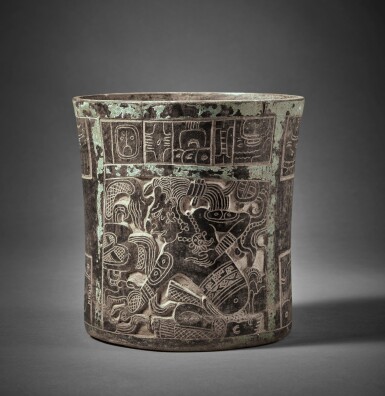
The graphic, carved panels on each side of this grayware vessel vividly depict a Young Lord invoking a Vision Serpent. Such ceremonies were integral to court life, using the theater of important lords stoking huge smoking braziers to implore the gods into being.
The youthful lord leans to his left reaching into the gaping mouth of the large effigy brazier whose headdress is marked by crossbands and an arching flare rising above. The lord’s thick, bound tresses flow behind his markedly extended forehead and past his prominent earflare. His arms are covered in large mirror symbols and he wears a patterned belt with stiff cross-hatched sashes. A jade bead necklace featuring a large effigy head pendant rests on the figure's chest.
On the reverse panel, the bearded Jaguar God of the Underworld is depicted emerging from the mouth of the Vision Serpent. The former God is one of the most important cult deities to the Maya and is known as a patron of warfare. He is frequently portrayed throughout the Classic and Late Classic era on carved monuments and ceramic vessels, and as one incarnation of the Sun God GIII, he is the sun as it descends to the Underworld. His image is often shown on effigy incensarios in his association with fire ceremonies.
His spotted jaguar paw limply extends from his folded arms which are covered with oval mirror emblems; he glares from the large scrolled pupil, his mouth agape, showing his snaggletooth. The jaguar ear is adorned with a long tube ornament and the finely striated hank of bound coiffure falls before his face. These dramatic scenes are framed by pale blue stucco bands, and the rim of the vessel is encircled by a sharply incised glyphic band that includes the calendar date 5 ahau and continues with references to the celestial sky band and possibly a name. Each panel is separated by uncarved columns, each with two large stylized glyphs top and bottom.
In the distinctive Chocholá style, the Maya artist carved into the clay while it was in an advanced leather-hard stage, adding finer details with incising and thus creating the overall vivid and nearly dimensional element of the scenes. The contrast of the vessel’s plain surface versus the excised portions emphasize the singular figures within each panel. As part of the elite ware used within Maya society, these elegant vessels were likely traded and used in regional ceremonies. It was the prerogative and an expected duty of the elite lords to perform the actions that reinforced their position and divine power. It is believed these ceramic wares were manufactured in a time period of only 50-100 years in the region of the northwestern Yucatan.
Cf. For a series of Chocholá vessels, see Michael D. Coe, The Maya Scribe and His World, Grolier Club, New York, 1973, p. 114, vessel 54.
You May Also Like


