
Property from an important European collection
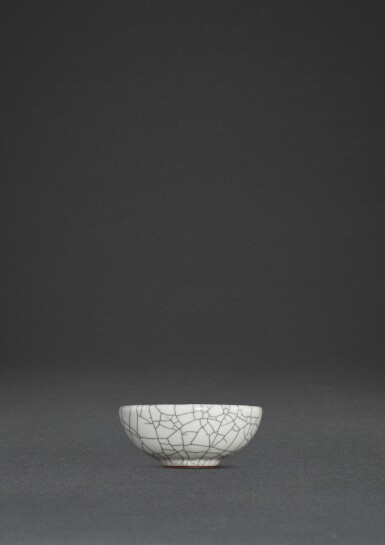
A fine and rare ge-type cup, Qing dynasty, 18th century or earlier | 清十八世紀或較早 仿哥窰盃
Auction Closed
April 9, 08:16 AM GMT
Estimate
600,000 - 800,000 HKD
Lot Details
Description
Property from an important European collection
A fine and rare ge-type cup,
Qing dynasty, 18th century or earlier
重要歐洲收藏
清十八世紀或較早 仿哥窰盃
finely potted with rounded sides resting on a short foot, covered overall save for the footring with a soft bluish-grey glaze suffused with a matrix of dark grey crackles
8 cm
Acquired from Edward T. Chow (1910-80) in the late 1960s.
----------------------------------------------
1960年代末購自仇焱之(1910-80年)
Deeply rooted in imperial wares of the Song and early Ming dynasties, this charming cup, covered with a stained crackle glaze, is a delight to hold and testifies to the continued celebration and reproduction of such wares centuries after the Song dynasty.
The official (guan) wares of the Southern Song dynasty (1127–1279) came in a wide range of appearances, ranging from green glazes with translucent crazing inside the glaze to opaque grey glazes with surface crazing that could be stained to form a contrasting darker web, as on the present cup. The latter were later distinguished from guan by the term ge and – like guan – were considered as one of the ‘five great wares of the Song dynasty’ (960-1279).
Rather than being a term distinguishing the wares of a special kiln, ge seems, however, to be a connoisseur’s term. The name derives from the term gege, literally ‘elder brother’, in reference to an anecdote that circulated in the Jiajing period (1522-1566) about a family of potters who lived in Chu prefecture, Zhejiang province. The elder brother, Zhang Shengyi, supposedly owned a kiln in the Longquan area during the Southern Song period. Perhaps these crackled wares were a speciality of his, but wares of ge type were not only made at Longquan, but also at other kilns, particularly the guan kilns at Laohudong in Hangzhou.
Attempts at reproducing the crackled ge-type glazes at kilns in Jingdezhen, Jiangxi province, began already in the early 15th century, and examples are known with Xuande (1426-1435) reign marks. The high Qing period saw a revival of old forms and glazes and among them, glazes of ge type. Official records from 1728 written by Tang Ying (1681-1756), the supervisor of the imperial kilns at Jingdezhen, describe the renewed interest in iron-rich glazes designed to imitate Song wares like Ru, guan and ge. Ge-type wares of the Yongzheng period, made under Tang Ying, are particularly fine and come both with and without reign marks; both marked and unmarked pieces from the collection of the Palace Museum, Beijing, are illustrated in Selection of Ge Ware: The Palace Museum Collection and Archaeological Discoveries, Beijing, 2017, nos 131–140.
----------------------------------------------
此盃源溯宋代及明初御瓷,釉面片紋密布,惹人愛不釋手。自宋以來,哥釉受世人所崇,數百年間屢有復刻,不曾斷絕。
南宋一朝,官窰瓷器形貌豐富,有粉青釉者,片紋如冰裂,透於釉下,亦有灰釉者,片紋如金絲鐵線,開於釉表。此盃之類屬後者,其原型後由官窰中細分為哥窰,與官窰並尊,躋身「宋代五大名窰」之列。
早自十五世紀初,江西景德鎮便已著力復燒哥窰,更有宣德(1426-1435)年款例傳世。盛清時期,天子慕古,前朝器形、釉色多重新啟用,哥釉亦得延續。據景德鎮御窰廠督陶官唐英(1681-1756)1728年記載,逐天子喜好,御窰嚴控釉中鐵含量,以仿宋代汝、官、哥等瓷。雍正時期,唐英督造仿哥釉瓷質量精純,或帶款,或無款,皆有傳世例現存故宮博物院,北京,錄《哥瓷雅集 : 故宮博物院珍藏及出土哥窰瓷器薈萃》,北京,2017年,編號131至140。
You May Also Like


