Gustave Doré
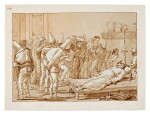
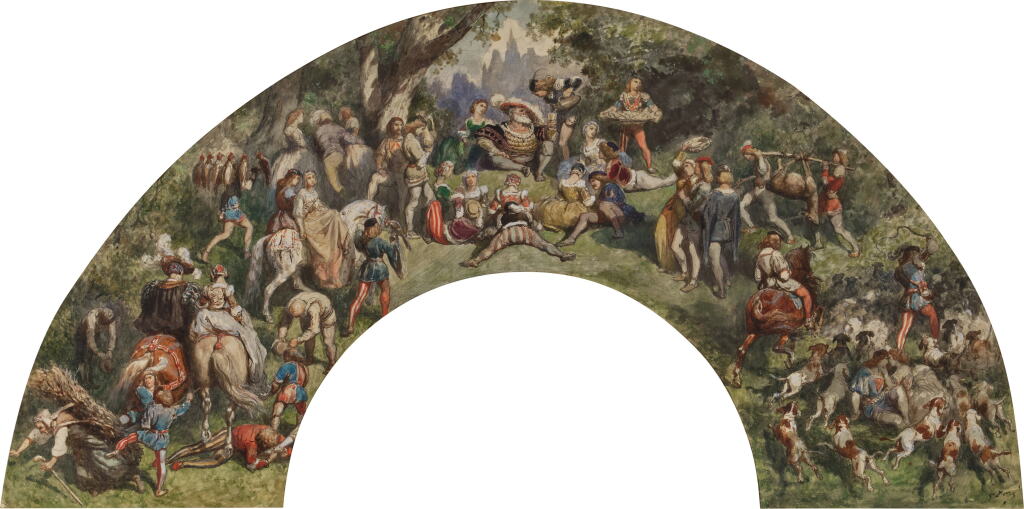
The Universe of Gargantua (After Dinner in the Willow Grove)
Auction Closed
January 31, 03:58 PM GMT
Estimate
20,000 - 30,000 USD
Lot Details
Description
Gustave Doré
Strasbourg 1832 - 1883 Paris
The Universe of Gargantua (After Dinner in the Willow Grove)
watercolor and gouache over black chalk on fan-shaped vellum
signed in brown ink, lower right: G Doré
11 ⅛ by 22 ¼ in.; 282 by 565 mm
With Talabardon & Gautier, Paris;
Where acquired by the present owner, 2010.
Paris, Musée d’Orsay, Doré, l’imaginaire au pouvoir, 18 January - 11 May 2014.
P. Kaenel, "Gustave Doré: la tentation du paysage et le rêve de l’histoire," in Gustave Doré, un peintre né, exhibition catalogue, Bourg-en-Bresse 2012, p. 15, reproduced;
Doré, l’imaginaire au pouvoir, exhibition catalogue, Paris 2014, p. 6, reproduced and pp. 88 and 315.
The humorous subject of this fan-shaped gouache was identified by one of the organizers of the important Gustave Doré exhibition that took place at the Musée d’Orsay in 2014. It is an illustration of a hilarious passage taken from Chapter IV of Book I of a classic of French literature, François Rabelais’ Gargantua, specifically a chapter entitled “Comment Gargamelle, estant grosse de Gargantua, mangea grand planté de tripes.” It recounts how Gargamelle, the daughter of the King of the Parpaillons, being pregnant by her husband Grandgousier with Gargantua, carried him in her womb to term after eleven months of gestation. The giant baby came out as Gargamelle was eating a plentiful quantity of tripe in a willow grove, where the court feasted and made merry. Comment Gargamelle, estant grosse de Gargantua, mangea grand planté de tripes.
Occasion et maniere comment Gargamelle enfanta fut telle. Et, si ne le croyez, le fondement vous escappe. Le fondement luy escappoit vne apresdinee, le iij. iour de feburier, par trop avoir mangé de gaudebillaux. Gaudebillaux: sont grasses tripes de coiraux. Coiraux : sont beufz engressez à la creche & prez guimaulx. Prez guimaulx: sont qui portent herbe deux fois l’an. D’iceulx gras beufz auoient faict tuer troys cens soixante sept mille & quatorze, pour estre à mardy gras sallez: affin qu’en la prime vere ilz eussent beuf de saison à tas, pour au commencement des repastz faire commemoration de saleures & mieulx entrer en vin.
Les tripes furent copieuses, comme entendez: & tant friandes estoient que chascun en leichoit ses doigtz. Mais la grande diablerie à quatre personnaiges estoit bien en ce que possible n’estoit longuement les reseruer, car elles feussent pourries. Ce que sembloit indecent. Dont fut conclud qu’ils les bauffreroient sans rien y perdre. A ce faire conuierent tous les citadins de Sainnais, de Suillé, de la Rocheclermaud, de Vaugaudray, sans laisser arriere le Coudray, Montpensier, le Gué de Vede et aultres voisins : tous bons beuueurs, bons compaignons, & beaulx ioueurs de quille là. Le bon homme Grandgousier y prenoit plaisir bien grand : & commendoit que tout allast par escuelles. Disoit toutesfoys à sa femme qu’elle en mangeast le moins, veu qu’elle aprochoit de son terme, et que ceste tripaille n’estoit viande moult louable. Celluy (disoit il) a grande enuie de mascher merde, qui d’icelle le sac mangeue. Non obstant ces remonstrances, elle en mangea seze muiz, deux bussars & six tupins. O belle matiere fecale, qui doiuoit boursouffler en elle!
Apres disner tous allerent (pelle melle) à la saulsaie: et là sus l’herbe drue dancerent au son des ioyeux flageolletz, & doulces cornemuses: tant baudement que c’estoit passetemps celeste les veoir ainsi soy rigouller.
English translation by the Scottish aristocrat Sir Thomas Urquhart (1611–1660) and completed by the French-born English author Peter Anthony Motteux (1663–1718).
[The occasion and manner how Gargamelle was brought to bed, and delivered of her child, was thus: and, if you do not believe it, I wish your bum-gut fall out and make an escapade. Her bum-gut, indeed, or fundament escaped her in an afternoon, on the third day of February, with having eaten at dinner too many godebillios. Godebillios are the fat tripes of coiros. Coiros are beeves fattened at the cratch in ox-stalls, or in the fresh guimo meadows. Guimo meadows are those that for their fruitfulness may be mowed twice a year. Of those fat beeves they had killed three hundred sixty-seven thousand and fourteen, to be salted at Shrovetide, that in the entering of the spring they might have plenty of powdered beef, wherewith to season their mouths at the beginning of their meals, and to taste their wine the better.
They had abundance of tripes, as you have heard, and they were so delicious, that everyone licked his fingers. But the mischief was this, that, for all men could do, there was no possibility to keep them long in that relish; for in a very short while they would have stunk, which had been an undecent thing. It was therefore concluded, that they should be all of them gulched up, without losing anything. To this effect they invited all the burghers of Sainais, of Suille, of the Roche-Clermaud, of Vaugaudry, without omitting the Coudray, Monpensier, the Gue de Vede, and other their neighbours, all stiff drinkers, brave fellows, and good players at the kyles. The good man Grangousier took great pleasure in their company, and commanded there should be no want nor pinching for anything. Nevertheless he bade his wife eat sparingly, because she was near her time, and that these tripes were no very commendable meat. They would fain, said he, be at the chewing of ordure, that would eat the case wherein it was. Notwithstanding these admonitions, she did eat sixteen quarters, two bushels, three pecks and a pipkin full. O the fair fecality wherewith she swelled, by the ingrediency of such shitten stuff!
After dinner they all went out in a hurl to the grove of the willows, where, on the green grass, to the sound of the merry flutes and pleasant bagpipes, they danced so gallantly, that it was a sweet and heavenly sport to see them so frolic.]
You May Also Like