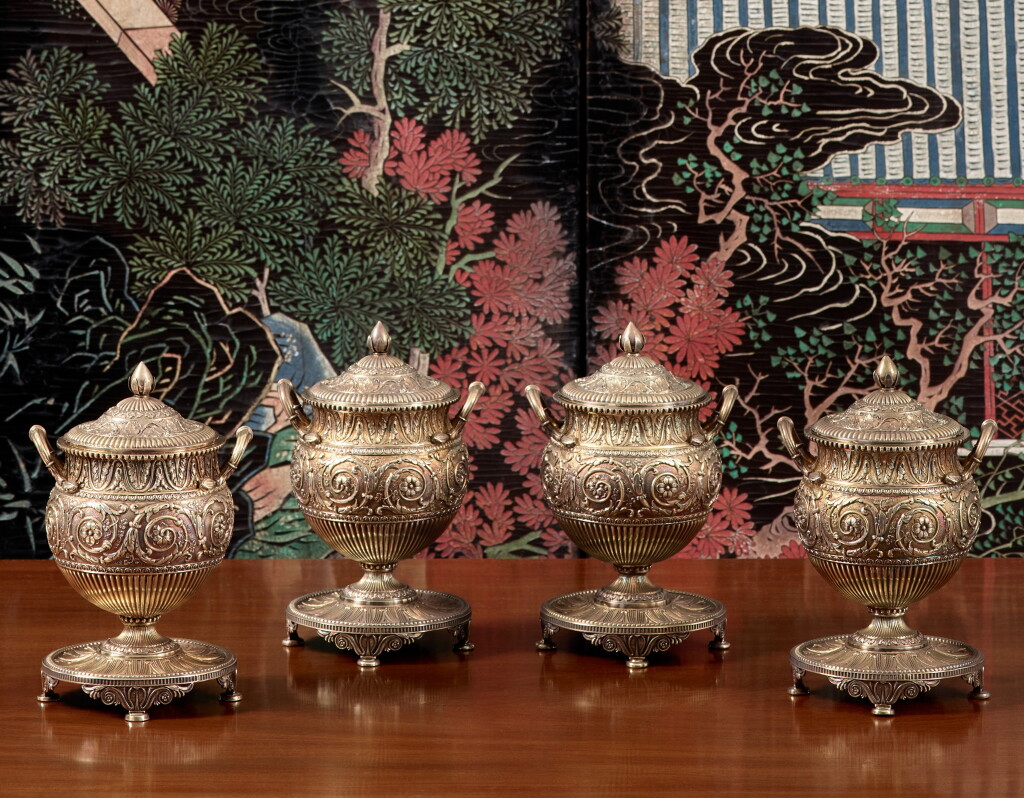
A Set of Four George III Silver-Gilt Sugar Vases and Covers, Digby Scott & Benjamin Smith for Rundell, Bridge & Rundell, London, 1805
Auction Closed
June 18, 05:01 PM GMT
Estimate
50,000 - 70,000 USD
Lot Details
Description
each vase-form on a circular base with four foliate panel feet, the base cast and chased with stiff leaves and bell-flowers, partly gadrooned below scrolling foliage and rosettes, serpent-headed handles, bud finial, engraved on rim with Howe crests, each marked under base and on cover, also stamped on cover RUNDELL BRIDGE ET RUNDELL AURIFICES REGIS ET PRINCIPIS WALLIAE LONDINI FECERUNT.
118 oz 10 dwt
3688.5 g
Height 7 in.
19.5 cm
Probably Richard, 1st Earl Howe of the second creation (1796-1870), by descent to
Francis, 5th Earl Howe, sold
Christie's, London, 1 July 1953, lot 111.
The source for these sugar vases was probably a Roman marble funerary urn in the collection of the 1st Marquess of Lansdowne, see David Udy in "Piranesi's Vasi, the English Silversmith and his Patrons", Burlington Magazine, December 1978, p. 837, fig. 55-57. The design in silver is attributed to sculptor John Flaxman, who used a version in his tomb monument for Sir Thomas Burrell in 1796. Flaxman became Rundell's most important designer around 1804, when Scott and Smith were in charge of Rundell's workshop.
The first known examples were produced by Scott and Smith probably no earlier than 1805, the same date as the present examples. A set of eight vases of this design, 1808-1809, were made for George IV as Prince of Wales at a cost of L376 4s, see Carlton House: The Past Glories of George IV's Palace, 1991, cat. no. 95, p. 133.
You May Also Like