
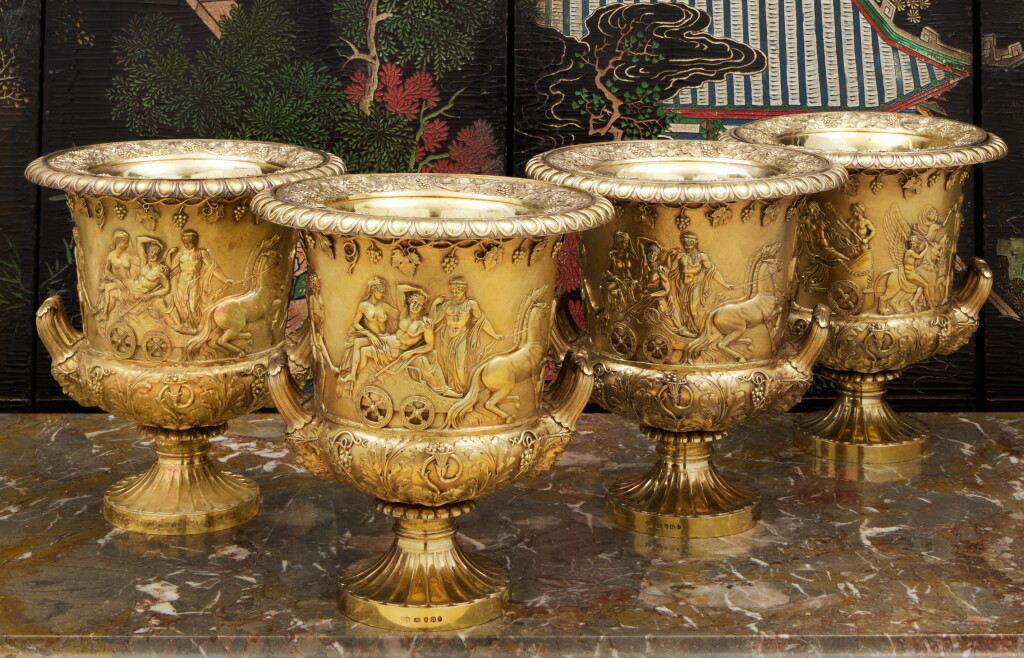
A Set of Four Regency Silver-Gilt Wine Coolers, Paul Storr, London, 1811
Auction Closed
June 18, 05:01 PM GMT
Estimate
150,000 - 250,000 USD
Lot Details
Description
each campana-shaped and on fluted spreading circular foot, the lower bodies with acanthus and vine tendrils, handles with satyr's mask terminals, upper bodies cast with a Bacchic procession on matted ground, egg-and-dart rim, liners, vine-chased detachable collars, marked on base rims, collars and liners and with retailer's stamp 'RUNDELL BRIDGE ET RUNDELL AURIFICES REGIS ET PRINCIPIS WALLIAE LONDINI', numbered and with scratch weights: Number 1: 180.4 ozs.; Number 2: 182.5 ozs.; Number 3: 181.5 ozs.; Number 4: 184.5 ozs
726 oz
22,605 g
Height 11 in.,
28.5cm.
Probably His Excellency Mahdi Al-Tajir, sold
Christie's, London, March 17, 1999, lot 83
London, Koopman Rare Art, 2013. Gilt-Edged Splendour: Masterpieces in Silver Gilt, no. 14, pp. 36-39
Christopher Hartop, Art in Industry: The Silver of Paul Storr. London, 2015, fig. 73, pp. 72-73.
The shape of these strongly classical coolers is based on the Medici Vase, but with the frieze of figures instead taken from a relief "Triumph of Bacchus" on a Roman sarcophagus in the Vatican Museum. The sarcophagus was engraved by E. Q. Visconti for his Museo Pio-Clementino (8 vols. Rome 1782-1802, vol. IV, pp. 194-195, plate 24).
The "Rundell's Album" at the Victoria & Albert Museum, with designs for and after plate executed by the Royal Goldsmiths, has a drawing for these coolers. It was probably copied by sculptor and designer Edward Hodges Baily about 1820 from a working drawing, presumably circa 1809, in the Rundell, Bridge and Rundell collection. Baily only became chief modeler for Rundell's in 1816, too late to have been the guiding hand for this design.
This model of wine coolers proved quite popular and was commissioned by Rundell's from Paul Storr several times. Among the earliest are a set of six on detachable stands of 1809 and 1811, made for the 1st Earl Howe (sold Christie's London, 1 July 1953, lots 107 and 108, illustrated in N.M. Penzer, Paul Storr, London, 1954, pl. XXIX), and a set of four of 1809 made for the Marquess of Ormonde (Oman, op. cit., fig. 9 and now at the Royal Pavilion, Brighton).
You May Also Like


