
Lady Laura-Thérésa Alma-Tadema
The Persistent Reader
Auction Closed
February 2, 09:59 PM GMT
Estimate
80,000 - 120,000 USD
Lot Details
Description
Lady Laura-Thérésa Alma-Tadema
British 1852 - 1909
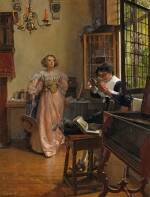
The Persistent Reader
signed lower right: Laura Ther/Alma Tadema and dated Opus LXXXVIII
oil on panel
panel: 23 by 17 ½ in.; 58.4 by 44.5 cm
framed: 31 ¾ by 26 in.; 80.3 by 66 cm
The artist
M. Knoedler & Co., New York
Mrs. Henry Walters, Baltimore
Her sale, Parke Bernet, New York, 26 April - 2 May 1941, lot 990
Private Collection
Marvin Sadik, Scarborough, Maine
Acquired by the present owner from the above in 1987
Persistent Reader encapsulates many of the best qualities of the paintings by Sir Lawrence Alma-Tadema's wife, an artist in her own right, who commanded considerable esteem in her own day. As noted in her 17 August 1909 obituary in The Times of London, “she gave us Dutch interiors... with pretty young mothers… often in dresses of the seventeenth century, placed in rooms with white walls and old oak furniture. Lady Alma-Tadema’s treatment of light was extremely skillful, her colour exquisite, her textures subtly wrought, her effects charming.” In this painting, Lady Alma-Tadema handles with particular finesse the complex reflections on the chandelier and dexterously contrasts the crisp reflections on the man’s linen collar with the muted sheen of the woman’s satin dress.
In 1871 Laura Epps married Lawrence Alma-Tadema, who, having made his reputation in Antwerp and in Paris, had recently moved to England. Under his instruction, Lady Alma-Tadema cultivated her talent and began exhibiting regularly in the 1880s. While she and Sir Lawrence developed similar styles and methods, they differed significantly in subject; he preferring scenes of Imperial Rome, she domestic Dutch interiors like the one offered here.
Her obituary concludes, “No living Englishwoman, it is probable, has received so many tributes to her genius in painting as flowed in during late years on Lady Alma-Tadema….”
You May Also Like